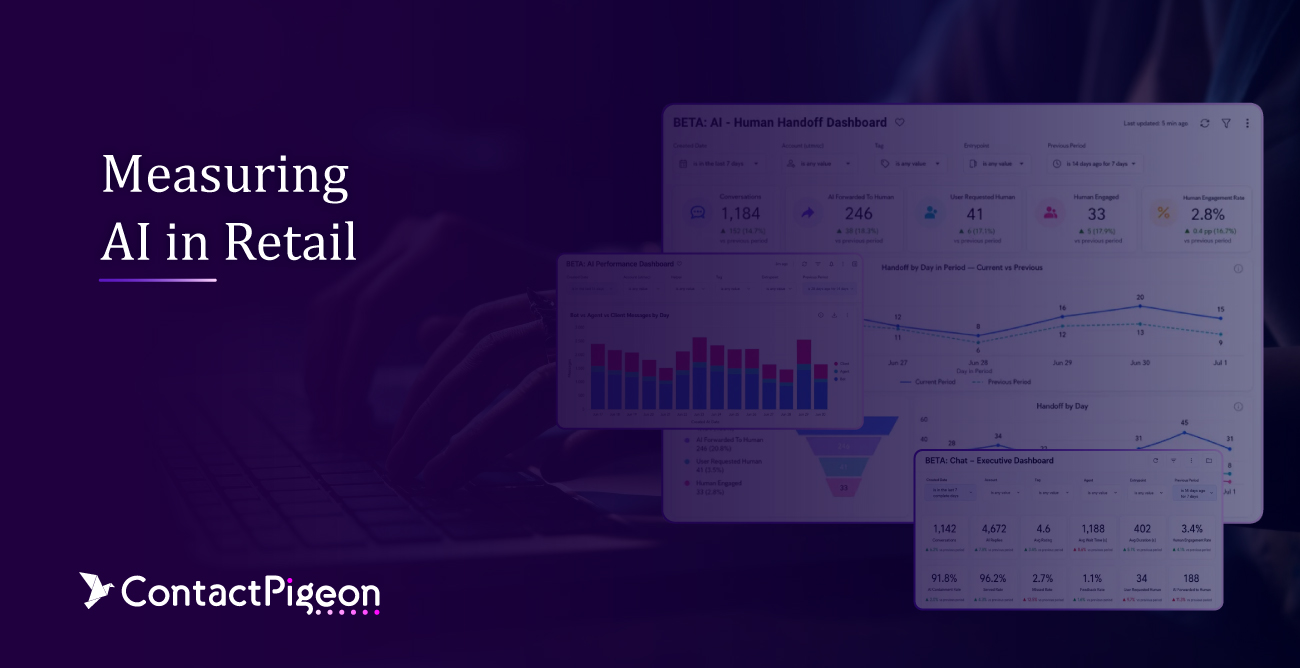
AI has moved from experimentation into everyday retail operations, making measuring AI in retail a more important priority for marketing and ecommerce teams. AI now answers product questions, guides discovery, supports customers through AI agents, recommends products, and reduces friction across the journey. Yet many teams still evaluate its performance through one narrow lens: did it increase revenue?
That question matters, but it is not enough. AI creates value long before a sale happens, answering a sizing question, explaining a return policy, recommending the right product, reducing uncertainty, or routing a customer to a human at the right moment. The real question for a CMO is not only “did AI generate sales,” but “did AI help customers move through the journey with more confidence, less friction, and better support?”
Executive summary
-
Revenue is only one part of AI measurement. AI also influences customer confidence, purchase intent, support quality, operational efficiency, and the overall shopping experience long before a purchase occurs.
-
AI conversation intelligence transforms conversations into business insights. Customer interactions reveal intent, product interest, purchase barriers, support needs, escalation patterns, and commercial outcomes that traditional analytics cannot explain.
-
CMOs should measure AI across six KPI layers. A complete scorecard includes commercial impact, conversation engagement, customer intent, conversation quality, human handoff, and agent performance to evaluate AI from both customer and business perspectives.
-
Customer intent is one of the most valuable AI signals. Questions about sizing, delivery, payments, stock availability, and product comparisons reveal where customers hesitate and where the business should improve the customer journey.
-
Context matters when interpreting AI metrics. High containment, low handoff, or increased conversation volume are not automatically positive or negative. Every metric should be evaluated alongside customer satisfaction, resolution quality, and business outcomes.
-
Conversation data should drive business decisions. AI insights can improve product pages, merchandising, checkout experiences, shipping communication, support documentation, staffing, and AI training, creating a continuous optimization loop.
-
AI measurement becomes more valuable when connected to customer data. Combining conversation intelligence with a retail CDP links AI interactions to customer profiles, purchase history, segmentation, and lifecycle behavior, providing a complete view of the customer journey.
-
Leadership needs an executive scorecard, not isolated metrics. The most effective AI reporting balances adoption, usefulness, commercial influence, operational performance, customer intelligence, and long-term business learning rather than focusing only on AI-generated revenue.
What AI conversation intelligence means for retail
AI conversation intelligence is the process of transforming conversations between customers and AI agents into structured business insights. It helps retailers understand customer intent, product interest, purchase barriers, support needs, escalation patterns, and commercial outcomes.
The retail AI conversation intelligence scorecard
CMOs need a broader AI scorecard built around six KPI layers: commercial impact, conversation volume and engagement, customer intent, conversation quality, human handoff, and agent performance and operational load.
| Layer |
What It Measures |
CMO Question |
Commercial Impact |
| Commercial performance |
Purchase rate with chat, purchase uplift, and conversion trends |
Is AI influencing revenue and purchase behavior? |
Measures the contribution of AI conversations to revenue and conversions. |
| Conversation engagement |
Conversations, AI replies, duration, and engagement rate |
Are customers using the AI experience? |
Shows adoption, interaction levels, and customer engagement. |
| Customer intent |
Intent tags, high-intent topics, purchase barriers, and support needs |
What are customers trying to do or solve? |
Reveals customer motivations, friction points, and buying signals. |
| Conversation quality |
Ratings, served rate, missed rate, feedback, and conversation recaps |
Is AI actually helpful? |
Evaluates AI quality and identifies opportunities for improvement. |
| Human handoff |
AI forwarded, user requested human, human engaged, and containment rate |
Does AI escalate conversations appropriately? |
Shows whether AI balances automation with human support. |
| Agent and team load |
Wait time, agent workload, missed conversations, and handling duration |
Is AI improving service operations? |
Measures operational efficiency and team capacity. |
KPI layer 1: Commercial impact
Commercial impact shows how AI conversations influence shopping behavior, including both direct and assisted impact. It helps CMOs understand whether shoppers who interact with AI are more likely to buy than shoppers who do not, and creates a clearer way to measure AI’s role in the customer journey. This is the revenue-related layer, but it is only the beginning of the framework.
| KPI |
What It Shows |
|
Chat engagement rate
|
How many visitors choose to interact with the AI experience
|
|
Purchase rate with chat
|
How often visitors who interact with AI complete a purchase
|
|
Purchase rate without chat
|
The baseline conversion rate for visitors who do not use chat
|
|
Purchase rate uplift
|
The difference in purchase rate between visitors who use AI and those who do not
|
|
Purchase rate over time
|
Whether AI-assisted conversion remains consistent or changes during specific periods
|
KPI layer 2: Conversation volume and engagement
Before CMOs evaluate outcomes, they need to understand adoption. If customers are not using the AI agent, even the best AI system will not create meaningful impact.
These metrics show whether customers are actually engaging with the AI experience, and help teams understand patterns across days, traffic periods, campaigns, or seasonal moments, including demand spikes, campaign-driven question patterns, and periods where AI or human support capacity may need to scale.
High conversation volume is not always positive by itself. A spike can mean high demand, but it can also reveal confusion, poor product information, or repeated support questions. Volume is only a good sign when paired with good resolution, helpful answers, low frustration, and meaningful commercial or customer-experience outcomes.
| KPI |
What It Shows |
| Total conversations |
Overall usage of the AI experience |
| AI replies |
How actively the AI responds within customer conversations |
| Conversation growth over time |
Whether adoption is increasing, remaining stable, or declining |
| Average conversation duration |
How long customers remain engaged in the interaction |
| Messages by customer, AI, and human agent |
How much of the conversation is handled by AI and how often human support is involved |
KPI layer 3: Customer intent and purchase barriers
Intent tags show what customers are trying to do when they interact with AI. This is one of the most valuable parts of AI measurement because it turns conversations into customer intelligence.
Clicks show where people go, whereas intent shows what people need. A customer visiting a product page may just be browsing. A customer asking “is this available in my size?” or “can I get this before Friday?” is revealing decision-making context. Analytics may show a drop-off; intent tags can explain whether that drop-off happened because of stock, delivery timing, payment friction, product uncertainty, or lack of confidence.
AI conversations should become a feedback loop for merchandising, ecommerce, CRM, CX, and support teams. If hundreds of shoppers ask the same product, delivery, sizing, or payment question, that is not just chat activity, it is business intelligence.
| KPI |
What It Shows |
| Top intent tags |
The most common customer needs, questions, and goals |
| Intent trends over time |
How customer questions change by day, season, campaign, or commercial period |
| Intent satisfaction |
How effectively different types of customer questions are handled |
| Intent escalation rate |
Which customer intents are most likely to require human assistance |
| High purchase intent conversations |
Where conversations show the strongest proximity to purchase and revenue influence |
| Barrier-related intents |
The questions and concerns preventing customers from moving forward |
KPI layer 4: Conversation quality and customer experience
Conversation quality shows whether AI is actually helpful. A conversation can be technically completed and still fail the customer, which is why CMOs should track quality signals, not only volume. Useful metrics include average rating, feedback rate, missed rate, missed conversations, served rate, conversation rating, first and last customer message, AI recap, and last page or product before chat.
This helps teams see what happened before and after the customer spoke to AI. If many conversations start from a product page and mention stock availability, product page best practices can help address missing product information, unclear delivery messaging, or weak stock visibility. The same logic applies to sizing questions pointing to weak size guidance, delivery-timing questions pointing to unclear shipping information, and returns questions pointing to weak policy visibility.
Conversation Explorer is where measurement becomes diagnosis. Instead of seeing only a missed rate or average rating, teams can inspect the actual conversation context: what the customer asked, where they came from, which product they viewed, how the AI responded, and whether the journey continued.
| KPI |
What It Shows |
| Average rating |
How customers evaluate the quality of the interaction |
| Feedback rate |
How often customers provide a rating or other signal after the conversation |
| Missed rate |
How often conversations are not served successfully |
| Served rate |
How reliably customers receive a response and complete support experience |
| Conversation recap |
The main topic, actions, outcome, and unresolved points from the exchange |
| Last page or product before chat |
Which page, product, or journey step triggered the customer’s question |
KPI layer 5: Human handoff and escalation quality
Human handoff is one of the most misunderstood AI metrics. Many teams assume a lower handoff rate is always better, but this is not always true. Some conversations should move to a human, especially when the issue is sensitive, complex, urgent, or commercially important. Useful metrics include AI forwarded to human, user requested human, human engaged, human engagement rate, handoff by day, handoff funnel, and escalations over time.
Trustworthy retail AI agents do not try to avoid human support at all costs. They solve what they can, recognize what they cannot, and bring in a human when the customer needs one. Containment rate, the share of conversations AI can handle without human help, matters, but only if customers are still getting useful answers. Keeping people inside an AI conversation is not a success if they leave frustrated. The goal is not maximum containment, but the right resolution path for the customer and the business.
| KPI |
What It Shows |
|
AI forwarded to human
|
How often the AI identifies that a conversation requires human support
|
|
User requested human
|
How often customers actively ask to speak with a person
|
|
Human engaged
|
How often a human agent enters and participates in the conversation
|
|
Human engagement rate
|
The share of conversations that involve human support
|
|
Handoff funnel
|
Where conversations progress, pause, or drop as they move from AI to human support
|
|
Escalation trends
|
Whether handoff volume and outcomes improve or worsen over time
|
Interpreting handoff metrics
| Metric Signal |
Weak Interpretation |
Better Interpretation |
|
High containment rate
|
AI is performing well
|
Review resolution, satisfaction, repeat questions, and sentiment to confirm that conversations are being handled effectively
|
|
High handoff rate
|
AI is failing
|
Complex, urgent, sensitive, or high-value conversations may require human support
|
|
Low handoff rate
|
AI is efficient
|
Customers may be remaining in the AI experience even when human support would be more appropriate
|
|
High user-requested-human rate
|
Customers dislike AI
|
The AI may need stronger answers, clearer scope, or a faster and more visible escalation path
|
|
High AI-forwarded-to-human rate
|
AI cannot resolve enough conversations
|
The AI may be correctly identifying conversations that are complex, sensitive, or outside its approved scope
|
KPI layer 6: Agent performance and team load
AI measurement should also show how work is distributed between AI and human teams. Useful metrics include conversations by assigned owner, served conversations, missed conversations, missed rate, average wait time by agent, average duration by agent, average rating by agent, chats and average messages per chat by agent, and volume, ratings, and load by hour and agent.
This is especially useful for retail teams that use AI alongside human agents, showing which agents are handling the most conversations, which periods create the highest load, where wait times increase, where missed conversations happen, whether certain agents or teams need support, and when staffing should be adjusted.
AI performance is about how well AI and human teams work together when real customer demand peaks. The goal is to use AI to absorb repetitive demand, identify where humans create the most value, and help teams serve customers faster during retail peaks.
| KPI |
What It Shows |
|
Conversations handled by agent
|
How conversations and workload are distributed across the support team
|
|
Average wait time
|
How quickly customers receive human support after entering the queue
|
|
Average conversation duration
|
How long conversations take to handle or resolve
|
|
Missed conversations
|
Where service gaps appear because conversations are not handled successfully
|
|
Average rating by agent
|
How customer satisfaction varies by conversation owner
|
|
Messages per chat
|
The amount of interaction required, indicating conversation complexity
|
|
Conversation load by hour
|
When demand peaks and where staffing coverage may need adjustment
|
Turning AI conversation data into business actions
The real value of AI measurement is not reporting. It is turning repeated customer questions into better product pages, better journeys, better support, and better commercial decisions.
| Insight from AI Conversations |
Business Action |
|
Many customers ask about size or fit
|
Improve size guides, product content, AI training, and product page guidance
|
|
Many customers ask about delivery timing
|
Improve shipping messaging, checkout clarity, and AI delivery answers
|
|
Stock unavailable appears frequently
|
Improve inventory visibility, alternative recommendations, and back-in-stock journeys
|
|
Payment issues appear frequently
|
Review checkout UX, payment options, and payment error messaging
|
|
High purchase intent combined with a request for human support
|
Prioritize real-time human handoff for high-value conversations
|
|
High missed rate during specific hours
|
Adjust staffing, AI coverage, and automation rules during peak periods
|
|
Customers repeatedly ask the same questions
|
Improve FAQs, product data, onsite content, and the AI knowledge base
|
|
High return or refund intent
|
Improve post-purchase communication and make return policies easier to find
|
|
Many customers ask for product comparisons
|
Add comparison content, guided selling flows, and stronger AI recommendation logic
|
|
Many conversations begin from the same product page
|
Review product information, imagery, stock status, reviews, and delivery details on that page
|
How AI measurement works inside a retail CDP
A retail customer data platform is what connects these AI conversation metrics to the rest of the customer picture (segmentation, purchase history, and channel activity) rather than leaving them siloed in a support tool. In CDP-driven retail, the real advantage is connecting AI conversations with the customer data retailers already use to understand, segment, and activate their audience.
| Dashboard |
What It Helps Teams Understand |
|
Executive Dashboard
|
A high-level view of conversations, AI replies, ratings, wait time, containment, served rate, missed rate, feedback, and human engagement
|
|
AI Performance Dashboard
|
Message volume, AI replies, human agent replies, customer messages, and escalation trends over time
|
|
Intent Tags
|
Customer intent trends, sentiment, purchase intent, support topics, barriers, and satisfaction by intent
|
|
Conversation Explorer
|
Searchable conversation-level data including customer, agent, rating, tags, entry point, recap, last page, and last product viewed
|
|
Human Handoff Dashboard
|
When AI forwards conversations, when users request human support, how often agents engage, and how the handoff funnel performs
|
|
Agent Performance Dashboard
|
Human agent workload, missed conversations, wait time, duration, ratings, and conversations handled by day
|
|
Chat Commercial Impact
|
Purchase rate with chat, purchase rate without chat, purchase rate uplift, and conversion trends over time
|
What CMOs should report to leadership
CMOs should avoid reporting only total conversations, total AI replies, and total revenue from AI. Instead, they should build a simple executive scorecard. Leadership does not need every AI metric. They need a balanced view of adoption, usefulness, customer intent, commercial influence, operational load, and business learning.
| Business Question |
KPI to Track |
|
Are customers using the AI agent?
|
Chat engagement rate, total conversations, and AI replies
|
|
Are conversations useful?
|
Average rating, feedback rate, served rate, and missed rate
|
|
What do customers need?
|
Intent tags, intent trends, and high purchase intent topics
|
|
Is AI influencing conversion?
|
Purchase rate with chat, purchase rate without chat, and purchase rate uplift
|
|
Is AI reducing friction?
|
Resolved conversations, helpful answers, and missed rate
|
|
Is AI escalating properly?
|
AI forwarded to human, user requested human, and human engaged
|
|
Are human teams supported?
|
Average wait time, agent load, missed conversations, and average duration
|
|
Is the business learning from AI?
|
Common barriers, repeated questions, and product information gaps
|
|
Is AI creating customer intelligence?
|
Top intents, purchase barriers, product questions, support needs, and recurring objections
|
|
Is AI performance improving over time?
|
Trends in served rate, missed rate, average rating, escalation quality, purchase uplift, and repeat questions
|
|
Is AI safe to scale?
|
Error rate, negative feedback, unresolved conversations, sensitive-topic escalations, and satisfaction after human handoff
|
|
Is AI commercially reliable?
|
Conversion by intent, purchase rate uplift by segment, revenue per AI-assisted conversation, and repeat purchase after an AI-assisted purchase
|
Common misreadings of AI dashboard data
More conversations do not always mean better performance; a spike can reveal demand, but it can also reveal confusion or missing information. Higher purchase rate with chat does not automatically prove causation, since chat users may already have stronger intent. High containment is not always good, since customers may be trapped in AI conversations without useful answers. Low handoff is not always good, since some complex, sensitive, or high-value cases should move to a human. High AI reply volume can mean engagement, but it can also mean the AI needs too many turns to solve the problem. Revenue uplift without intent data does not explain what improved. Missed conversations can indicate demand the business failed to capture.
AI dashboards are only useful when CMOs interpret them with context. The goal is not to make every number go up or down. The goal is to understand whether AI is helping the customer and the business reach the right outcome.
Frequently Asked Questions
What is AI conversation intelligence in retail?
AI conversation intelligence is the process of turning AI chat and agent interactions into structured insights about customer intent, product interest, purchase barriers, support needs, human escalation patterns, and commercial outcomes.
Why isn’t revenue enough to measure AI performance?
Revenue shows whether AI contributed to sales, but it does not explain what customers needed before they bought, where they hesitated, or what the business should improve.
What is containment rate, and is higher always better?
Containment rate is the share of conversations AI resolves without human help. A high rate is only meaningful when customers also receive useful and satisfying answers. Otherwise, it may indicate that customers are unable to reach human support when they need it.
How should CMOs report AI performance to leadership?
CMOs should use a balanced scorecard covering adoption, usefulness, customer intent, commercial influence, operational load, and business learning. This gives leadership a fuller view than total conversations or AI-attributed revenue alone.
What can retailers do with the customer intent data AI conversations generate?
Recurring questions and barriers can inform product content, merchandising, checkout UX, delivery messaging, and support documentation. These conversations can become a continuous feedback loop across teams.
Final thoughts: AI needs a wider scorecard
Retail AI should be measured as part of the customer journey, not as a standalone tool. Revenue remains important, but the strongest teams will also track intent, conversation quality, handoff patterns, agent performance, and commercial influence.
With Menura AI and ContactPigeon’s CDP, retailers can understand how conversations influence discovery, support, conversion, and customer experience. Request a demo to see how it works.