The CVS marketing strategy brings together several customer needs: collecting a prescription, buying everyday essentials, accessing savings, and finding support with health care. Those visits involve different decisions, levels of urgency, and expectations of privacy. Connecting them gives CVS opportunities to build a recurring relationship, provided each interaction remains relevant to the task at hand.
That makes CVS a useful case for retail leaders assessing how loyalty, digital services, and retail AI for health and pharmacy should work together. The strategic question is how to turn repeated contact into useful service and sustainable commercial value, while maintaining clear boundaries around sensitive information.
This independent analysis focuses on CVS Pharmacy within CVS Health. Group financials include insurance and health services; they are identified separately from the Pharmacy & Consumer Wellness segment.
Performance timeline of CVS Health and CVS Pharmacy
The following charts cover 2023–2025, the latest three completed financial years. They show group scale, retail segment revenue, and segment profitability using reported figures.
Chart 1: CVS Health consolidated revenue
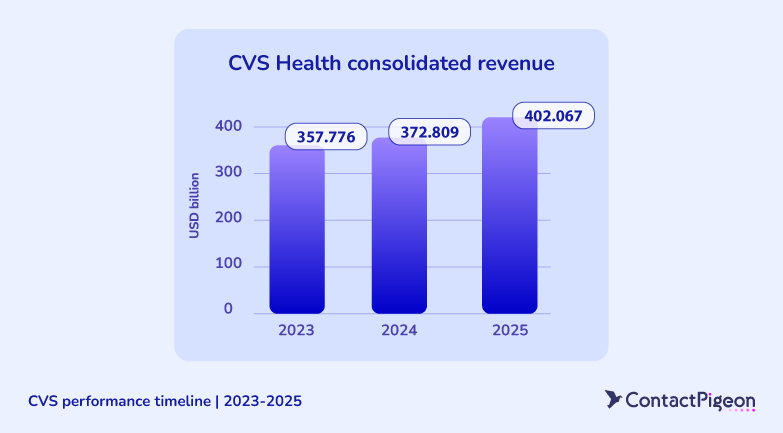
Revenue increased from USD 357.776 billion in 2023 to USD 372.809 billion in 2024 and USD 402.067 billion in 2025. The annual increases were 4.2% and 7.8%, respectively; group growth provides context but cannot establish the effectiveness of retail marketing.
Chart 2: Pharmacy & Consumer Wellness revenue
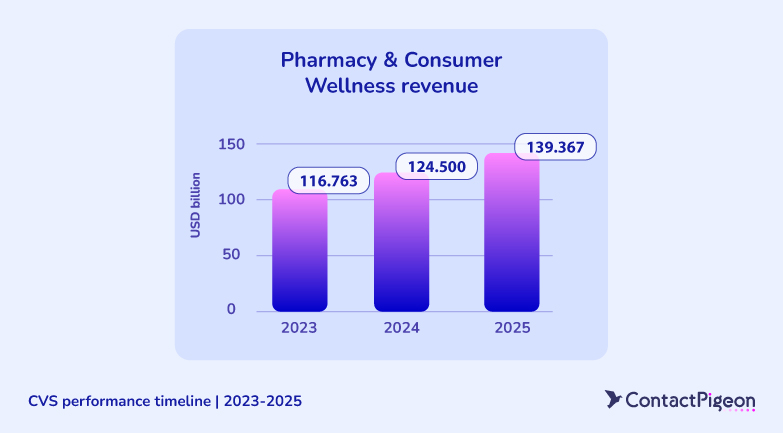
Segment revenue rose from USD 116.763 billion in 2023 to USD 124.500 billion in 2024 and USD 139.367 billion in 2025. The increases were 6.6% and 11.9%, respectively, making this the more relevant revenue series for examining the pharmacy retail business.
Chart 3: Pharmacy & Consumer Wellness adjusted operating income
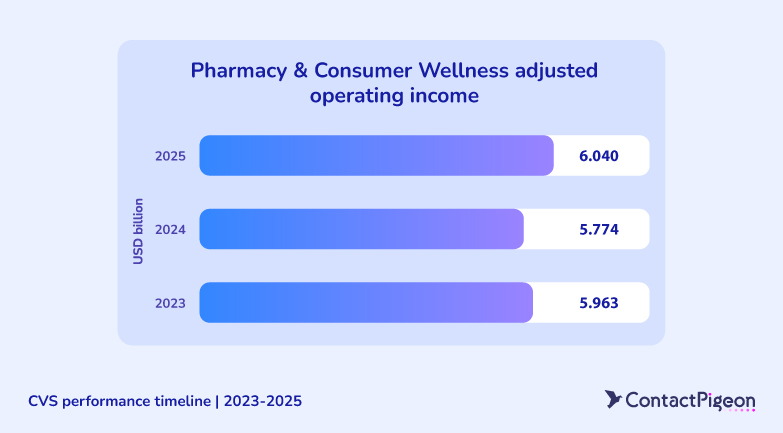
Adjusted operating income was USD 5.963 billion in 2023, USD 5.774 billion in 2024, and USD 6.040 billion in 2025. Profit fell by USD 189 million in 2024 before recovering to USD 266 million in 2025. This is a non-GAAP measure; revenue growth and profit growth should be assessed independently.
Comparability note: these are reported segment results, not a constant perimeter series. Omnicare was deconsolidated in September 2025. CVS does not disclose a comparable standalone CVS.com revenue series in these releases.
Business model decoded: CVS’s retail strategy explained
The CVS marketing strategy reflects the different needs its business serves. Prescription services bring customers back for ongoing pharmacy needs, while health, beauty, and everyday merchandise create additional shopping occasions. Each activity has different revenue drivers and costs, so evaluating performance requires looking separately at pharmacy growth, front store sales, and segment profitability. [CVS Reports 2024, 2025]
| Dimension | CVS reality |
|---|---|
| Customer promise | Local pharmacy access alongside health, beauty and everyday merchandise. |
| Assortment | Prescription services plus third-party and CVS branded retail products; private label share not publicly disclosed here. |
| Revenue model | Pharmacy, front store and other segment revenue; distinct from insurance and PBM activity. |
| Profitability | 2025 segment adjusted operating margin: 4.3%, versus 4.6% in 2024. |
| Cost exposure | Drug purchasing, reimbursement pressure and the physical pharmacy network. |
| Format choice | Smaller pharmacy-focused locations complement conventional stores. |
Value creation: A visit can begin with several different needs
A pharmacy chain must serve both planned purchases and immediate needs. At Shoptalk 2025, CVS Chief Merchandising Officer Musab Balbale said three-quarters of retail traffic came from the front store. That executive statement describes traffic and cautions against treating every store visit as an extension of prescription collection.
For marketing teams, the implication is to distinguish customer missions. A shopper replacing a household essential needs product availability and convenience; a customer managing a prescription needs accurate service information. A shared brand can serve both without assuming they belong in the same promotional journey.
Value capture, scale and structural constraints
CVS attributed 2024 segment pressure partly to pharmacy reimbursement and lower front store volume, while improved drug purchasing provided an offset. These are economic factors that a campaign dashboard alone will miss.
The practical lesson is to evaluate commercial initiatives against the part of the business they can influence. A loyalty offer can be tested for incremental merchandise purchases; its results should not be used to explain changes in prescription reimbursement. Store formats also require different expectations of assortment breadth, service capacity, and customer demand.
Omnichannel architecture: CVS’s online-to-offline retail strategy
The CVS marketing strategy connects stores, the website, and the app around tasks customers need to complete. Linked accounts, prescription management, pickup barcodes, and eligible delivery services provide several routes through the pharmacy and shopping experience. The practical value depends on whether customers can complete their task and understand the conditions that apply to their chosen service.
| Layer | Documented connection |
|---|---|
| Channels | Stores, CVS.com and the CVS Health app. |
| Identity | Prescription delivery benefits require a linked pharmacy profile, ExtraCare number and CVS.com account. |
| Fulfillment | Eligible retail orders support same-day delivery; availability and minimums apply. |
| Physical handoff | The 2025 app announcement includes a prescription pickup barcode. |
| Returns | Same-day delivery guidance provides a store return route. |
Customer identity and data continuity
CVS’s ExtraCare Plus terms make account linkage an explicit requirement for qualifying prescription delivery benefits. This is an observable connection between membership and service access, but it does not establish that clinical information is available for every retail targeting decision.
For another retailer, the equivalent design question is precise: what must be recognized to complete the customer’s task, and which permissions govern that recognition? An account can connect a purchase to an order update while access to other information remains restricted.
Fulfillment logic and its limits
CVS documents same-day retail delivery in as little as three hours for eligible addresses and qualifying orders. Its guidance also describes a USD 10 minimum for the relevant ExtraCare Plus benefit after discounts. Those conditions form part of the customer promise.
An omnichannel assessment should therefore test eligibility as well as channel availability. Advertising delivery without reflecting the customer’s address, selected items, or applicable threshold risks creating a promise the transaction cannot satisfy. Public evidence does not establish how CVS prioritizes stores against distribution facilities.
Analysis of CVS’s growth marketing strategy
CVS’s marketing strategy uses membership, repeat engagement, and supplier advertising to build value around existing shopping relationships. Method: observational executive review of public disclosures and documented benefits, not a measured attribution audit. Public evidence does not support a ranked list of six to eight growth engines by last twelve-month impact. The table includes only supported mechanisms.
| Engine | Evidence and timeframe | What the evidence establishes |
|---|---|---|
| Loyalty | Two membership tiers introduced in 2024; current terms describe savings and service benefits. | A recurring membership proposition. |
| Retail media | CMX reports 90M+ addressable ExtraCare members; page accessed 2026-11-03. | Addressable audience scale, not monthly active customers. |
| AI media optimization | CorIQ reports 13% average ROAS improvement using CVS internal 2025 data. | A supplier-reported performance signal. |
| Incrementality measurement | CMX describes randomized test and control groups; accessed 2026-11-03. | A documented measurement method for qualifying campaigns. |
Loyalty creates reasons to identify and return
ExtraCare gives the CVS marketing strategy a recurring point of contact with customers. Its free and paid membership tiers combine rewards with service benefits that can support regular shopping and pharmacy needs. For other retailers, the useful lesson is to design benefits around frequent customer tasks, then assess whether their use generates additional purchases and retention at a sustainable cost.
The transferable principle is to connect membership value to a recurring need. Retailers should examine whether benefits change purchase frequency or simply discount transactions that would have happened anyway. Redemption, incremental margin, and renewal behavior answer different parts of that question.
Retail media monetizes a defined shopping relationship
Retail media extends the CVS marketing strategy to brands seeking to reach relevant shoppers. CVS Media Exchange draws on front store loyalty purchase history and digital engagement to support audience targeting. Its documented test and control methodology also addresses an important commercial question: whether advertising generates additional sales among the customers it reaches.
The network’s reported addressable membership gives suppliers scale, but the business case still depends on what advertising adds. CMX’s randomized test and control approach provides a more useful evaluation framework than treating every attributed purchase as new demand.
AI efficiency claims need a denominator
CorIQ’s published internal 2025 figures include 50% faster media planning alongside its reported ROAS improvement. These are company claims, with limited public detail about the sample and comparison baseline. They support examining the workflow, not forecasting an equivalent result for another retailer.
A CMO assessing a similar investment should request time saved per planning cycle, the share of recommendations accepted, and incremental margin after media costs. Faster production creates value when the resulting decisions remain accurate and commercially useful.
Analysis of CVS’s eCommerce strategy
The CVS marketing strategy connects online shopping with its pharmacy and store network through CVS.com, the app, loyalty benefits, and eligible pickup and delivery services. These connections help customers choose how to obtain products, while the purchase experience depends on clear availability information and straightforward checkout. Baymard’s published research illustrates both strengths and friction: single-column checkout forms supported efficient completion, while difficulty finding substitution options and reentering payment details after an error complicated some purchases. These documented examples highlight practical priorities for CVS’s eCommerce experience: making fulfillment choices understandable, helping shoppers resolve unavailable items, and simplifying error recovery.
Retail AI for health and pharmacy: What CVS demonstrates
AI supports several distinct applications within the CVS marketing strategy, including product and service search and retail media optimization. These applications address different tasks and need separate performance measures, from helping shoppers find relevant information to improving campaign outcomes. In health and pharmacy, implementation also requires a clear boundary between shopping assistance and questions that need a pharmacist or another qualified professional.
Documented retail applications
CVS’s January 2025 app announcement included AI-powered search. In the same release, conversational support for refills and order status was described as a planned addition. The launch statement alone therefore cannot establish that every proposed conversation flow was already available.
On the commercial side, CorIQ applies AI to media planning and optimization. These examples demonstrate why an AI program should have a defined operational owner: search quality, advertising effectiveness, and health service accuracy require different measures.
Health100 expands the scope of engagement
In March 2026, CVS Health and Google Cloud announced Health100, a health technology subsidiary developing an AI-based consumer engagement platform. The stated scope includes navigation, cost visibility, and connections across health care providers, with an initial launch planned for 2026.
In July, CVS announced DirectTrust accreditation for the Health100 app against the CARIN Code of Conduct for consumer-facing applications. The review covered areas including consent, transparency and data use. Accreditation is evidence of a governance milestone; it does not establish clinical effectiveness, retail sales uplift, or universal availability of the announced platform.
A practical operating framework for pharmacy retailers
The following framework is a proposed application for retailers, not a description of CVS’s internal controls. Start with a narrow customer task and define which information the assistant may use, what it can complete, and when a person must take over.
- Product discovery: answer factual questions, measure grounded answer accuracy and successful discovery.
- Service assistance: provide order or delivery information only when an authorized integration supplies it. Measure correct resolutions and repeat contacts.
- Retail follow-up: use permitted shopping signals for relevant reminders, with purchase suppression and customer preferences applied. Measure incremental repeat purchases and complaints.
- Clinical questions: route questions about interactions, dosage changes, or personal treatment suitability to an appropriate professional. Measure handoff completion and review failures.
Consider a customer looking for a fragrance-free moisturizer available for delivery. A retail assistant can clarify budget and format, then consult approved catalog and fulfillment data. If the conversation shifts to whether that product is suitable alongside a prescribed treatment, the workflow needs professional input. The transition should be designed before the assistant is deployed.
CVS marketing strategy resources
An executive interview adds context to the CVS marketing strategy by explaining the role of the front store in customers’ everyday visits. One directly relevant video is included here; limited high-signal video content was verified for this review.
CVS chief merchant Musab Balbale on why the front store is its future
Publisher: Omni Talk Retail
Platform: YouTube
Published: 26 March 2025
Speaker: Musab Balbale, then SVP and Chief Merchandising Officer, CVS Health. Focuses on the discussion of local assortment decisions and the distinction between front store visits and pharmacy needs. It provides a merchandising perspective that is easy to miss when reading CVS only as a health care group.
CVS Health and Pharmacy: Additional statistics in context
These figures describe different populations and operating dimensions. They should not be added together or treated as equivalent measures of active retail customers.
- Approximately 9,000 retail pharmacy locations at 31 December 2025: the physical access network described in CVS’s March 2026 corporate profile.
- More than 1,000 walk-in and primary care medical clinics at 31 December 2025: wider group care infrastructure, not an additional count of retail pharmacies.
- Approximately 87 million pharmacy benefit plan members at 31 December 2025: a PBM population, distinct from ExtraCare membership.
- Around 3,000 square feet: the average footprint stated for the new pharmacy-focused format in October 2026.
- Nearly 20 pharmacy-focused locations planned for 2026: an announced rollout target, not a verified completed-store count.
- USD 106.1 billion in Q2 2026 consolidated revenue, up 7.3% year over year: a group financial update, not an eCommerce growth rate.
Latest news and strategic developments at CVS
These 2026 developments indicate changes in technology, operating format, and financial performance. Their implications below are analytical interpretations rather than quantified outcomes.
7 October 2026: A smaller format reaches Boston
CVS opened its first Boston-area pharmacy-focused location as part of a selective rollout. A full pharmacy and a narrower retail assortment make this a format decision with implications for local access and merchandise planning. It suggests retailers should assess physical coverage and assortment breadth as separate investment choices.
5 August 2026: CVS raises full-year guidance
CVS reported Q2 results and increased its 2026 outlook. The results provide a more recent group financial reference than the completed-year charts, but do not isolate marketing contribution or the return on AI investment.
29 July 2026: Health100 reaches a governance milestone
DirectTrust accreditation adds evidence about the Health100 app’s approach to consumer data access and stewardship. For retail executives considering adjacent health services, it illustrates the need to include governance milestones in the delivery plan alongside product releases.
Lessons learned from CVS’s marketing strategy
The CVS marketing strategy offers transferable principles where retailers share recurring purchase needs, connected channels, or sensitive customer interactions. The evidence supports these design lessons without proving that every CVS initiative caused commercial growth.
1. Separate customer missions before joining journeys
CVS serves front store shoppers and pharmacy users under one brand. Where a retailer serves several kinds of need, define the intended task before deciding on messages, content, or success metrics; visit frequency alone does not reveal intent.
2. Evaluate each revenue stream on its own economics
CVS’s segment disclosures separate pharmacy and front store performance. Apply the same discipline when business lines have different pricing mechanisms or costs, so a growing category does not conceal weakness elsewhere.
3. Make membership benefits usable at the point of need
ExtraCare Plus connects eligibility to practical service benefits through linked accounts. This principle applies when recognition removes a concrete obstacle, such as confirming an entitlement; measure successful use as well as enrollment.
4. Ask what advertising added
CMX documents a test and control approach to incrementality. Retailers with sufficient campaign scale can use holdouts to distinguish demand created by a message from purchases likely to occur without it.
5. Define the boundary of each AI job
CVS’s disclosed AI applications span retail search, media, and health engagement. When a retailer operates across different risk levels, assign each workflow its own allowed data, evaluation criteria, and escalation route.
6. Match the format to the local service need
The pharmacy-focused rollout narrows the physical offer while preserving pharmacy access. Where local demand varies, evaluate whether a smaller assortment and a different service model fit the location; transferring the format requires local economics and demand evidence.
Applying the CVS marketing strategy to pharmacy customer engagement
The CVS marketing strategy shows how recurring customer needs can support a broader relationship across stores, loyalty, and digital services. For pharmacy retailers, the practical starting point is a specific journey where better coordination could help customers complete a task, such as repurchasing a personal care essential.
A retailer could test a replenishment reminder for an opted-in audience, suppress it after a recorded purchase, and compare repeat purchases with a holdout group. Defining the permitted data, an accountable owner, and the success measure gives the team a basis for deciding whether to expand the journey.
ContactPigeon’s pharmacy customer engagement solutions connect retail data, segmentation, and channel activation, while Menura AI can support product discovery and shopping assistance using the retailer’s catalog and configured knowledge. Together, these capabilities can help retailers put journeys like this into practice, with clinical questions directed to an appropriate professional.
FAQs
What is the CVS marketing strategy?
CVS’s marketing strategy connects loyalty benefits, digital services and retail media with recurring pharmacy and shopping needs. ExtraCare encourages customer identification and repeat engagement, while the website, app and stores provide different ways to shop and access services. Evaluating this strategy requires examining retention, incremental purchases and profitability within each part of the business.
What can pharmacy retailers learn from CVS’s ExtraCare program?
ExtraCare illustrates how membership can connect savings with recurring customer needs. Its free and paid tiers offer different combinations of rewards and service benefits, giving customers reasons to identify themselves and return. Pharmacy retailers can apply this principle by designing benefits around frequent shopping tasks and measuring benefit use, incremental purchases and the cost of rewards.
How does CVS connect its stores, website and app?
CVS documents connections through customer accounts, loyalty membership, prescription management and eligible delivery services. Its app also supports physical pharmacy interactions, including a barcode for prescription pickup. These capabilities give customers several ways to complete a task, although eligibility varies by service, product and location. Public documentation does not fully disclose inventory synchronization or order routing rules.
How does CVS use retail AI for health and pharmacy?
CVS has documented AI applications in product and service search, alongside media planning and optimization through CVS Media Exchange’s CorIQ platform. Its separate Health100 initiative extends into broader health care navigation and engagement. These applications serve different purposes, so their data requirements, human oversight and performance measures need to be assessed individually.
Has AI been shown to increase CVS Pharmacy’s total retail revenue?
The public evidence reviewed for this case study does not isolate AI’s contribution to CVS Pharmacy’s total retail revenue. CorIQ’s reported improvements concern specific media performance and planning measures, with limited public detail about the comparison baseline. Those results cannot establish how much company revenue AI generated. Assessing that contribution requires controlled comparisons and clearly defined outcomes.
Where should pharmacy retailers draw the line between AI shopping assistance and clinical advice?
A retail assistant can explain approved product attributes, compare formats and provide order information through authorized integrations. Questions about medicine interactions, dosage changes or suitability for an individual’s treatment require an appropriate professional workflow. Retailers should define that handoff in advance, including what context can be shared and how the customer reaches a pharmacist or other qualified professional.