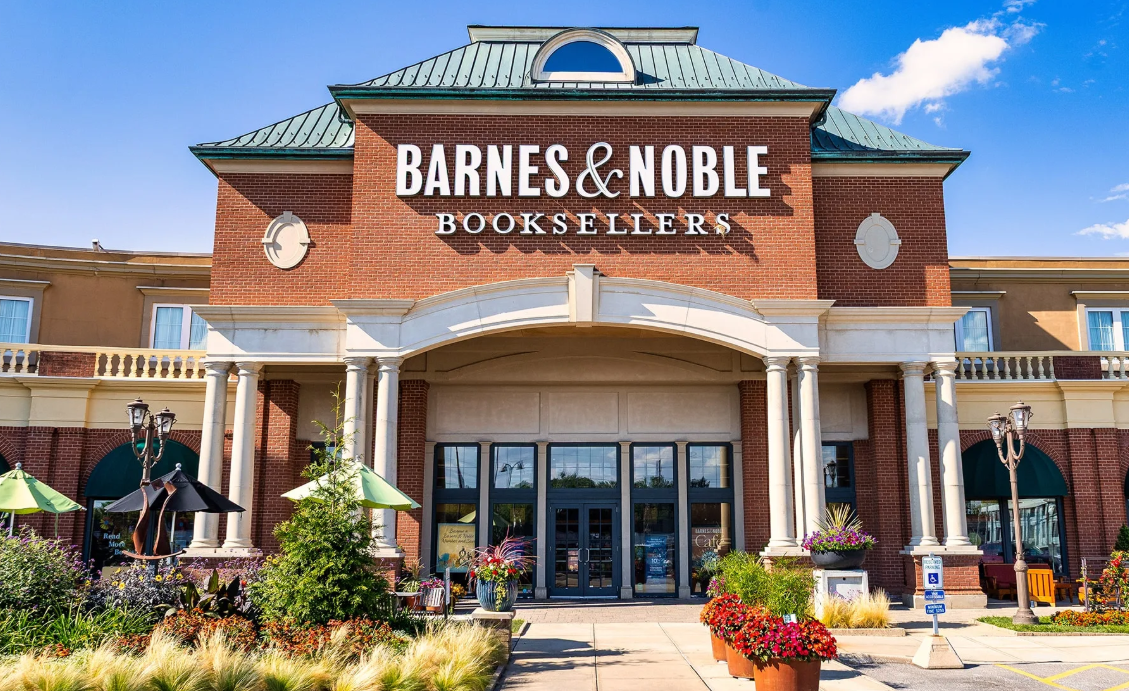
The Barnes & Noble marketing strategy has become particularly relevant as the bookseller expands its physical footprint again. By September 2026, it had reached 720 locations across the United States, after falling below 600 stores as recently as 2023. The renewed footprint is one of the clearest signs of a broader shift in how the company approaches retail.
Since James Daunt became CEO in 2019, Barnes & Noble has given individual store teams greater control over merchandising, redesigned stores around browsing and local discovery, and invested in the digital infrastructure that supports customers before, during, and after a store visit. Its website, loyalty program, pickup options, and digital recommendations increasingly support the same customer relationship rather than operating as separate channels.
Its resurgence shows how a national retailer can combine scale with local product expertise while using digital channels to make physical retail more useful and easier to access. The model offers a practical way to examine how stores, customer context, product discovery, and digital engagement can work together across the shopping journey.
Performance timeline of Barnes & Noble
Barnes & Noble’s recent performance is most clearly visible through the recovery of its physical footprint. While the private retailer does not disclose the detailed revenue and profitability data available from public companies, its store estate shows a clear change in direction:
Chart 1: Barnes & Noble store footprint milestones, 2019–2026
Barnes & Noble ended 2025 with more than 700 locations and continued expanding its U.S. footprint during 2026, reaching 720 stores by September. After falling below 600 locations in 2023, physical expansion has returned as a growth lever after more than 15 years of declining store numbers.
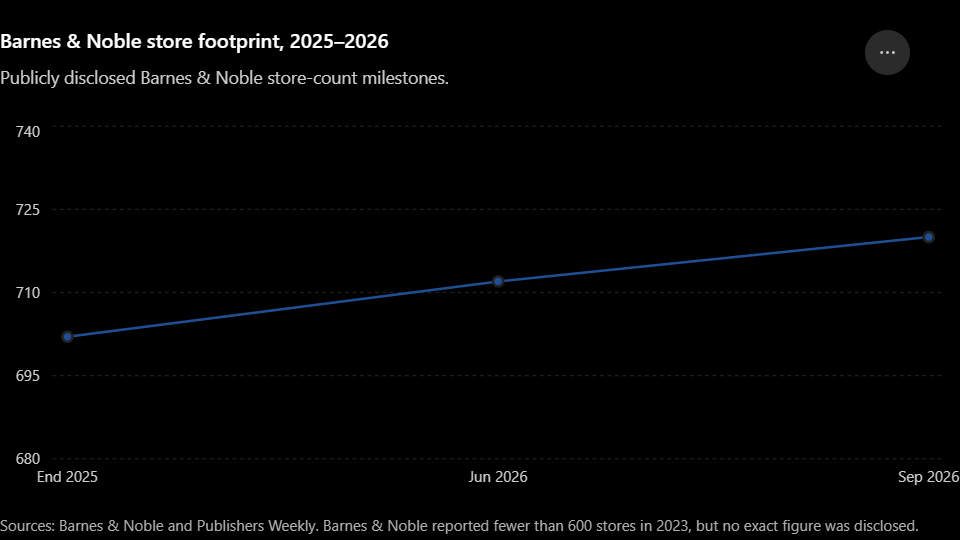
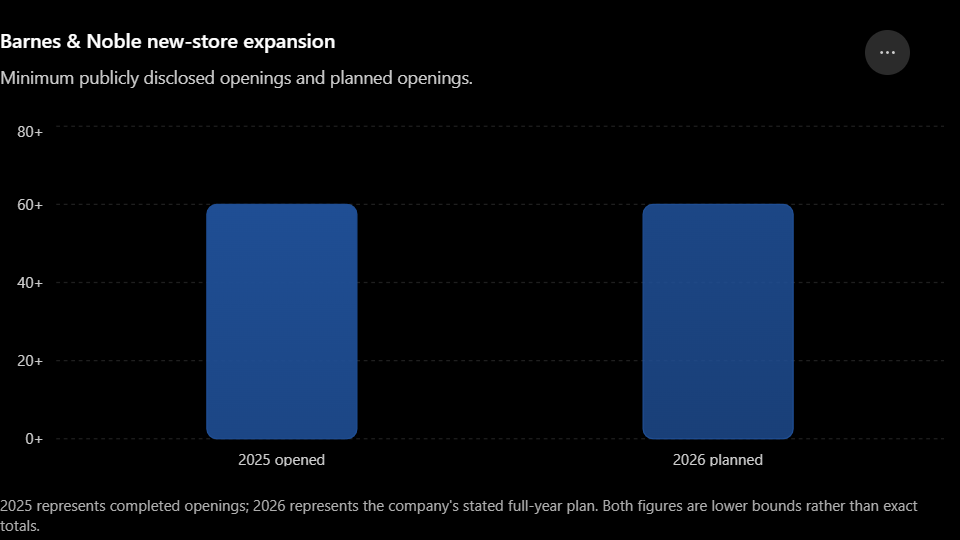
Chart 2: Barnes & Noble new-store expansion, 2023–2026
Growth is being expressed through renewed physical distribution, which makes store economics, local assortment quality and digital-to-store connectivity more strategically important.
Business model snapshot
The Barnes & Noble retail strategy combines national purchasing and operating scale with a store proposition centered on books, local curation and physical discovery. Its primary structural lever is the ability to distribute a broad assortment across hundreds of stores while allowing individual bookselling teams more discretion over how that assortment is presented.
Value creation logic
Barnes & Noble’s central customer proposition is discovery. The company can sell the same nationally distributed titles available elsewhere, so part of its differentiation comes from deciding which books to surface, how to group them and who helps the customer navigate the assortment.
Under Daunt, individual stores have been given greater authority over merchandising. In a PBS interview, he described the bookselling team as responsible for arranging a large selection in a way that engages its particular community. Store employees interviewed for the same report contrasted this approach with the previous model, where displays and even table positioning could be dictated centrally. This changes the role of assortment. Inventory becomes useful partly because a customer can browse it within a curated context.
Value capture and economics
Detailed profitability is not publicly disclosed, but several structural components are visible. Stores generate sales from books alongside categories including toys, games, stationery, gifts, music and café purchases in applicable locations. Barnes & Noble said that non-book departments contributed strongly to its 2024 sales performance, while books performed more strongly again in 2025.
The company also uses exclusive and special editions as a differentiated product layer online. Its current assortment includes Barnes & Noble-exclusive versions across fiction, nonfiction, YA, children’s books, music and other categories.
Membership creates another economic mechanism. The free Rewards tier encourages identifiable repeat purchasing through stamps and rewards, while the USD 39.99 annual Premium tier combines the rewards system with eligible-purchase discounts, shipping benefits and other perks.
Scale effects and structural advantages
The company can combine national infrastructure with decentralized presentation. That matters because localized curation does not require Barnes & Noble to operate as hundreds of economically independent businesses. Purchasing, technology, branding, loyalty and core infrastructure remain part of a scaled organization.
The same philosophy has appeared in Barnes & Noble’s acquisition of independent bookstore businesses. Tattered Cover was acquired in 2024 and continued under its existing identity, while Barnes & Noble agreed in September 2026 to acquire Joseph-Beth Booksellers while preserving its name, booksellers and community programming.
Structural limits and trade-offs
Localization introduces variation by design. A centrally standardized retailer can enforce the same assortment priorities across hundreds of locations. Barnes & Noble has deliberately reduced some of that control.
The trade-off is therefore organizational. Store autonomy creates more room for local judgment, but it also depends on experienced teams capable of making good merchandising decisions.
Physical expansion introduces another constraint: new stores require appropriate locations, staffing and inventory. Barnes & Noble’s model remains materially exposed to physical retail economics even as its digital infrastructure improves.
Omnichannel architecture: Barnes & Noble’s online-to-offline retail strategy
Barnes & Noble uses digital commerce primarily as an extension of the broader bookstore relationship. BN.com and the B&N app support online shopping, account-based membership and store pickup, while stores continue to play a major role in discovery and fulfillment.
Omnichannel architecture snapshot
Channel and inventory connectivity
Barnes & Noble supports both paid online orders for store pickup and online reservations that are paid for at the store. The company says pickup orders can generally be prepared within two hours, after which customers receive an email or text confirmation.
The mobile app provides the same basic bridge between discovery and the store. Users can browse products, access bookseller recommendations, display their membership card and order or reserve products for pickup. This gives digital a specific job within the customer journey: it can convert intent into a store visit without requiring every journey to end with parcel delivery.
Customer identity and data continuity
Barnes & Noble’s membership structure provides an identifiable relationship across store and digital transactions. Rewards are earned on eligible purchases in Barnes & Noble and Paper Source stores, BN.com and NOOK. Online store-pickup transactions are also tied into the same rewards logic.
Order orchestration and fulfillment logic
Customers can choose a store during the purchase process and select store pickup where inventory permits. Barnes & Noble also supports online reservation without prepayment.
Architectural trade-offs
The model places significant value on the store without making customers dependent on a purely store-based journey.That creates an important architectural requirement: digital tools have to preserve local context. A shopper searching online should be able to understand whether the product can become a store visit, while loyalty activity should remain meaningful regardless of where the transaction occurs.
The June 2026 Shopify migration is particularly relevant here. Barnes & Noble described BN.com as “essential support” for its bookstores and said the new platform would improve its ability to surface recommendations rooted in bookstore-team expertise.
Analysis of Barnes & Noble’s growth marketing strategy
A distinctive part of the Barnes & Noble marketing strategy is that growth is being driven through the product, stores, community participation, loyalty and cultural discovery rather than a publicly disclosed large-scale paid-media engine.
Growth engine snapshot
1. The store is a growth channel
Barnes & Noble’s physical expansion is itself part of customer acquisition. The company has returned to markets it previously left, opened in new communities and relocated older stores into formats designed around its newer bookselling model. The footprint reached 720 locations in September 2026. New stores create additional distribution, but they also create a local discovery surface that BN.com alone cannot replicate.
2. Local merchandising functions as demand sensing
A centralized retail team can analyze a nationwide trend and distribute instructions to stores. Barnes & Noble allows more of that interpretation to happen locally. That becomes especially relevant when demand emerges from communities such as BookTok. Barnes & Noble employees have described noticing titles gaining momentum online and building adjacent displays around the interests those titles reveal.
Daunt has described this decentralized structure as particularly compatible with social-media trends because younger booksellers are often already participating in the same cultural conversations as local customers. The broader lesson is that social listening does not have to terminate in a marketing dashboard. It can influence what customers physically encounter.
3. BookTok connects digital influence with physical discovery
BookTok has been commercially relevant to publishing well beyond Barnes & Noble, but the retailer has integrated the trend into its store experience. BookTok-driven titles have appeared in dedicated displays, while store teams can use individual viral books as starting points for broader themed recommendations. The important mechanism is the translation of digital demand into adjacent discovery. A shopper may arrive looking for one title and encounter a wider selection organized around the same taste.
4. Loyalty connects transactions across channels
Barnes & Noble redesigned its loyalty model in 2023 after more than two decades without a major overhaul. The company introduced a free Rewards tier alongside its paid Premium Membership. Rewards users earn one stamp for every USD 10 spent on eligible purchases, with 10 stamps converting into a USD 5 reward. Premium Membership costs USD 39.99 annually and adds a 10% eligible-purchase discount and other benefits. Importantly, those mechanics work across stores and BN.com giving Barnes & Noble a cross-channel reason to maintain an identifiable customer relationship.
5. Content supports product discovery
BN.com extends bookseller-led discovery through editorial surfaces. The online bookstore currently features bestsellers, bookseller recommendations, book-club selections, monthly picks, special editions, and B&N Reads editorial content. This creates multiple paths into the catalogue beyond direct title search. The model is particularly appropriate for books because customers frequently begin with a preference, author, genre, cultural signal, or mood rather than a known SKU.
6. Exclusive editions introduce product differentiation
Barnes & Noble also sells exclusive versions of books and other media, including editions with differentiated covers, content, or physical design. For a retailer selling widely distributed third-party products, exclusivity can shift the competitive question away from simply “Who has this title?” toward “Which version do I want?”
7. Organic participation reduces dependence on centrally produced marketing
In an August 2026 interview, Daunt said Barnes & Noble does not operate a conventional marketing department or marketing budget, arguing that local booksellers and organic participation help stores respond naturally to emerging trends. That statement should not be interpreted as proof that Barnes & Noble has zero customer-acquisition costs or conducts no promotional activity whatsoever. The more useful strategic point is that the company places unusually high reliance on store quality, local teams, product enthusiasm, and earned cultural relevance.
Analysis of the eCommerce strategy of Barnes & Noble
Barnes & Noble’s eCommerce strategy supports the wider retail model by helping customers move between digital discovery and physical store engagement. BN.com, the mobile app, loyalty features and store-pickup options extend access to the catalogue while keeping the store relevant within the purchase journey. The 2026 migration of BN.com to Shopify also marks a significant infrastructure update, giving the retailer a more flexible foundation for digital merchandising, recommendations and future omnichannel development. The company specifically positioned the migration as a way to improve speed, usability and reliability while supporting future functionality. For retail leaders, the significant point is architectural. Store autonomy can only travel into digital experiences if the eCommerce layer has enough flexibility to expose local knowledge, recommendations, availability, and fulfillment options.
Home page and discovery analysis
What works
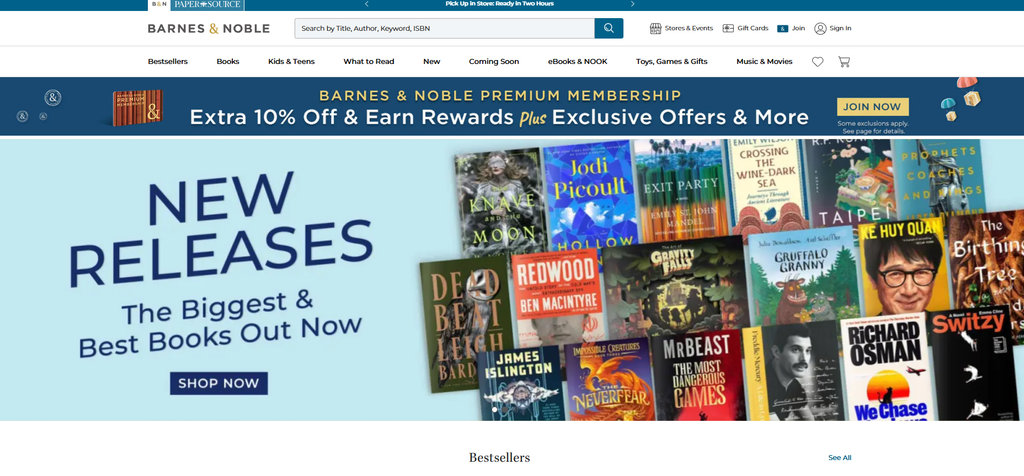
- Search is highly prominent. The search bar sits at the center of the header and explicitly supports title, author, keyword, and ISBN searches. For a catalogue as large as Barnes & Noble’s, that gives high-intent users a direct route to a known product.
- The navigation reflects major shopping missions. Bestsellers, Books, Kids & Teens, What to Read, New, Coming Soon, and eBooks & NOOK cover both category-led and discovery-led browsing.
- Merchandising is immediately visible. The “New Releases” hero gives the homepage a strong editorial role instead of functioning as a generic catalogue entrance.
- Membership is integrated into the commercial experience. The Premium Membership banner communicates the 10% savings and rewards proposition before the customer begins browsing.
What could be stronger
- The membership banner and hero consume most of the first screen. On desktop, shoppers see a large membership promotion followed by another oversized promotional banner before reaching actual product recommendations. That delays access to browseable merchandise.
- The homepage gives substantial space to broad promotional messaging. “New Releases” is useful, but it does not appear personalized to the individual visitor. A returning customer could potentially be shown recommendations based on categories, authors or titles they have previously browsed.
- The header is information-dense. The primary navigation, search, stores, gift cards, membership, sign-in, wishlist and cart all compete within a relatively small area. It is functional, but visually busy.
- Bestsellers appear relatively far down the page. One of the most useful discovery modules is pushed below the main promotional content.
Category page analysis
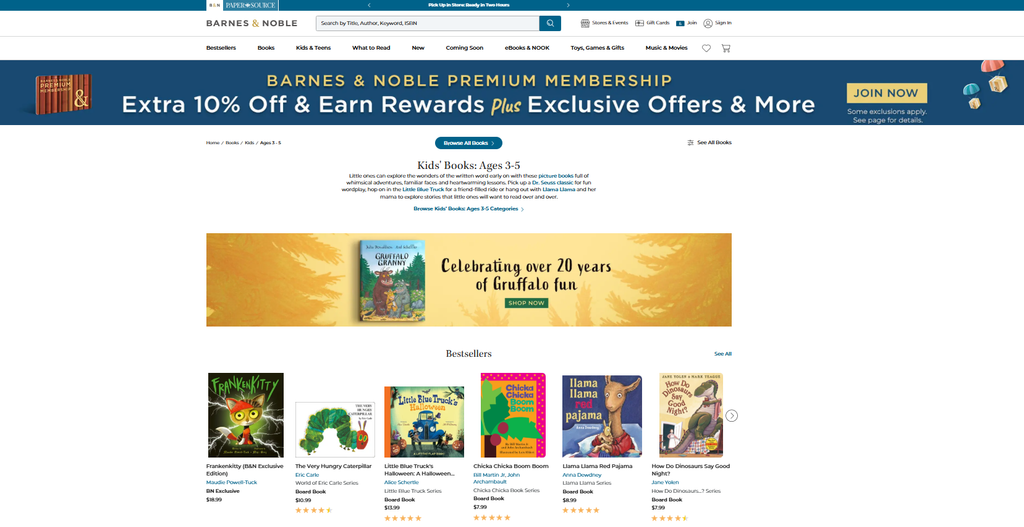
What works
- The category is clearly defined. “Kids’ Books: Ages 3–5” immediately tells shoppers where they are, while breadcrumbs preserve category hierarchy.
- Editorial context supports discovery. The introductory copy explains what customers can expect from the category and links to further subcategories.
- The page combines merchandising with products. The Gruffalo promotional module is directly relevant to the category, followed by a bestseller carousel.
- Product cards expose useful decision information. Visible details include author, series, format, price, ratings and B&N-exclusive status where applicable.
- Recognizable titles are grouped into a curated bestseller module. This is useful for shoppers who know the age group but have not chosen a particular title.
What could be stronger
- There is a large amount of unused space before the products. The category title, description and promotional banner occupy considerable vertical space before customers reach the assortment.
- The page behaves more like an editorial category landing page than a strong PLP. There are no immediately prominent filters for characteristics such as price, format, author, series, rating or availability.
- Only a small portion of the assortment is visible initially. A horizontal bestseller carousel supports inspiration, but it is less efficient for customers who want to compare many options quickly.
- The “Browse Kids’ Books: Ages 3–5 Categories” link adds another navigation step. Subcategories could potentially be surfaced more visibly to make refinement faster.
- Store availability is not part of the visible product-card information. For an omnichannel retailer, showing local availability earlier could make the physical network more useful during browsing.
Product page Analysis
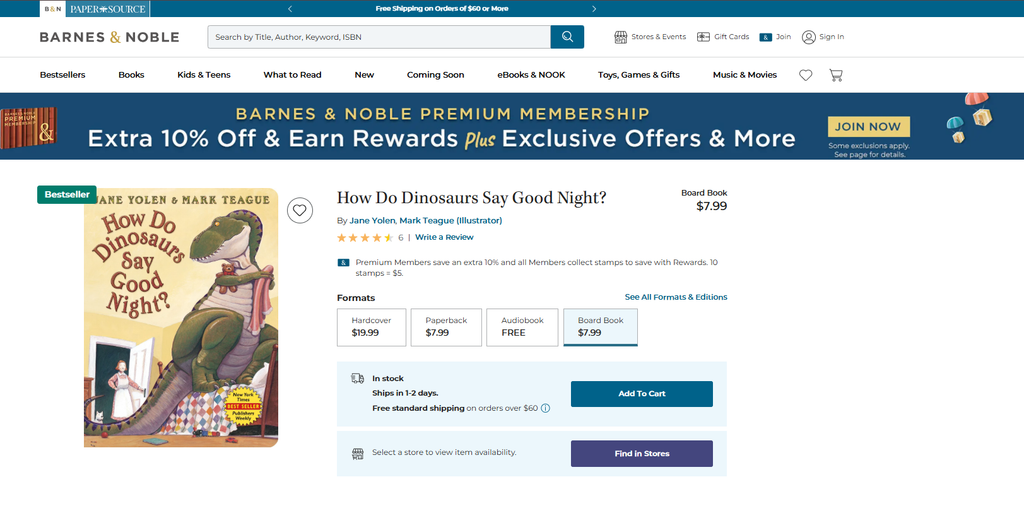
What works
- Format selection is particularly strong. Hardcover, paperback, audiobook, and board-book options appear together with their respective prices. That addresses an important book-specific decision directly on the PDP.
- Price and availability are highly visible. The selected Board Book format, USD 7.99 price, and “In stock” status are easy to understand.
- Delivery expectations are stated before checkout. “Ships in 1–2 days” reduces uncertainty before the customer adds the item to cart.
- Store discovery is built into the PDP. “Find in Stores” gives physical inventory a clear role within the online product journey.
- Membership value is contextualized around the product. The page reminds customers that Premium Members receive 10% off and that members earn Rewards stamps.
- Ratings and reviews are positioned close to the title. This puts social proof near the primary purchase decision.
What could be stronger
- The Premium Membership banner still dominates a large portion of the screen. The customer is already on a high-intent PDP, so using so much above-the-fold space for a generic membership promotion competes with the product itself.
- Store availability requires another action. The page says “Select a store to view item availability” rather than immediately showing availability for a previously selected or nearby store.
- The PDP is transactionally clear but does relatively little visible guided selling. From the screenshot, there is no prominent “If you liked this…”, age-based recommendation, similar title, or related series guidance near the purchase block.
- Product context could go further. A parent buying a children’s book may care about reading level, age fit, themes, length, or similar titles. Those decision-support attributes are not prominent in the visible area.
- The membership message appears in multiple places across the journey. Repetition can become distracting once the shopper has already understood the proposition.
Cart and checkout flow analysis
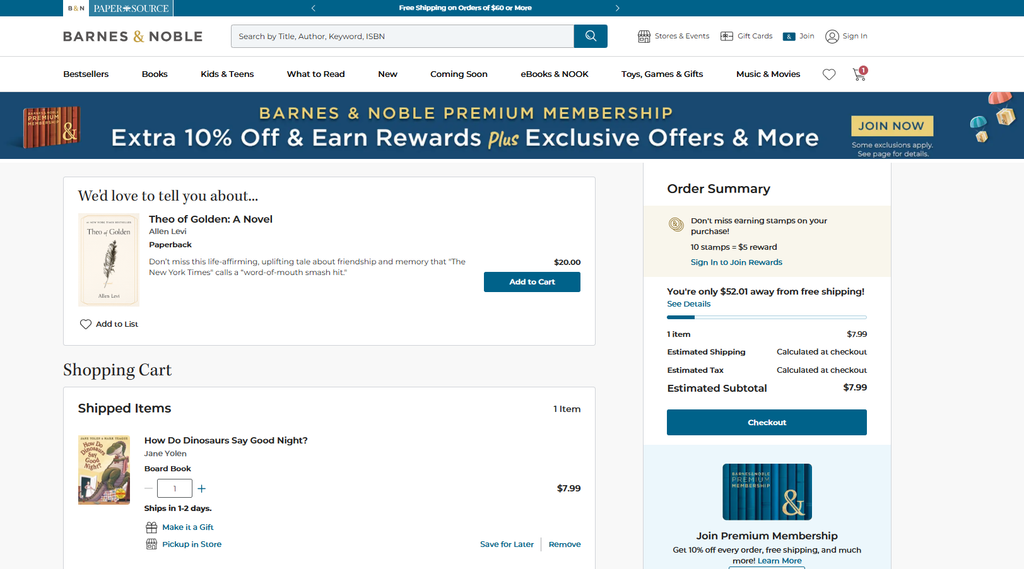
What works
- The order summary is persistent and easy to scan. Item count, estimated subtotal, shipping status, and checkout CTA are grouped clearly on the right.
- The free-shipping threshold is quantified. “You’re only $52.01 away from free shipping” gives customers a concrete target, supported by a progress indicator.
- The loyalty proposition is connected to the transaction. Customers are told they can earn stamps on the purchase and are given a direct sign-in/join action.
- Fulfillment alternatives remain available. “Pickup in Store” is still visible from the cart, which supports customers who may reconsider shipping.
- Save for Later is available. This can reduce the need to remove an item completely when purchase intent is postponed.
What could be stronger
- The cross-sell recommendation appears poorly matched to the cart. That makes the recommendation far less likely to increase AOV. A more relevant module might suggest another Jane Yolen title, another book in the How Do Dinosaurs… series, a bestselling board book for the same age group, or a complementary bedtime title.
- The free-shipping threshold creates an opportunity the recommendation does not exploit. The customer is told they need another USD 52.01 to qualify, yet the suggested item does not appear connected to their demonstrated intent. This is exactly where contextual cross-selling could help increase basket size.
- Shipping cost remains uncertain. “Estimated Shipping: Calculated at checkout” means the customer still does not know the final fulfillment cost before proceeding. That can introduce friction at a sensitive stage of the funnel.
- There are several competing commercial messages around the checkout action. Rewards, free-shipping progress, the cross-sell module, and another Premium Membership promotion all appear around the cart. Each has value individually, but together they create competition for attention.
- The recommendation occupies significant visual space despite weak relevance. Because it sits above the cart itself, the quality of this recommendation matters. An irrelevant item consumes valuable space that could instead support a more targeted cross-sell or basket-completion message.
- The Premium Membership upsell appears again beneath the checkout CTA. At this point, transaction completion should arguably receive stronger visual priority than another broad acquisition message.
Barnes & Noble marketing strategy resources: Videos and interviews worth watching
For leaders studying the Barnes & Noble marketing strategy, the most useful resources are interviews where James Daunt explains the operating model directly.
Video 1: Barnes and Noble Makes a Comeback With New Philosophy
Why it matters: Daunt explains why local booksellers rather than centralized merchandising teams became central to the store model. The report also shows how store teams translate trends such as BookTok into physical curation.
Video 2: How Barnes & Noble Made a Comeback
Why it matters: The discussion covers local control, BookTok, organizational structure and Daunt’s resistance to centralized marketing and merchandising.
Video 3: Inside CEO James Daunt’s Plan to Save Barnes & Noble
Why it matters: Fortune examines the move from standardized big-box execution toward smaller, more locally responsive bookstore environments.
Video 4: How to Bring a Business Back to Life
Why it matters: The conversation focuses heavily on management design, team autonomy and the cultural changes behind the turnaround.
Barnes & Noble: Key statistics behind the retail strategy
Barnes & Noble’s private ownership limits the amount of financial data available publicly, but its operating figures still reveal the scale of the business. Annual book sales, catalogue breadth and the volume of in-store events show how the company combines national reach with a retail model built around discovery, community and a large physical and digital assortment.
Stat 1: More than 190 million physical books sold annually
- Metric: 190+ million physical books
- Period: Annual
- Context: Covers physical books sold through Barnes & Noble stores and online operations.
- Source: Barnes & Noble Corporate
Stat 2: More than 1 million unique physical titles sold each year
- Metric: 1+ million unique physical book titles
- Period: Annual
- Context: Shows the breadth of the assortment Barnes & Noble serves across its retail network.
- Source: Barnes & Noble Corporate
Stat 3: 4.5 million eBooks available
- Metric: 4.5 million eBooks
- Period: Current company disclosure
- Context: Adds digital catalogue scale to a retail model still strongly centered on physical books and bookstores.
- Source: Barnes & Noble Corporate
Stat 4: More than 100,000 community events every year
- Metric: 100,000+ events
- Period: Annual
- Context: Quantifies the role physical stores play as community and discovery spaces beyond transactions.
- Sources: Barnes & Noble Stores & Communities and National Retail Federation
Stat 5: Approximately 1,500 national author appearances annually
- Metric: ~1,500 appearances
- Period: Annual
- Context: Barnes & Noble’s Author Events Department coordinates these appearances with publishers, in addition to thousands of locally organized author events.
- Source: Barnes & Noble Author Events
Latest news on Barnes & Noble
Barnes & Noble’s most recent developments point to a broader expansion strategy that now extends beyond opening bookstores. The company is also adding adjacent retail brands and selectively acquiring established bookselling businesses while preserving their existing identities.
Barnes & Noble acquires premium stationery brand Levenger
- Source: Barnes & Noble and Publishers Weekly
- Date: 2026-09-19
- What happened: Barnes & Noble acquired Levenger, a premium brand specializing in writing instruments, stationery, leather goods, desk accessories and the Circa notebook system.
- Why it matters: The acquisition expands Barnes & Noble beyond books into a closely related lifestyle category. A curated Levenger assortment is expected to appear in selected Barnes & Noble stores, with products also planned for Paper Source, creating new opportunities to connect the group’s existing retail brands.
Barnes & Noble agrees to acquire Joseph-Beth Booksellers
- Source: Barnes & Noble and Publishers Weekly
- Date: 2026-09-15
- What happened: Barnes & Noble signed an agreement to acquire Joseph-Beth Booksellers’ locations in Lexington, Kentucky, and Cincinnati, Ohio, together with their Bronte Bistro operations.
- Why it matters: Joseph-Beth is the third independent bookselling business acquired under James Daunt, following Tattered Cover and Books Inc. The company plans to retain Joseph-Beth’s brand, booksellers and community programming, reinforcing its approach of adding scale without fully standardizing acquired bookstore identities.
Barnes & Noble returns to major urban retail locations
- Source: Barnes & Noble: Costa Mesa and Barnes & Noble: Chicago
- Date: 2026-08
- What happened: Barnes & Noble opened a new 27,000+ sq. ft. store at South Coast Plaza in Costa Mesa and a 20,000+ sq. ft. bookstore on State Street in downtown Chicago.
- Why it matters: These are not simply additional suburban openings. Both represent a return to large, high-profile retail environments, including locations previously associated with major bookstore formats. They suggest that the company sees room for larger destination bookstores alongside its broader expansion program.
Barnes & Noble is increasing store size in selected proven markets
- Source: Barnes & Noble
- Date: 2026-08-19
- What happened: Barnes & Noble announced that its Lexington, Kentucky store would relocate within Fayette Mall to a space more than 50% larger, reaching over 13,000 sq. ft.
- Why it matters: The move shows that expansion is not limited to adding locations. In markets where customer demand supports it, Barnes & Noble is also increasing selling space, giving stores greater capacity for books and adjacent categories.
Barnes & Noble reports record sales across its existing Orlando stores
- Source: Barnes & Noble
- Date: 2026-09-02
- What happened: While announcing its fifth Orlando-area bookstore in two years, CEO James Daunt said all of the company’s existing Orlando locations had reached record sales levels during 2026.
- Why it matters: This provides a useful signal that the company’s expansion in at least one market is occurring alongside growth at existing locations, rather than relying exclusively on new-store additions.
What retailers can learn from Barnes & Noble
Barnes & Noble’s turnaround offers more than a store-expansion story. Its broader lesson is about relevance: giving local teams enough autonomy to respond to customer demand, using digital channels to extend the usefulness of stores, and making product expertise easier to access across the journey.
For other retailers, the value lies in understanding which parts of that model can transfer and which depend on conditions specific to bookselling.
Give local teams authority where customer context varies
Barnes & Noble gave store teams greater control over merchandising, displays and local presentation. This allows individual bookstores to respond to the interests of their own communities instead of applying the same priorities everywhere.
For other retailers, the principle is to identify where local knowledge can improve relevance and give frontline teams defined authority in those areas.
Treat stores as part of the discovery journey
Barnes & Noble’s stores are designed around browsing, curation, and bookseller recommendations. Their role extends beyond completing transactions.
This is especially relevant for retailers where customers need inspiration, comparison, or expertise before making a decision. Physical stores become more valuable when they help customers understand the assortment rather than simply provide another place to buy it.
Turn digital demand signals into merchandising decisions
Barnes & Noble’s response to trends such as BookTok shows how digital behavior can influence what customers encounter in stores. Interest in one title can inform wider displays, recommendations and category presentation.
Retailers can apply the same logic by connecting search behavior, social trends, product engagement and local demand signals with merchandising decisions instead of keeping those insights inside marketing dashboards.
Use digital channels to extend store expertise
BN.com, the Barnes & Noble app, loyalty and store pickup give customers more ways to access the retailer’s physical network and product knowledge.
The wider lesson is to design digital experiences around the same customer context that makes the store useful. Product information, availability, preferences and current intent should carry across channels wherever possible.
What transfers and what does not
Not every part of Barnes & Noble’s model should be copied directly. The useful distinction is between the underlying principle and the conditions required for it to work.
A practical customer-relevance framework
The Barnes & Noble example can be reduced to four types of context that retailers need to connect if they want discovery to remain relevant across channels:
Product context
Customers need more than a product record. Useful discovery depends on attributes, relationships, alternatives and the reasons one product may fit a particular need. At Barnes & Noble, bookseller expertise provides much of this context.
Customer context
Previous purchases, preferences, loyalty status, location and browsing behavior can all change what is useful to recommend. The objective is to carry that understanding across interactions rather than restart the relationship in every channel.
Local context
Availability, regional demand, store-level trends and frontline knowledge can influence what should be surfaced. Barnes & Noble’s decentralized merchandising model makes this layer particularly visible.
Interaction context
A customer asking a question, searching, browsing a product or requesting store availability is providing information about the decision they are currently trying to make.
Retailers that can combine these four forms of context can move beyond static product presentation toward useful, situational discovery.
“Barnes & Noble is a useful retail lesson because relevance is not created by choosing between physical and digital. It comes from making each channel strengthen the other. The retailers we see create durable growth are the ones that use store context, product discovery, customer data and digital engagement as one connected commercial system. When customers can move naturally between inspiration, expertise and purchase, the experience becomes more useful – and the brand gives them a stronger reason to return.”
Joyce Qian, CMO, ContactPigeon
For more examples of how retailers connect channels and customer context, see our guides to omnichannel retail, the best omnichannel retailers, personalized shopping experiences and retail customer experience best practices.
Conclusion: What Barnes & Noble’s retail strategy means for other retailers
The central lesson behind the Barnes & Noble marketing strategy is that customer relevance can become part of the operating model itself. Store teams shape discovery, digital tools extend access to inventory and expertise, loyalty maintains continuity, and technology increasingly supports movement between those environments.
For retail leaders, the implication is to define what each channel should contribute to the customer’s decision. That requires accessible product information, useful customer context, local intelligence and systems capable of carrying those signals across the journey.
Building that type of connected experience becomes harder as stores, catalogues, customer data and digital interactions grow. ContactPigeon works with retailers addressing that orchestration problem, helping turn fragmented customer and product signals into more relevant engagement across physical and digital touchpoints.