The distinction between agentic vs conversational commerce is reshaping how purchase decisions are made in digital retail. Instead of guiding users through linear journeys of product discovery and comparison, retailers are increasingly interacting with systems that can interpret intent, evaluate options, and act on behalf of the consumer, signaling a broader shift in consumer adoption of agentic commerce. This transition redefines the role of the customer from active decision-maker to participant in a decision delegation model, where control is partially or fully transferred to AI.
Adoption, however, remains uneven. While some consumers readily delegate routine decisions, others require greater transparency and control before trusting automated systems. Understanding this variation is critical for retailers aiming to align AI-driven experiences with actual customer readiness.
- Agentic commerce consumer adoption is behavior-driven, not determined by demographics, requiring a shift toward AI readiness segmentation.
- Adoption is accelerating due to decision overload, improved AI accuracy, and increased exposure to AI interfaces.
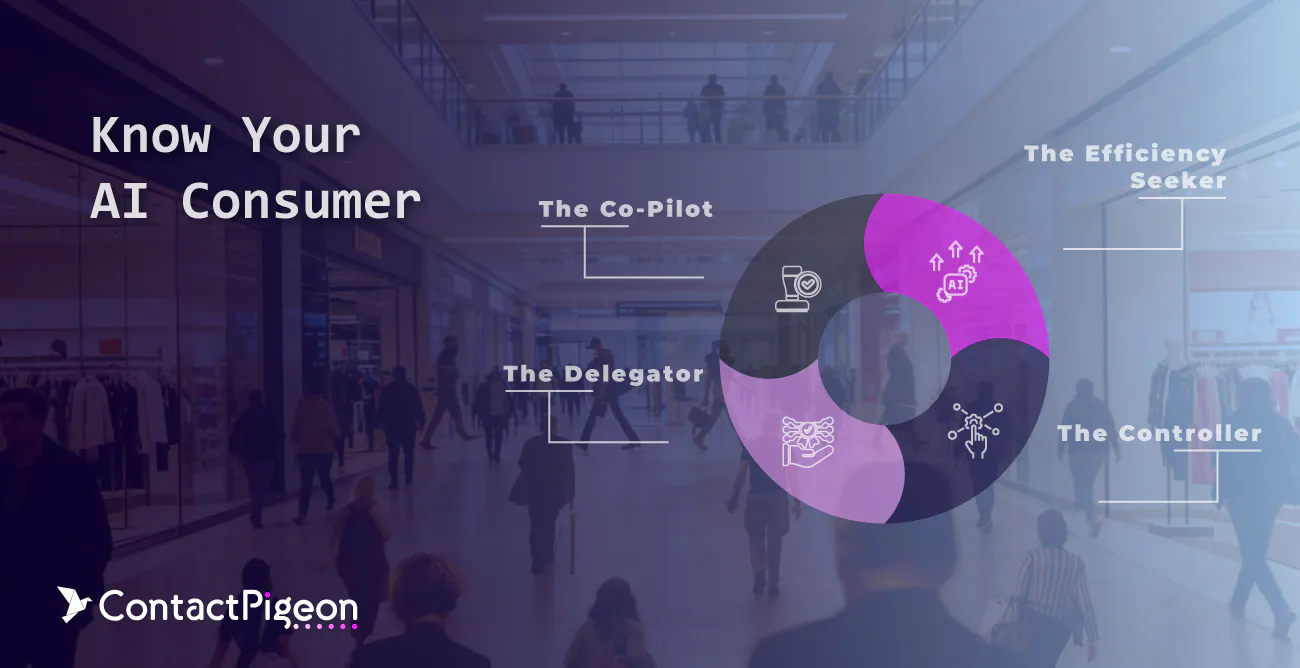
- Four key consumer types shape adoption: efficiency-oriented, assistance-oriented, delegation-ready, and control-oriented.
- The commercial impact is clear: faster decisions drive conversion, automation increases frequency, and delegation boosts CLV.
- Success depends on balancing automation with trust through real-time orchestration and adaptive AI experiences like Menura AI.
Demographics alone cannot explain agentic commerce adoption
Demographic segmentation offers limited insight into how consumers engage with agentic commerce. While younger audiences may be more digitally familiar, this does not necessarily translate into a higher willingness to delegate decisions to AI.
Instead, agentic commerce consumer adoption is driven by behavioral factors, including:
- Trust in AI systems
- Risk tolerance
- Decision fatigue
- Digital maturity
These variables often override age. For example, a time-constrained professional may adopt automation quickly to reduce effort in repeat purchases, while a younger user may prefer manual exploration in categories tied to personal preference. Similarly, privacy-sensitive consumers may resist automation regardless of demographic profile. As a result, adoption is better explained by mindset and context than by age alone, requiring a shift toward behavior-based segmentation.
Why is agentic commerce adoption accelerating now?
The rise of agentic commerce is not coincidental. It reflects a convergence of structural shifts in both consumer behavior and technological capability. Market data supports this shift. According to Capgemini, 68% of consumers have already bought products recommended by Gen AI tools, indicating a growing baseline acceptance of AI in commerce.
At the same time, Adobe reports a 1200% increase in traffic to U.S. retail websites from generative AI sources, highlighting the rapid emergence of AI as a discovery and decision layer. Salesforce data further shows that consumers are increasingly open to AI-assisted shopping, particularly when it improves efficiency and relevance. Taken together, these factors explain why agentic commerce adoption is accelerating now, moving from experimental use cases to a scalable, behavior-driven transformation.
| Factor | What is happening | Impact on consumer behavior |
|---|---|---|
| Decision saturation | Expanding assortments, infinite scroll, and constant promotional exposure increase cognitive load | Consumers are more willing to delegate decisions to reduce effort and speed up evaluation |
| Improved AI accuracy | LLMs and real-time data processing enhance contextual understanding and recommendation precision | Lower perceived risk increases trust in automated decisions |
| Increased AI exposure | Consumers interact with AI across assistants, search, and customer support channels | Familiarity normalizes AI usage and lowers adoption barriers |
The 4 types driving agentic commerce consumer adoption
Understanding agentic commerce consumer adoption requires a shift from demographic segmentation to behavioral segmentation based on AI readiness. The key question is no longer who the customer is, but how willing they are to delegate, share, or retain control in decision-making.
AI readiness can be defined as the degree to which a consumer trusts and relies on automated systems to support or execute purchase decisions. This creates a more actionable framework for personalization, experience design, and revenue optimization. The following four consumer types capture the primary patterns shaping adoption:
AI consumer segmentation framework
| Consumer type | Core motivation | AI role | Best-fit categories | Business impact |
|---|---|---|---|---|
| Efficiency-oriented | Speed and convenience | Decision accelerator | FMCG, grocery, high-frequency retail | Higher conversion rates, increased purchase frequency |
| Assistance-oriented | Confidence and validation | Decision support (co-pilot) | Beauty, fashion, health | Improved conversion, reduced returns, higher AOV |
| Delegation-ready | Convenience and automation | Decision owner | Subscriptions, replenishment, FMCG | Higher CLV, predictable revenue, retention growth |
| Control-oriented | Transparency and control | Decision validator | Luxury, high-ticket purchases | Trust-building, gradual conversion uplift |
Category dynamics shaping agentic commerce consumer adoption
Agentic commerce consumer adoption does not evolve uniformly across retail categories. Instead, it follows distinct patterns shaped by three key variables:
- Purchase frequency: How often decisions are repeated
- Decision complexity: The level of evaluation required
- Emotional involvement: The degree of personal or financial significance
Categories with high frequency and low complexity tend to adopt automation faster, while categories with high emotional or financial stakes require greater control and trust.
Category readiness for agentic commerce
These category dynamics reinforce a critical insight: agentic adoption is not universal, but conditional. It scales fastest where decisions are repeatable and low-risk, and slows where emotional involvement and perceived consequences remain high.
| Category | Adoption potential | Why | Main barrier | Recommended AI role |
|---|---|---|---|---|
| Groceries | High | Frequent, low-risk, repeat purchases | Brand switching sensitivity | Full automation / replenishment |
| Household essentials | High | Predictable demand, low decision complexity | Price sensitivity | Automated recommendations |
| Beauty | High | Advisory-driven, routine-based decisions | Trust in recommendations | Guided decision support |
| Fashion | Medium | Moderate frequency, subjective preferences | Fit uncertainty, personal taste | Assisted discovery |
| Consumer electronics | Medium | High comparison complexity | Specification evaluation, price | Comparison and filtering support |
| Luxury | Low | High emotional and financial involvement | Desire for control and brand experience | Advisory only |
| Furniture | Low | Low frequency, high consideration | Long decision cycles | Visualization and guidance |
| Gifting | Medium | High uncertainty, time pressure | Emotional relevance, personalization | Curated recommendations |
The economics behind agentic commerce adoption
Agentic commerce is not only a behavioral shift. It has a direct and measurable impact on commercial performance. At its core, agentic commerce consumer adoption compresses the decision-making process, reducing friction across the journey mapped through a retail customer journey builder and translating into clear economic outcomes:
- Faster decisions → higher conversion rates
By reducing the time required to evaluate options, AI-driven systems shorten the path to purchase and increase the likelihood of conversion. - Automation → higher purchase frequency
When routine decisions are automated, customers engage more frequently without the need for repeated effort, particularly in replenishment-driven categories. - Delegation → stronger customer retention strategy and higher customer lifetime value (CLV)
As consumers begin to trust AI to manage ongoing decisions, interactions become continuous rather than transactional, increasing retention and long-term revenue.
Trust as the limiting factor
Despite its economic potential, agentic commerce is constrained by a single critical variable: trust. It does not scale linearly with technology, but with trust. For retailers, the challenge is not only to deploy AI capabilities but to calibrate the level of automation to the consumer’s confidence, ensuring that performance gains do not come at the expense of credibility.
Trust in AI-driven decision-making is both progressive and fragile. It is built gradually through repeated positive interactions, but can be undermined quickly by inconsistency or perceived loss of control.
It is strengthened through:
- Accuracy: Recommendations must consistently meet expectations
- Consistency: Outcomes should be reliable across interactions
- Transparency: Users need to understand why decisions are made
At the same time, trust can deteriorate when:
- Recommendations feel irrelevant or incorrect
- The system behaves unpredictably
- Users lack visibility or control over decisions
How retailers misread agentic commerce consumer adoption
As agentic commerce evolves, many retailers misinterpret how adoption actually unfolds, leading to ineffective or misaligned strategies. These misinterpretations often lead to either overextension of AI capabilities or underutilization of their potential, reducing both performance and customer trust.
| Misinterpretation | What retailers assume | What actually happens | Impact |
|---|---|---|---|
| Demographic bias | Younger audiences will adopt AI faster | Adoption is driven by behavioral readiness, not age | Misaligned targeting and missed high-value segments |
| Over-automation | More automation improves performance for all users | Excessive automation reduces trust for users needing control | Lower engagement and potential drop in conversion |
| Category blindness | Adoption is consistent across all product categories | Adoption varies by frequency, complexity, and emotional involvement | Ineffective experience design and poor performance |
| AI as a channel | AI is an additional marketing or communication channel | AI operates as a decision layer shaping customer behavior | Underutilization of AI and limited business impact |
From segmentation to real-time orchestration
Agentic commerce requires a shift beyond traditional segmentation toward real-time orchestration of the customer experience. Static segmentation models classify users into predefined groups, but they do not account for changes in behavior, context, or intent. In contrast, an omnichannel customer experience strategy enables retailers to dynamically adjust experiences based on real-time signals.
This includes:
- Adapting the level of AI involvement depending on user behavior and context
- Balancing control and automation, allowing users to delegate decisions where appropriate while retaining oversight when needed
- Modulating recommendation depth and transparency based on trust levels and decision complexity
This shift has direct implications for personalization strategy. Instead of delivering fixed experiences to static segments, retailers must design systems that continuously respond to behavioral signals and evolving levels of AI readiness.
In this model, personalization becomes less about targeting and more about calibrating the interaction between the consumer and the system, ensuring that automation enhances performance without compromising trust.
What is agentic commerce consumer adoption?
Agentic commerce consumer adoption refers to how willing customers are to delegate decision-making to AI systems, ranging from assisted recommendations to fully automated purchasing.
Why is agentic commerce adoption increasing now?
Adoption is accelerating due to increased decision complexity in eCommerce, improved AI accuracy, and widespread exposure to AI-driven interfaces across digital channels.
What determines whether consumers trust AI in shopping?
Trust is built through accuracy, consistency, and transparency. It is influenced by perceived risk, prior experience with AI, and the level of control users retain.
How should retailers adapt to agentic commerce?
Retailers should move toward AI readiness segmentation, dynamically adjust automation levels, and design experiences that balance efficiency with user control.
Which categories adopt agentic commerce faster?
High-frequency, low-risk categories such as grocery and FMCG adopt faster, while high-value or emotionally driven categories like luxury and furniture adopt more slowly.
Conclusion: A selective transformation of the consumer
Agentic commerce does not represent a universal shift across all consumers, but it remains uneven, shaped by behavioral readiness, context, and trust rather than by demographics alone. The implication is clear: adoption is not binary. It evolves gradually, varying across individuals, categories, and decision types. Retailers that treat it as a one-size-fits-all transformation risk misalignment between experience and customer expectations. Winning organizations should take a more precise approach by:
- Identifying levels of AI readiness across their customer base
- Aligning experience design with varying degrees of control and automation
- Building trust progressively, ensuring that each interaction reinforces confidence in automated decisions
Ultimately, agentic commerce is not only a technological advancement but a shift in how decisions are distributed between humans and systems. Success depends on managing that balance effectively. To see how these principles can be applied in practice, explore Menura AI and discover how adaptive AI agents can align with different customer mindsets while driving measurable revenue impact.