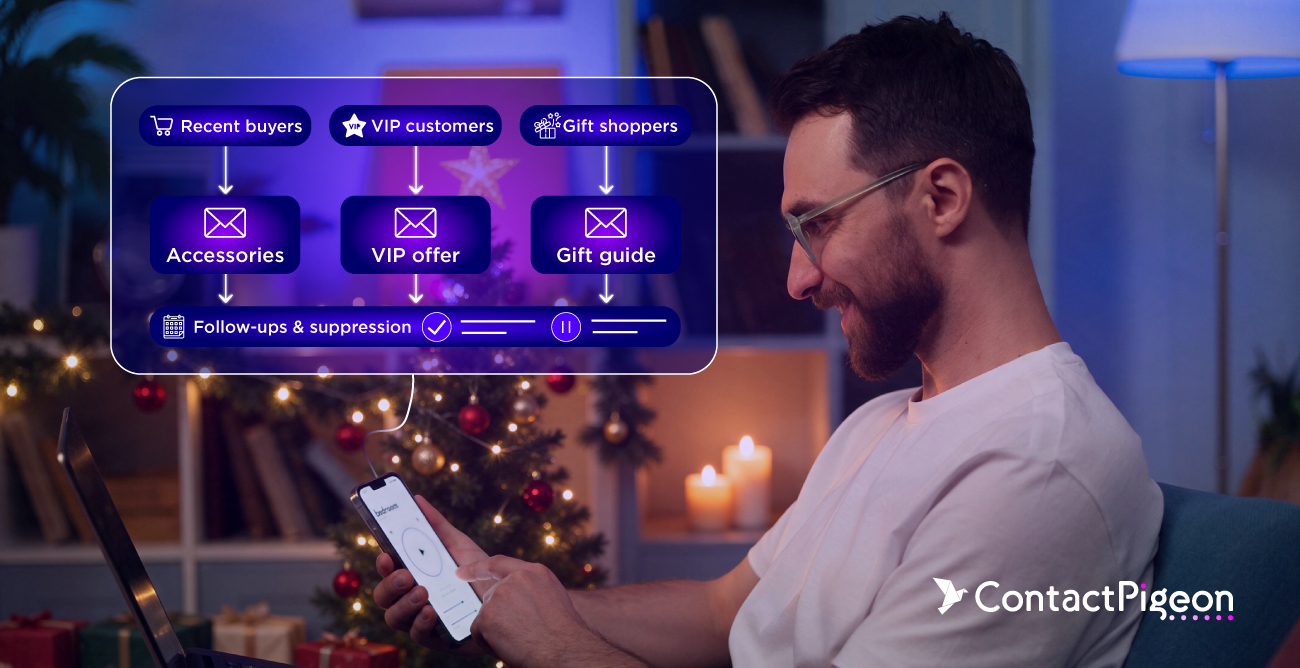
A customer buys a jacket during Black Friday, returns a week later to browse accessories, and qualifies for your Christmas VIP offer. An older cart reminder is still scheduled, while the next promotional email includes the jacket they already own. Christmas campaign segmentation helps your team decide which of these messages still serves a useful purpose.
Sending another jacket discount could spend margin on a completed purchase. Excluding the customer from every promotion could overlook their interest in accessories. For CRM and Lifecycle Directors, the decision depends on purchase history, current activity, and stated preferences, together with the commercial objective of each campaign.
A useful audience plan explains why an offer is relevant, what would justify a follow-up, and which events change eligibility. The examples throughout this guide illustrate those decisions; their timing and conditions should reflect your category, buying cycle, and fulfilment options.
What is Christmas campaign segmentation?
For a CRM Director, the practical output is an audience plan that connects each campaign to a specific opportunity. The team should be able to explain why a customer qualifies and what would make the message no longer useful.
How to define your audience
Start with the purchase or customer action the campaign is intended to encourage. A second purchase after Black Friday, completion of an existing basket, and an order for store collection each require different audience criteria.
Consider a homeware retailer promoting accessories to customers who recently bought a coffee machine. Purchase history identifies a potential audience, but the commercial opportunity depends on what was included in the original order. Customers who already bought the suggested accessories have a different need from those who purchased only the machine. Compatibility and availability also determine whether the recommendation is useful.
This is where Christmas customer segmentation becomes a campaign decision. “Recent buyers” describes a relationship with the retailer. A campaign definition adds the conditions that make a particular offer relevant.
Define the qualifying action and the stopping condition together. Buying the recommended accessory may end that sequence. An unrelated purchase may leave the opportunity open, although the team should review whether another message is appropriate given recent contact.
That level of specificity also helps merchandising and CRM agree on the purpose of the campaign. The audience, featured products, and expected outcome should support the same commercial objective.
Which customer segments should you prioritize for Christmas campaigns?
Prioritize customer situations that give your team a clear reason to change the message, offer, or timing. Recent purchases, an established customer relationship, an explicit gifting need, and current shopping activity can each affect that decision.
These groups overlap. A loyal customer may be buying a gift while considering something for themselves. Their purchase value alone cannot determine which of those needs the next campaign should address. Use the table to connect qualifying evidence with the offer and the conditions that change eligibility.
| Customer situation | Qualifying evidence | Message objective | Offer rule | Follow-up or exclusion |
|---|---|---|---|---|
| Recent buyer | A completed purchase within a category-relevant period | Support the purchase or introduce a relevant complementary item | Check the original basket before offering an incentive | Exclude the purchased item from its acquisition or recovery sequence |
| Repeat or high-value customer | Purchase frequency or value meeting the retailer’s definition | Recognize the relationship through relevant access, selection, or service | Apply the agreed loyalty benefit without automatically adding another discount | Recheck recent purchases and competing promotions |
| Customer shopping for a gift | An explicitly stated gifting need or preference | Help them choose within the stated budget and requirements | Use the agreed promotional rules for eligible products | Reassess when the shopping task is completed |
| Customer with recent browsing or cart activity | Recorded activity within a defined observation window | Help them continue a relevant shopping task | Test whether information or reassurance is sufficient before adding an incentive | Stop recovery for products subsequently purchased |
| Campaign nonresponder | No defined response to a specific campaign within its review window | Decide whether a follow-up remains useful | Do not treat nonresponse alone as a reason for a deeper discount | Check purchases, site activity, and other messages before resending |
The observation period should reflect the buying decision. Furniture may require more consideration than a familiar beauty product. A single inactivity threshold applied across both categories could lead the team to follow up too early or overlook a customer who is still considering a purchase.
Gift preferences need similar care. A shopper looking for a toy for a six-year-old has provided useful information about that shopping task. Applying the same preference to future campaigns without further evidence could make subsequent recommendations less relevant.
How to prioritize Christmas campaigns when customer segments overlap
Christmas campaign segmentation needs clear priority rules when several promotions apply to one customer. Assess whether each message still serves an unfinished shopping need. Completed purchases, unavailable products, and expired offers should change the decision before the team weighs competing promotions.
Return to the customer who abandoned a jacket and then purchased it. Recovery messaging for that basket has completed its purpose. The jacket should also be excluded from recommendations based on the assumption that the customer has not bought it.
Their VIP eligibility requires a separate decision. A VIP promotion featuring the same jacket offers little additional relevance. Access to an accessories collection may be worth considering, particularly if the customer has subsequently browsed that category.
The scope of the exclusion matters. A rule that stops an obsolete reminder can protect the customer experience without removing someone from every campaign for the rest of December.
The team should also review scheduled campaigns alongside automations. An email exclusion does not resolve the conflict if an equivalent SMS remains scheduled. Someone needs responsibility for deciding which promotion takes priority and ensuring the relevant rules are applied across the channels involved.
When should you send a Christmas campaign follow-up?
Send a follow-up when there is still a relevant shopping opportunity and the message adds something useful. Before repeating an offer, review what has happened since the first contact.
A customer who did not click an email may still have returned to the website or purchased through another route. Nonresponse to one message does not establish that they have lost interest, and it does not explain what prevented a purchase.
Suppose someone revisits a gift set after receiving a campaign but does not buy. Verified information about delivery, product contents, or available alternatives may help them evaluate the purchase. A discount could also be tested, but browsing activity alone does not show that price is the obstacle.
For Christmas campaign segmentation to inform the offer, the team needs to connect the observed behavior to a plausible customer need. Adding an incentive to every reminder can make it difficult to learn which customers needed the offer and which would have purchased without it.
For customers who have received several promotions without further observable activity, pausing may be appropriate. Define what would justify renewed contact, such as a new visit, an expressed preference, or a genuinely relevant campaign.
How Christmas delivery deadlines affect campaign eligibility
Delivery deadlines change which offers a retailer can fulfil and which audiences should receive them. A Christmas delivery message may depend on the destination, product availability, shipping service, and time of ordering.
For example, a home-delivery campaign may remain relevant in one region after the cutoff has passed in another. Customers who can use store collection may qualify for a separate offer, provided the relevant location and stock information are available.
This affects the value of the message itself. For a shopper approaching a deadline, a confirmed way to receive the product in time may be more useful than another discount. The campaign should make that option clear and target customers who can actually use it.
Check holiday campaign audiences and delivery promises together before each deadline reminder. A promotional message should not continue offering an option that is no longer available.
How to build a Christmas campaign audience with Menura AI Data Canvas
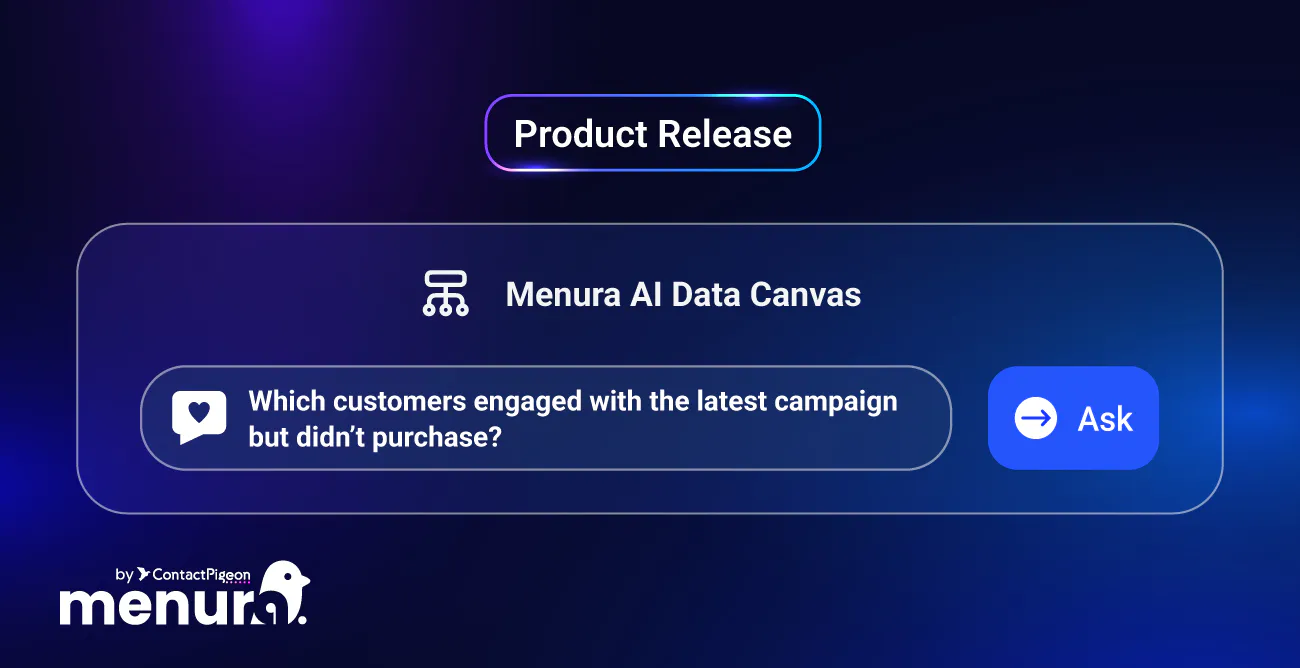
Menura AI Data Canvas supports Christmas campaign segmentation by helping teams investigate the customer groups behind an offer. One useful question is whether Black Friday buyers have shown subsequent interest in a category they have not yet purchased from. Where the necessary purchase and browsing data are available, the team could ask: “Which Black Friday customers later browsed a different product category without purchasing from it?” Review the date ranges, category definitions, group size, and purchase exclusions before interpreting the opportunity.
The commercial interpretation should remain specific to the evidence. Subsequent category browsing gives the team a reason to consider relevant products for another campaign. It does not establish that the customer is shopping for a gift or requires an incentive. A useful next step is to focus on one category, check whether the available selection supports a coherent message, and refine the group accordingly.
Save a useful finding to My Canvas with Keep it, then use the supported audience creation and activation options to carry it forward. The final audience definition should reflect the campaign’s purchase exclusions. Before scheduling, confirm how new purchases affect membership and which checks apply to later messages, so the execution remains consistent with the original decision.
How to measure Christmas campaign segmentation performance
Measure Christmas campaign segmentation against the decision it was intended to improve. If the aim was to encourage a relevant second purchase without unnecessary discounting, campaign revenue alone will leave part of the question unanswered.
For the audience identified in Data Canvas, the team could test a category-focused message with and without an incentive. Randomly assign eligible customers to the groups, keep the timing and other conditions comparable, and define the purchase window before launch.
Review purchase rate alongside the commercial return. A discount may generate more orders while reducing the contribution retained from each one. Where reliable cost data exists, account for the discount and relevant costs before deciding whether to extend the offer.
The review should cover:
- Purchase rate: unique purchasers divided by customers assigned to each group, using the same observation window.
- Commercial return: revenue and, where available, contribution after discounts and relevant costs.
- Customer response: unsubscribes and complaints, measured consistently.
- Execution: whether completed purchases stopped the relevant follow-ups as intended.
A no-message holdout addresses a separate question: whether sending the campaign generated additional purchases compared with sending nothing. Choose the comparison that answers the commercial decision in front of the team.
Record limitations, including small audience sizes, availability changes, or exposure to other campaigns. These factors affect how confidently a result can guide the next promotion.
What to include in your Christmas campaign audience plan
A Christmas campaign segmentation plan should give the CRM Director enough information to approve both the commercial decision and its execution. Record the opportunity, qualifying evidence, message objective, offer, purchase exclusions, and follow-up conditions. Include the competing campaigns and the person responsible for the final audience review.
The plan should also make unresolved questions visible. If the team does not know whether an incentive is necessary, define a test. If a delivery promise depends on regional conditions, specify the check. If a customer has completed one purchase but shown interest elsewhere, assess that new opportunity on its own evidence.
Menura AI Data Canvas can help your team investigate those opportunities and turn reviewed findings into audiences. Explore audience building with ContactPigeon to develop a Christmas campaign plan around your customers’ current needs.
Christmas campaign segmentation FAQs
Should recent buyers be excluded from Christmas promotional campaigns?
Apply exclusions according to the campaign’s purpose and the products purchased. A completed order should stop the relevant recovery message, while another campaign may remain useful if it addresses a separate shopping need and respects the customer’s contact preferences.
How can retailers identify Christmas gift shoppers?
Use explicitly stated information, such as a gifting need or a relevant preference collected during the shopping journey. Seasonal timing and product browsing can provide context, but neither confirms that the customer is buying a gift.
How often should Christmas campaign audiences be updated?
Review audience eligibility before each campaign and follow-up, accounting for new purchases, relevant activity, availability, and delivery conditions. Confirm how your platform updates membership and applies exclusions so the review process reflects how messages are actually sent.
How can retailers avoid sending overlapping Christmas promotions to the same customer?
Review scheduled campaigns and automations together, establish which message takes priority, and apply the relevant exclusions across channels. Distinguish duplicate delivery of one campaign from competing promotions: a customer may receive each campaign only once and still encounter conflicting offers.
Should every Christmas customer segment receive a discount?
Choose incentives according to the campaign objective and the customer’s situation. Relevant recommendations, verified delivery information, or early access may provide a useful reason to purchase. Where audience size allows, test an incentive against a comparable message without one before extending the offer.