Build vs. buy AI agents? If your engineers already have a working prototype, building can look cheaper. But what have you actually priced? Your team has estimated what it takes to build the first version. The supplier’s fee may also cover the work of keeping it running. Until you know what each estimate includes, it’s hard to tell which option costs less.
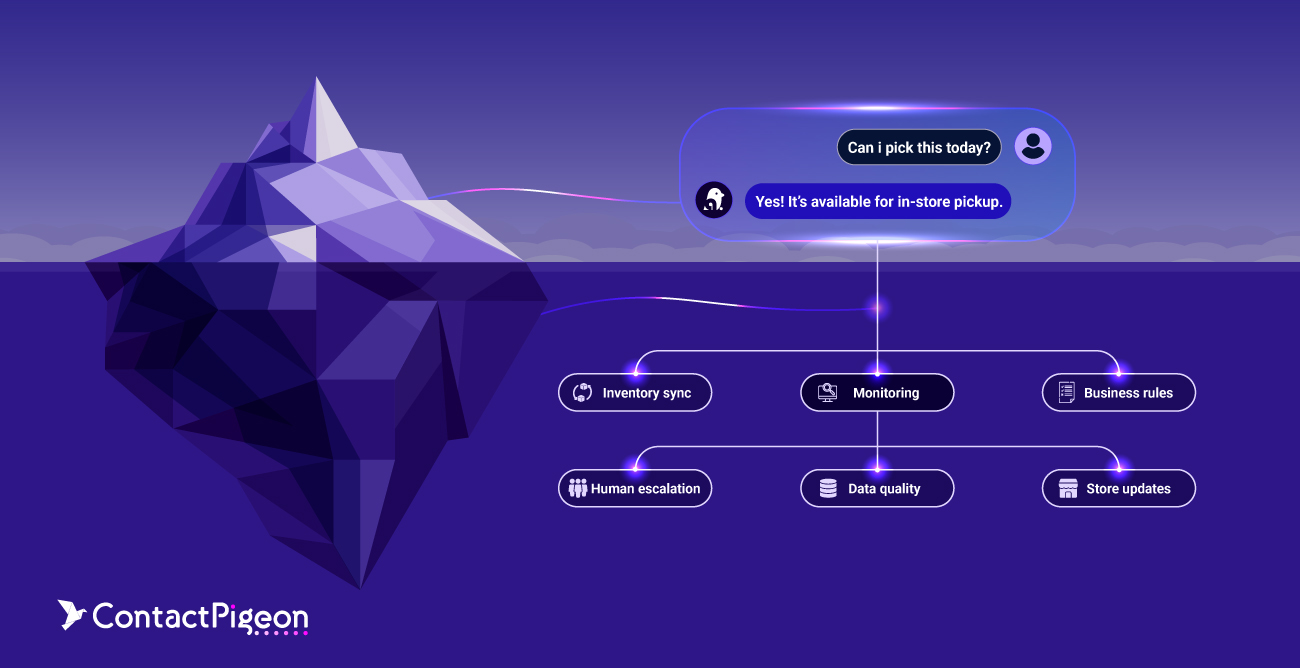
Say a shopper asks, “Can I pick this up today?” The prototype can check the store’s inventory, but if the store stops sending updates, someone needs to catch the problem before another shopper makes a wasted trip. If you build the assistant, who on your team will do that? If you buy it, will the supplier handle it, or will your team still get the call?
Start with one job you want the agent to do and ask both teams to price the work through launch and beyond. That gives you a clearer view of what you’d pay a supplier to handle and which decisions are worth keeping in-house. We’ll use the pickup question to show how that comparison works: who keeps the stock information accurate, who steps in when it’s wrong, and what each team needs to have in place before the first store goes live.
From there, you can use the scorecard to compare three options for your own business: build the agent, buy it, or buy the shopping assistant and keep control of decisions such as whether an item can be reserved. We’ll also cover what to test in a pilot so you can explain why you’re recommending one option and what evidence would change your mind.
What does an in-house AI agent estimate need to cover?
Start with the promise being made to the shopper. An agent that displays the latest stock figure needs access to inventory. An agent that reserves the last item also needs permission to place a hold, a way to release it, and confirmation that the store can see it. That single word, “reserve,” changes both the development estimate and the support commitment.
Ask the team to price three kinds of work: getting the first store live, keeping it running through normal trading, and adapting it when a system or policy changes. Include the time merchandising spends correcting records and store colleagues spend resolving errors. Finance can then use the retail AI agent total cost of ownership model to compare all three routes over the same period and trading volumes.
The eCommerce director can help finance decide which work is worth funding. If shoppers reserve items successfully but arrive to find the shelf empty, look at where the promise breaks down. Fixing the stock feed may do more for those customers than investing in a more capable assistant.
Who owns a retail AI agent after launch?
Once the scope is clear, the CIO can ask each team to put a name beside the work. The split below is a starting point for that conversation. A supplier may maintain the connector while retail IT manages access and store operations follows up with affected customers.
Staffing and responsibility matrix
| Work | Internal build | Purchased platform | Hybrid |
|---|---|---|---|
| Catalog, inventory and policy accuracy | Retail data owner maintains sources and feed checks | Retail data owner fixes sources. Vendor owns agreed ingestion checks | Retail data owner publishes and versions the agreed fields |
| Integrations and permissions | Retail engineering builds and supports connections | Vendor maintains contracted connectors. Retail IT manages access and custom mappings | Retail engineering owns internal services. Vendor owns its connector |
| Evaluation and release | Retail product owner approves tests. Engineering deploys and rolls back | Vendor tests platform updates. Retail product owner accepts shopper outcomes | Both test the boundary. Each can roll back its component |
| Monitoring and incident response | Retail engineering takes the alert. Operations handles affected shoppers | Vendor handles platform incidents under contract. Retail operations owns store follow-up | One retail incident lead coordinates both support teams |
| Security review and handover | Retail IT reviews access, records decisions and trains the next owner | Retail IT reviews supplier controls and tests exports | Retail IT reviews both sides and documents how to replace either component |
Once you’ve named the people who would run the agent, ask each team lead where the time would come from. The engineer who maintains the inventory connection may already be on payroll, so the pilot might require no new hire. But if that engineer is also due to fix a checkout issue before peak season, which project takes priority? The commercial sponsor needs to know what approving the pilot would mean for work the business has already committed to.
The same question applies when you compare suppliers. Suppose a vendor monitors the inventory connection and alerts you when a store stops sending updates. Does the fee also cover investigating the problem and restoring the connection? Who handles pickup requests while the figures are out of date? Checking what the available integrations cover helps you work out how much engineering and store support time to include alongside the supplier’s fee. When deciding whether to build vs buy AI agents, the committee can now compare what it would cost each team to keep the same service running. It can also see where buying would free up a team that already has other commitments.
Build vs buy AI agents: How should retailers score their options?
Agree on mandatory requirements before applying weights. If the agent must verify a reservation, an option that cannot distinguish a pending hold from a confirmed one drops out.
For the remaining options, set weights before reviewing proposals. The illustrative weights below assume the retailer depends on live inventory.
| Criterion | Weight | Evidence to request |
|---|---|---|
| Strategic differentiation | 20% | Show which shopper or merchant decision we can change independently |
| Delivery and support capacity | 20% | Name the launch team, service owner and peak cover |
| Integration fit | 15% | Demonstrate a fresh stock lookup and a failed reservation |
| Controls and auditability | 15% | Trace one promise to its source, permission and outcome |
| Time to usable value | 10% | Identify dependencies on the path to the first live store |
| Lifecycle cost | 10% | Compare finance-reviewed estimates at the same scope and volume |
| Exit and portability | 10% | Export test cases and show how to replace a component |
Score each route against the requirement you agreed. A 1 means substantial additional work, a 3 means the route meets the requirement with a manageable dependency, and a 5 means it fits within the proposed staffing, budget and operating conditions.
Alongside each score, record whether the supporting evidence was demonstrated, documented or remains unverified. If a mandatory capability is still unverified, keep the recommendation provisional until someone tests it.
Multiply each score by its weight, then add the results. For example, a 4 on integration fit at a 15% weight contributes 0.60 to the total out of five.
The weights should reflect how your stores operate. If teams change collection rules every week, give more weight to their ability to make those changes themselves. If the rules are stable and the service needs to be ready for peak trading, an earlier launch may be worth more.
What if two options score almost equally?
If you’re still deciding whether to build vs buy AI agents after scoring both options, look at where the scores differ most. If buying leads on launch time and building leads on control, check how often store collection rules changed last season and how quickly those changes had to reach shoppers.
Ask each team to walk one of those changes through approval, testing and release. For the supplier, check whether its support commitment covers completing the change or simply answering the ticket.
If both routes can meet the retailer’s turnaround, an earlier launch may settle the decision. Otherwise, carry the unverified assumption into the pilot and name the person who will test it.
When does each sourcing route make sense in retail?
Buy when the workflow is standard and support capacity is scarce
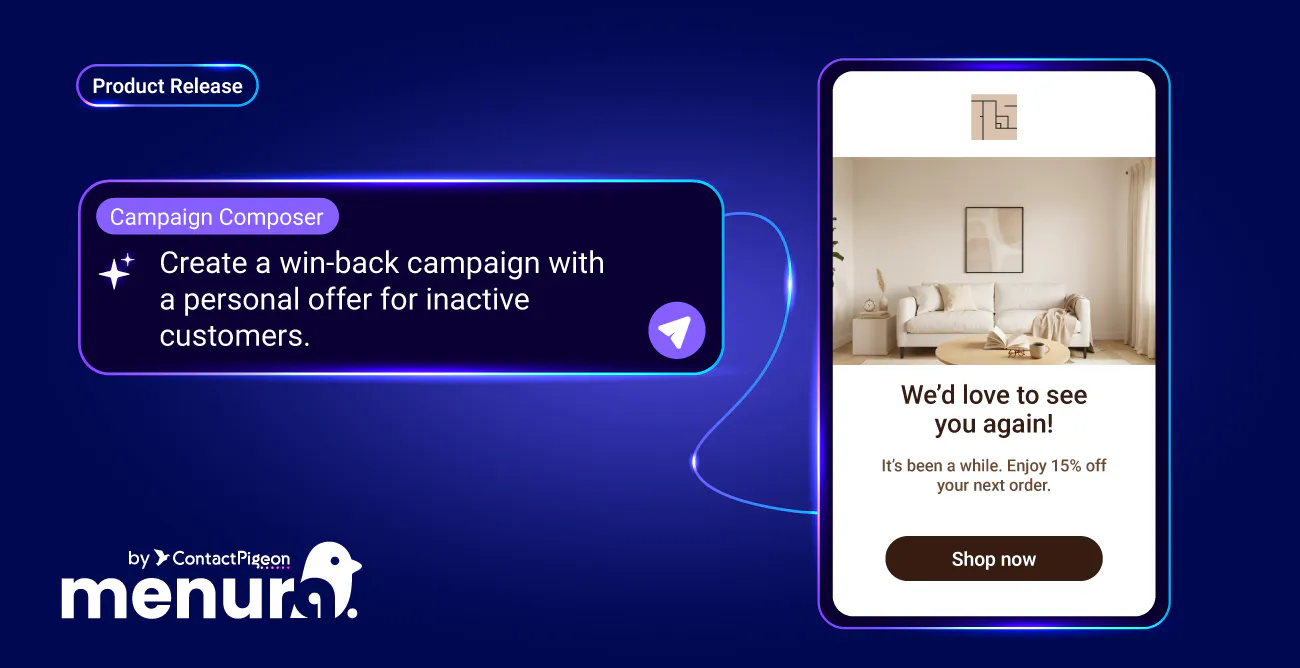
When the immediate job is helping shoppers find and compare products, a retail team can evaluate an existing assistant against its own catalog. Menura AI Retail Assistant supports guided discovery and can pass a conversation to a colleague with its context. Ask it to compare products with incomplete sizing information, then follow the handoff. That shows merchandising and support where their work begins.
As the team reviews ContactPigeon’s platform capabilities, it can identify which connections it already uses. IT can use the ContactPigeon Trust Center to prepare questions about data access and retention for the specific deployment.
Build when a proprietary decision shapes the customer experience
Consider a retailer that keeps its last spare part for a customer with a repair booked tomorrow. That decision protects a service the customer has already paid for. If the retailer changes those rules often, owning that part of the agent can be worth the engineering time. The case for building is stronger when the same team can support those rules through peak trading.
Walmart’s introduction of Sparky illustrates a different reason to invest in the shopper experience. The assistant helps customers compare products using reviews and find items for an occasion. The sourcing question for another retailer is which knowledge of its own assortment or customers could make that experience distinctive enough to warrant ongoing investment.
Choose hybrid when the boundary can be tested
For store collection, the retailer could keep its existing reservation service and buy the conversation that guides shoppers to it. Checkout would still confirm the hold. If a customer data platform supplies shopper context, the retailer and supplier also need to agree which fields the assistant can see and what it should do if a lookup fails.
Which risks belong in the pilot risk register?
A pilot gives store teams a chance to find out which promises they can safely make to shoppers. For each of the three cases below, the retailer needs someone who can spot the problem, someone who can fix it and a way to check that the next shopper gets the right answer.
Stale inventory. A shopper travels for an item that has been sold. The inventory owner sets a freshness limit and tests that collection promises stop when the feed exceeds it.
Unconfirmed reservation. A timeout leaves the shopper unsure whether the hold succeeded. The checkout owner tests that the assistant can retrieve the outcome before offering to try again.
Changed answers after an update. A new release describes unavailable items as ready to collect. The retail product owner replays approved shopper questions and rehearses disabling the affected action. The guide to stress-testing retail AI agents covers further peak-trading scenarios.
How do you explain your recommendation on whether to build vs buy AI agents?
The committee can now explain why a route fits, who will run it and what evidence could reverse the choice. A short decision memo gives finance, engineering and store operations the same basis for signing off. Here is an illustrative memo for the collection pilot.
Decision and owners. Pilot a hybrid collection service. Retail engineering owns the stock lookup, the supplier runs the conversation and checkout confirms the reservation.
Reason and assumption. A full build would divert engineers from checkout. The packaged option tested could only display stock. The pilot depends on reliable inventory timestamps at each participating store.
Rollout gate. Store operations must trace each collection promise in the test set to a confirmed hold. After the pilot, the eCommerce director will review completed reservations alongside failed pickups and decide whether to expand.
When to reconsider. Pause if the agent promises an unconfirmed hold. Reopen sourcing if a supplier can verify reservations directly or support demand exceeds the capacity retail IT agreed to provide.
Run the build-vs-buy assessment
Before approving the pilot, bring the people responsible for inventory, checkout and store operations into the same conversation. Their answers to these four questions will tell you whether the first store is ready and which commitments still need an owner.
- Scope: Can everyone name the shopper action and the system that confirms it?
- People: Have the delivery and support owners committed capacity through peak trading?
- Evidence: Has each team tested the same failure cases and recorded the gaps?
- Decision: Has the sponsor agreed what would justify rollout, a pause or a different route?
Complete the weighted scorecard above with those answers in hand. If a purchased platform is on the shortlist, bring your hardest unresolved case to a ContactPigeon walkthrough and ask to see how the team would handle it.
Frequently asked questions about sourcing retail AI agents
When does building a retail AI agent make sense?
Build when ownership lets you change a commercially important decision, such as allocation or service eligibility, and a funded team can operate it. Ask the sponsor to identify one change the business expects to make independently and explain what customers gain from it.
What can a hybrid retail AI deployment look like?
A retailer can buy product discovery and retain its own pricing or loyalty decision service. Document the request, permitted response, timeout behavior and accountable owner on each side. That gives both teams a practical way to test the arrangement before involving customers.
Which costs are easy to miss when deciding whether to build vs buy AI agents?
Include catalog corrections, evaluation after model or policy changes, incident investigation, store follow-up and time spent maintaining connectors. Apply the same demand assumptions and support hours to every option. The retail AI agent total cost of ownership model breaks down the cost comparison for finance teams.
How should a retailer compare AI agent vendors?
Use the same catalog sample, shopper tasks and exception cases for every supplier. Ask retail operations to grade the outcomes and IT to verify permissions, logs and recovery. Record what the vendor demonstrated, what requires configuration and what depends on future delivery.
How can a retailer tell whether an AI agent is ready for more stores?
Start with what happened to shoppers in the pilot. For store pickup, compare completed reservations and failed pickups with the store’s usual figures. If more shoppers reserved an item but more also left empty-handed, find out why before expanding. Check that the next stores have the stock data and staff cover that made the pilot work.
What should a retailer be able to take with it if it switches AI suppliers?
Ask for a sample export before signing. Give it to the team that would handle a move and ask whether they can recover the approved product answers, the rules for handing a shopper over to a colleague, and the test questions used to check updates. Anything they would have to recreate belongs in the cost of switching.