“How much does a retail AI agent cost?” sounds like a straightforward procurement question. In practice, the software price is only one part of the answer. For enterprise retailers, retail AI agent cost extends across implementation, data preparation, integrations, AI consumption, governance, monitoring, optimization, and the internal teams responsible for keeping the system useful after launch. This distinction becomes particularly important as AI agents move from isolated experiments into production. McKinsey reported in 2026 that enterprise AI spending increased almost fourfold as organizations moved toward broader adoption, while 93% of respondents to its Enterprise AI FinOps survey said they had exceeded their AI budgets.
The issue is not simply that AI is expensive. It is that different solutions place costs in different parts of the organization. A platform may have a higher visible license but require less custom infrastructure. Another option may appear inexpensive at procurement but demand substantial work from engineering, data, and operations teams. A third may rely heavily on consumption-based model costs that increase as adoption grows. For a buying committee, the useful question is therefore: What will it cost to implement, operate, and continuously improve this AI agent at the level of reliability, relevance and control our retail business requires? That is a total cost of ownership question.
What is the total cost of ownership of a retail AI agent?
The total cost of ownership (TCO) of a retail AI agent is the combined cost of acquiring, implementing, integrating, operating, governing, and maintaining the agent over a defined period.
A practical enterprise model should include at least:
- Software and platform costs
- AI model and usage costs
- Data preparation
- Integrations
- Initial implementation
- Security and governance
- Testing and quality assurance
- Monitoring
- Continuous optimization
- Internal personnel
- Support and maintenance
- Change management
This goes beyond the traditional question of license price. IBM similarly identifies model consumption, infrastructure, licensing, data pipelines, and technical talent as separate components of enterprise AI TCO.
For retail specifically, the model should also account for the environment in which the agent operates, including product catalogs, inventory, customer profiles, promotions, ecommerce platforms, order systems, ERP environments, and customer-service workflows. The more systems an agent must understand or act upon, the more important this wider cost model becomes.
Why retail AI agent pricing is difficult to compare
Enterprise AI agents do not follow one standard pricing model. Providers may charge through platform subscriptions, usage-based fees, implementation costs, support packages, or a combination of these. Custom deployments can also shift more of the cost toward internal engineering and infrastructure.
That means headline prices can be misleading. The biggest differences usually come from three areas:
- AI usage: Deloitte notes that enterprises increasingly combine SaaS products, APIs, and self-hosted infrastructure, all with different cost structures. A simple product-information request may require relatively little processing, while workflows involving retrieval, recommendations, and actions across multiple systems can cost more as usage scales.
- Implementation responsibility: Vendors differ in how much work they expect the retailer to handle. This can include ecommerce and ERP integrations, product-data mapping, customer-data access, testing, escalation workflows, and ongoing maintenance. Any work left to internal teams should be included in the TCO calculation.
- Governance requirements: An agent that only recommends products needs different controls from one that can modify orders, issue offers, or take customer-facing actions. Gartner recommends governance proportional to what an agent can access and the actions it is allowed to take, with more autonomous agents requiring stronger monitoring, auditability, and guardrails.
What should be included in retail AI agent TCO?
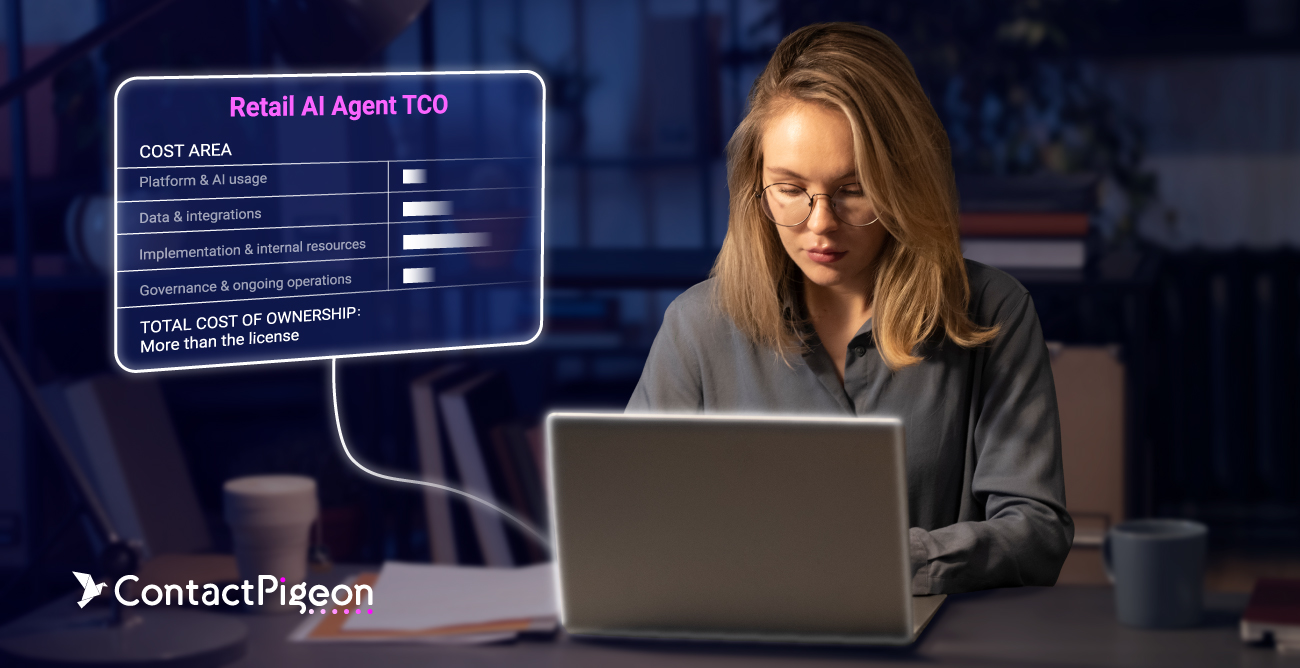
A useful TCO model separates costs into categories so that every solution can be evaluated against the same structure. The advantage of this taxonomy is that it makes proposals comparable. Instead of asking Vendor A and Vendor B for “the price,” procurement can ask both parties how each of these categories is handled.
The hidden retail AI costs that are easy to underestimate
Some expenditure is visible immediately. The contract price appears on the proposal, but the internal effort often does not, creating several common blind spots.
1. Product data preparation
A retail AI agent cannot make reliable recommendations from a catalog it cannot interpret. Retailers may have thousands or millions of SKUs with information distributed across titles, descriptions, categories, specifications, images, inventory systems and supplier feeds.
The agent must identify which attributes matter, find the relevant information, and understand how those attributes relate to the customer’s request. That can expose gaps in existing catalog structure.
A retailer evaluating AI should therefore ask: How much data preparation is required before this agent can answer the questions our customers actually ask? This should be priced into the implementation rather than discovered afterwards.
2. Integrating the systems behind the conversation
A useful retail agent rarely operates against one source. A shopping assistant may require product information, inventory and customer context. Order-support functionality may need access to the OMS. Personalization may depend on CDP data. Promotions may live elsewhere again.
As agents become more capable, the surrounding infrastructure becomes increasingly important. McKinsey argues that scaling agentic AI requires governed data foundations that agents can reliably interpret and reuse across enterprise systems.
The relevant TCO question is not therefore simply if it integrates with an ecommerce platform, but which systems need to participate in the use case, how will they be connected, and who is responsible for maintaining those connections.
3. Governance and control
Governance becomes an operating expense when AI moves into production. The organization may need to define:
- What information the agent can access
- Which customer information it can use
- What actions it can perform
- When human approval is required
- What happens when confidence is low
- How conversations and actions are logged
- How exceptions are escalated
- Who owns incidents
- How changes to the agent are approved
These requirements intensify as autonomy increases. Deloitte’s 2026 research found that only 21% of surveyed enterprises reported having mature agentic-AI governance in place, despite expectations that AI-agent adoption will expand considerably through 2027. Retrofitting these controls later can require additional technical and operational work.
4. Monitoring after deployment
Launching the agent is not the end of the implementation. Retail conditions continuously change. Therefore, the agent needs ongoing monitoring across both technical and commercial performance.
That may include:
- Response quality
- Failed conversations
- Escalations
- Customer intent
- Conversion behavior
- Commercial outcomes
- API or integration failures
- Policy violations
- Incorrect recommendations
- Unusual cost patterns
5. Continuous optimization
A retail agent should improve as teams learn what customers ask and where conversations struggle. Consider a retailer launching an AI shopping assistant before Black Friday.
During the first weeks, customers may reveal that they frequently need:
- comparisons between similar products,
- clarification about delivery deadlines,
- sizing assistance,
- gift recommendations,
- bundle suggestions,
- or help understanding promotional rules.
Those conversations create opportunities to improve the agent. If nobody is responsible for reviewing and acting on that information, the technology can remain technically operational while delivering below its commercial potential. Optimization therefore carries a cost, whether it is handled by the vendor, the retailer or both.
The operational view: Where TCO appears after the contract is signed
“The biggest cost differences usually appear after the software decision has been made. Data quality, integrations, testing, monitoring, and ongoing optimization determine how much operational effort an AI agent actually requires. Retailers should look at what their teams will need to build, maintain, and manage over time, because that is where a large part of the total cost of ownership sits.”
— Charalampos Nikas, COO & co-founder, ContactPigeon
This operational perspective is important because AI costs do not remain static once a system reaches production. McKinsey’s 2026 research on enterprise AI spending found that cost visibility becomes increasingly difficult as adoption expands across applications, teams, and workflows. A realistic TCO model should therefore include both initial deployment costs and the resources required to keep the agent commercially useful over time.
The retail AI agent TCO formula
A useful starting point is a 3-year retail AI agent TCO.
Platform and AI usage
- Implementation
- Data preparation
- Integrations
- Governance and security
- Testing and QA
- Internal personnel
- Monitoring
- Optimization
- Support and maintenance
- Change management
Each category should then be split into:
- One-time costs
- Recurring fixed costs
- Usage-dependent costs
- Internal resource costs
This matters because the cost profile changes over time.
Year 1: Implementation-heavy
The first year will commonly include more expenditure associated with:
- Data preparation
- Integration
- Configuration
- Governance design
- Testing
- Team training
- Initial workflow changes
Years 2–3: Operation-heavy
Once deployed, cost moves toward:
- AI consumption
- Monitoring
- Integration maintenance
- Optimization
- Support
- Internal management
- New use cases
This is why a three-year view is generally more useful than comparing first-year vendor quotes.
A practical TCO worksheet for buying committees
Before comparing providers, build one common model. Make sure that the numbers are not populated from generic industry averages, but from the retailer’s actual environment and vendor proposals. That produces a model that finance can challenge, procurement can compare and operational teams can validate.
.
Build vs. buy: Where the TCO moves
A build strategy can make sense when the capability is sufficiently differentiated, the organization has the required technical resources, and retaining deep control over the architecture creates meaningful value.
Buying can make more sense when a specialist platform already provides the capabilities the retailer needs, avoiding unnecessary custom development. The decision should be based on the total cost of building, running, and maintaining the required capabilities over time.
How ContactPigeon approaches retail AI TCO
Menura AI is designed specifically around retail environments, where useful AI depends on more than a conversational interface.
A retail agent may need to understand:
- Product catalogs
- Detailed product attributes
- Customer profiles
- Behavioral data
- Inventory
- Orders
- Promotions
- Ecommerce workflows
- Customer-service information
Your existing retail infrastructure can change the TCO equation
For retailers already using ContactPigeon, Menura AI can work with existing customer data, product information, integrations, analytics, and engagement infrastructure. That can reduce the amount of new technology that needs to be built solely for the AI implementation and gives retailers a more realistic view of total cost based on their actual architecture.
Explore Menura AIWhat should retailers ask AI agent vendors before comparing price?
Buying committees can make proposals much easier to compare by asking every provider the same questions:
- What is included in the quoted platform price?
Clarify AI usage, integrations, analytics, support, monitoring, and optimization. - What work is required from our internal teams?
Estimate involvement from IT, data, ecommerce, CX, and other functions. - Which integrations already exist?
Separate native integrations from custom development. - What data preparation is required?
Review catalog quality, required attributes, and customer-data dependencies. - How does pricing change with adoption?
Model expected and high-usage scenarios. - Who owns monitoring and optimization after launch?
Determine what is handled by the provider and what remains internal. - What will we need to maintain ourselves?
This is often where the largest TCO differences appear.
Build your retail AI TCO model
If you are evaluating retail AI agents, we can help you map the costs against your actual environment, including your product data, ecommerce stack, integrations, customer data, operational requirements, and intended use cases.
Request a Menura AI TCO assessment and build the business case around what your implementation will actually require.