Beauty shoppers are rarely looking for just “a moisturizer” or “a lipstick.” They are looking for the right product for their skin type, shade, routine, budget, preferences, and desired results. That is what makes beauty retail such a strong fit for AI agents. Shoppers need guidance, not just more product options. Agentic commerce helps beauty retailers turn browsing into a more personal, helpful, and confidence-building experience. Acting like digital beauty advisors, AI agents can understand intent, ask the right questions, recommend relevant products, and support shoppers from discovery to purchase and beyond. In this article, we’ll explore how AI agents are changing beauty retail, the most practical AI agent use cases for beauty, and the best practices brands can use to turn AI-powered guidance into better customer experiences and stronger results.
AI agents are becoming digital beauty advisors, helping shoppers move from product overload to more confident decisions.
Beauty retail is a natural fit for AI agents because shoppers often need guidance around skin type, shade, ingredients, routines, preferences, and product suitability.
The most valuable AI agent use cases for beauty retailers include guided product discovery, skincare routine building, shade matching, cart recovery, replenishment, post-purchase education, and loyalty personalization.
Successful AI agents depend on clean product data, including category, ingredients, skin concern, shade, finish, texture, usage instructions, reviews, stock availability, and similar products.
ContactPigeon and Menura AI help beauty retailers connect smarter product discovery with omnichannel personalization, automation, and customer engagement.
What are AI agents in beauty retail?
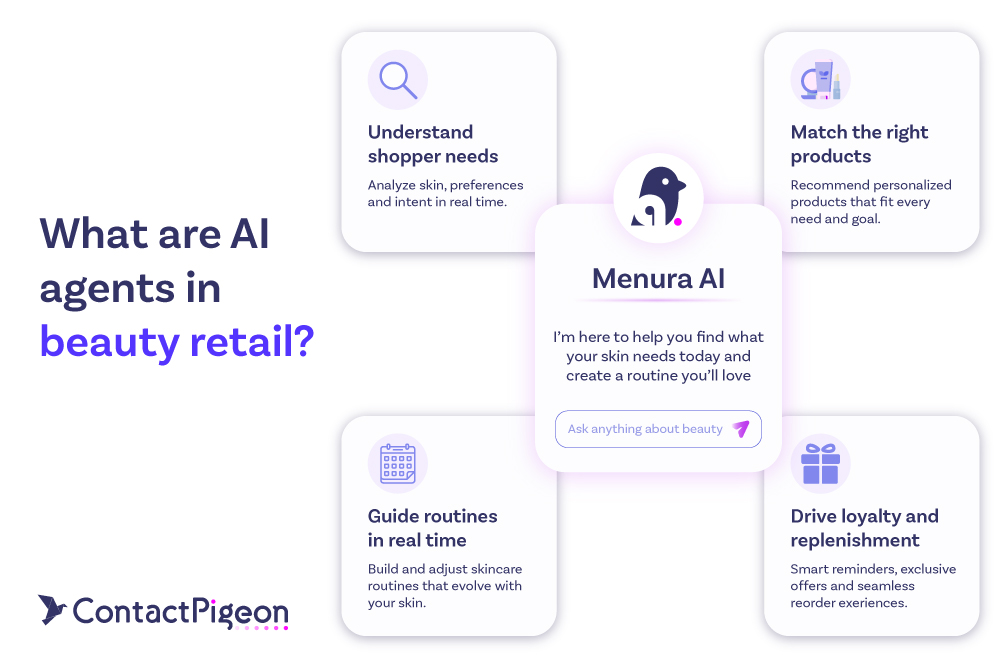
AI agents in beauty retail are intelligent digital assistants that help shoppers discover, compare, and choose products based on their needs, preferences, and real-time intent. Unlike basic chatbots that usually follow scripted flows or answer FAQs, AI agents can guide more complex shopping journeys, ask follow-up questions, and make personalized product recommendations.
Why beauty retail is a natural fit for AI agents
Beauty is a high-consideration category. Shoppers often need advice, reassurance, education, and comparison before they feel ready to buy. AI agents can help retailers provide that guidance at scale.
Beauty decisions are highly personal
Beauty products are tied to skin type, skin tone, hair texture, sensitivities, lifestyle, preferences, and confidence. What works for one shopper may not work for another. An AI beauty advisor can ask targeted questions and narrow down the options based on what the customer actually needs. Instead of showing dozens of moisturizers, an AI agent can identify products with a lightweight texture, hydrating ingredients, a non-greasy finish, and makeup-friendly wear.
Choice overload creates hesitation
Large catalogs with similar-looking products at first glance make the experience feel overwhelming. A shopper may compare multiple serums, foundations, cleansers, or fragrances without knowing which one is the right fit.
More choice does not always create confidence. Often, it creates doubt. AI agents can simplify the journey by turning a large catalog into a guided shortlist. Instead of making shoppers evaluate every option, they can recommend a few relevant products and explain why each one fits.
Beauty shoppers need trust and education, not just promotion
In beauty retail, many shoppers are not only deciding what to buy. They are also trying to understand how products work, when to use them, how to combine them, and what results to expect.
This is especially important in categories like skincare, haircare, makeup, and fragrance. A customer may want to know whether a serum fits into their current routine, whether a product is suitable for sensitive skin, how to layer ingredients, or how to choose between two similar formulas.
AI agents can act as product education layers inside the shopping journey. They can answer questions in plain language, simplify complex product information, compare alternatives, and help customers understand the role of each product before they buy.
Beauty has strong repeat-purchase potential
Consumers may take time to choose a product, but once they find something that works, they often come back. They repurchase favorites, build routines, try complementary products, and respond well to relevant recommendations.
That makes AI agents useful beyond the first purchase. They can help a new shopper choose a cleanser, suggest a serum to an existing customer, send replenishment reminders, or recommend a new launch based on previous purchases.
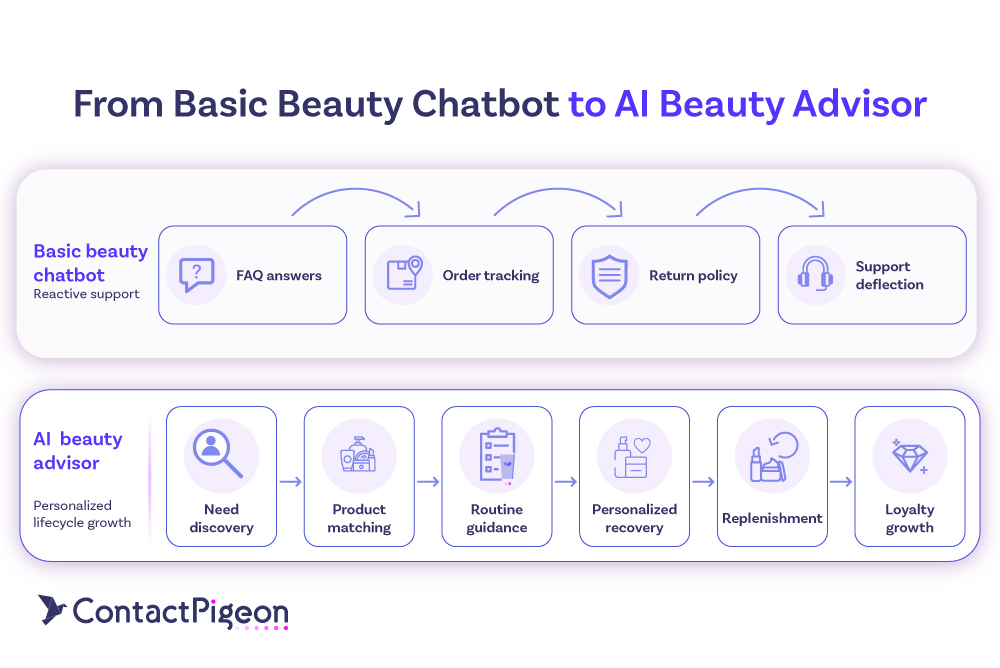
What changed: From beauty chatbots to AI beauty advisors
For years, chatbots in retail were mostly used as support tools. They helped customers track orders, check return policies, find store information, or get answers to common questions. These use cases were useful, but they were usually separate from the core shopping experience.
AI beauty advisors represent a shift in both technology and purpose. Instead of simply reacting to customer questions, they can actively support product discovery, decision-making, personalization, and post-purchase engagement. They can help a shopper understand what they need, compare products, build a routine, recover from hesitation, and return for the next purchase.
Top 10 AI agent use cases for beauty retailers
The most valuable AI agent use cases for beauty retailers are those that reduce uncertainty, guide product decisions, and connect shopper intent to relevant next steps. Each use case works best when the agent is connected to rich product data, including skin type, texture, finish, ingredients, fragrance-free claims, price, reviews, and availability.
1. Guided product discovery
Beauty shoppers often know what they want to achieve, but not which product to choose. An AI agent can ask about skin type, concerns, current products, budget, and preferences, then narrow a large catalog into a relevant shortlist.
2. Skincare routine building
Beauty shoppers often do not need one product but a routine that makes sense.
3. Shade matching and product compatibility
Shade selection is one of the most difficult parts of online beauty shopping. AI agents can support shade guidance by using product data, customer preferences, previous purchases, quiz answers, virtual try-on inputs, and customer feedback.
4. Ingredient and suitability guidance
Beauty shoppers increasingly care about ingredients, allergens, sensitivities, product claims, and transparency. An AI agent can make this information easier to understand.
5. AI-powered beauty advisor for gift shopping
Beauty gifts are hard to choose because the buyer may not know the recipient’s shade, skin type, routine, or preferences.
6. Cart recovery with personalized reassurance
Many beauty shoppers abandon carts because they are unsure, not because they are uninterested. AI agents can help recover that hesitation with useful, personalized follow-ups.
7. Replenishment and subscription nudges
Beauty products often have natural replenishment cycles. AI agents can identify when a customer may be ready to reorder based on product type, purchase date, usage frequency, and behavior
8. Post-purchase education
The beauty experience does not end at checkout. Customers still need to know how to use products correctly and how to fit them into their routine.
9. Loyalty and VIP personalization
AI agents can make loyalty programs feel more personal by recommending products based on tier, purchase history, preferences, and predicted next need.
10. Customer service and product Q&A
AI agents can answer product, delivery, return, stock, and usage questions without pulling shoppers away from the buying journey.
The beauty AI agent journey matrix
Best practices for beauty retailers implementing AI agents
AI agents can create real value in beauty retail, but only when they are tied to clear use cases, reliable data, and thoughtful customer experience rules. Understanding agentic commerce consumer adoption can help retailers identify where shoppers need AI guidance and where its impact can be measured. To get the most value from these AI agent use cases for beauty retailers, brands need more than a conversational interface. They need clean product data, responsible customer data use, explainable recommendations, and clear performance metrics.
Start with high-intent use cases
Beauty retailers should begin with use cases that sit close to purchase intent or repeat-purchase behavior. These are easier to launch, easier to measure, and more likely to create commercial value. Strong starting points include guided product discovery, skincare routine building, cart recovery, replenishment reminders, customer service, and loyalty personalization. These use cases are more useful than trying to apply “AI for everything.” They solve clear shopper problems and connect directly to engagement, conversion, retention, and customer lifetime value.
Connect the agent to clean product data
An AI beauty advisor is only as useful as the product data behind it. If the data is incomplete, vague, or outdated, recommendations will feel generic or unreliable. For beauty retailers, product data should include category, ingredients, skin type, skin concern, shade, finish, texture, fragrance notes, usage instructions, approved claims, stock availability, price, reviews, bundles, and similar products. The richer the product data, the better the agent can explain why a product fits the shopper’s needs.
Use customer data responsibly
Customer data can make AI recommendations more relevant, but beauty is personal. Retailers should be transparent about how data is used and careful with sensitive information related to skin, appearance, preferences, and self-image. Personalization should feel helpful, not invasive. A strong AI agent uses customer signals to improve the experience while giving shoppers transparency, control, and confidence.
Keep recommendations explainable
Instead of saying, “We recommend this moisturizer,” the agent should explain the reason behind the recommendation. This turns a product recommendation into a confidence-building moment. It also makes the experience feel more consultative and less transactional.
For example:
“This moisturizer is a good match because it is lightweight, fragrance-free, and designed for oily skin.”
Design for accessibility and inclusion
AI agents should not assume every shopper interacts in the same way. Some customers may prefer short answers, while others may need more guidance. Some may rely on screen readers, simplified language, voice input, or clearer navigation. Beauty retailers should design AI experiences that are easy to understand, inclusive, and accessible across different needs, abilities, and levels of digital confidence. This means clear language, readable layouts, transparent choices, and alternative ways to move through the shopping journey.
Measure more than clicks
Clicks can show interest, but they do not show whether the AI agent helped the shopper make a better decision. The strongest AI agent strategies are measured by how well they reduce uncertainty, improve product confidence, and move shoppers toward the next best action.
Useful KPIs include:
- product discovery engagement
- AI-assisted conversion rate
- add-to-cart rate after AI interaction
- cart recovery conversion
- average order value
- repeat purchase rate
- replenishment rate
- customer satisfaction
- return rate
- product recommendation acceptance rate
- and revenue influenced by AI-assisted journeys
How ContactPigeon and Menura AI support smarter beauty product discovery
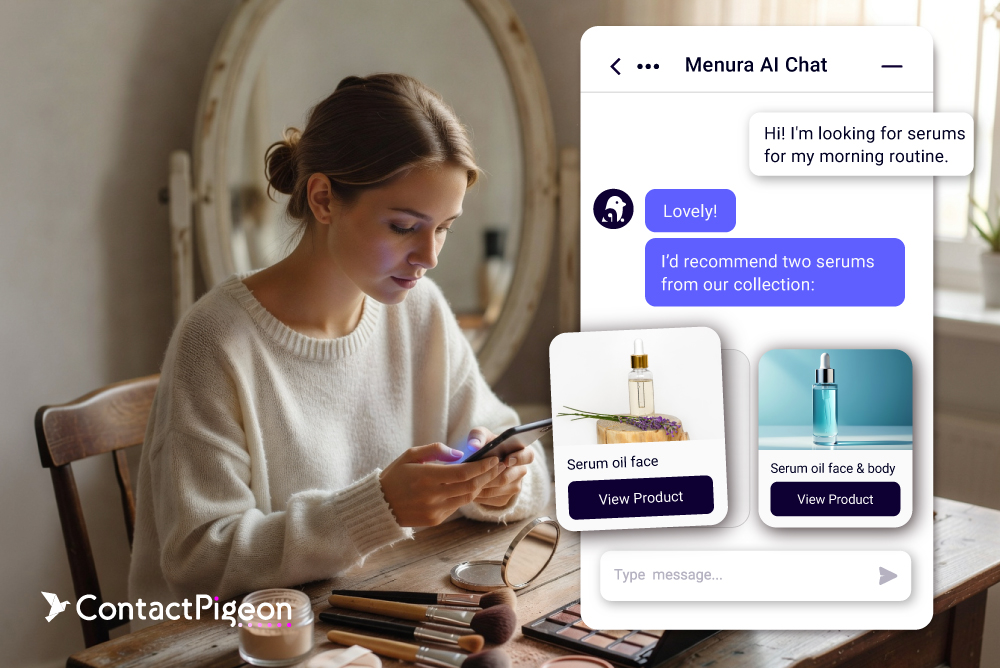
For beauty retailers, AI agents become more powerful when they are connected to real customer behavior, product data, and omnichannel activation. ContactPigeon helps beauty brands turn shopper signals into more relevant journeys across email, SMS, push notifications, onsite messages, and automation flows. Instead of treating product discovery as a one-time website interaction, retailers can connect it with the full retail customer journey, from first visit to repeat purchase.
With Menura AI, beauty retailers can offer a more guided discovery experience. Shoppers can ask questions, explain what they need, compare products, and receive more relevant recommendations conversationally. The value is not only better recommendations. It is a better context. When AI-powered discovery connects with segmentation, autonomous activation, and customer engagement, retailers can continue the conversation after the first interaction through personalized cart recovery, replenishment reminders, post-purchase education, and loyalty campaigns.
What are AI agents in beauty retail?
AI agents in beauty retail are digital assistants that help shoppers discover, compare, and choose beauty products based on their needs, preferences, behavior, and shopping intent. Unlike basic chatbots, they can support more complex journeys such as product discovery, routine building, cart recovery, and post-purchase education.
How are AI agents different from beauty chatbots?
Basic beauty chatbots usually answer FAQs, track orders, or share return information. AI agents play a more active role in the shopping journey by asking follow-up questions, understanding customer needs, recommending products, and explaining why those products fit.
What are the best AI agent use cases for beauty retailers?
The most practical AI agent use cases for beauty retailers include guided product discovery, skincare routine building, shade matching, ingredient guidance, gift shopping, personalized cart recovery, replenishment reminders, post-purchase education, loyalty personalization, and customer service.
Can AI agents reduce cart abandonment in beauty ecommerce?
Yes. Many beauty shoppers abandon carts because they feel unsure about shade, suitability, ingredients, reviews, or whether the product fits their routine. AI agents can reduce that uncertainty with personalized reassurance, comparison support, shade guidance, reviews, and relevant follow-up messages.
What data do beauty retailers need before launching an AI agent?
Beauty retailers should prepare clean product data, including category, ingredients, skin type, concern, shade, finish, texture, fragrance notes, usage instructions, claims, price, reviews, stock availability, bundles, and similar products. Customer data such as browsing behavior, purchase history, preferences, and loyalty tier can also improve personalization when used responsibly.
Final thoughts
Trustworthy AI agents are changing beauty retail because they solve one of the category’s biggest challenges: helping shoppers choose with confidence. Beauty customers need guidance that feels personal, useful, and easy to act on. AI agents can support that need by acting as digital beauty advisors across discovery, conversion, and loyalty. For beauty retailers, the next step is using AI in ways that can remove friction, guide decisions, and create more relevant customer experiences. As these AI agent use cases for beauty retailers mature, the biggest opportunity will not be automation alone. It will help shoppers feel understood, supported, and confident at every step of the journey.
Ready to turn beauty product discovery into a smarter, more personalized shopping experience?
Discover how ContactPigeon and Menura AI can help your beauty retail team guide shoppers from browsing to confident buying.