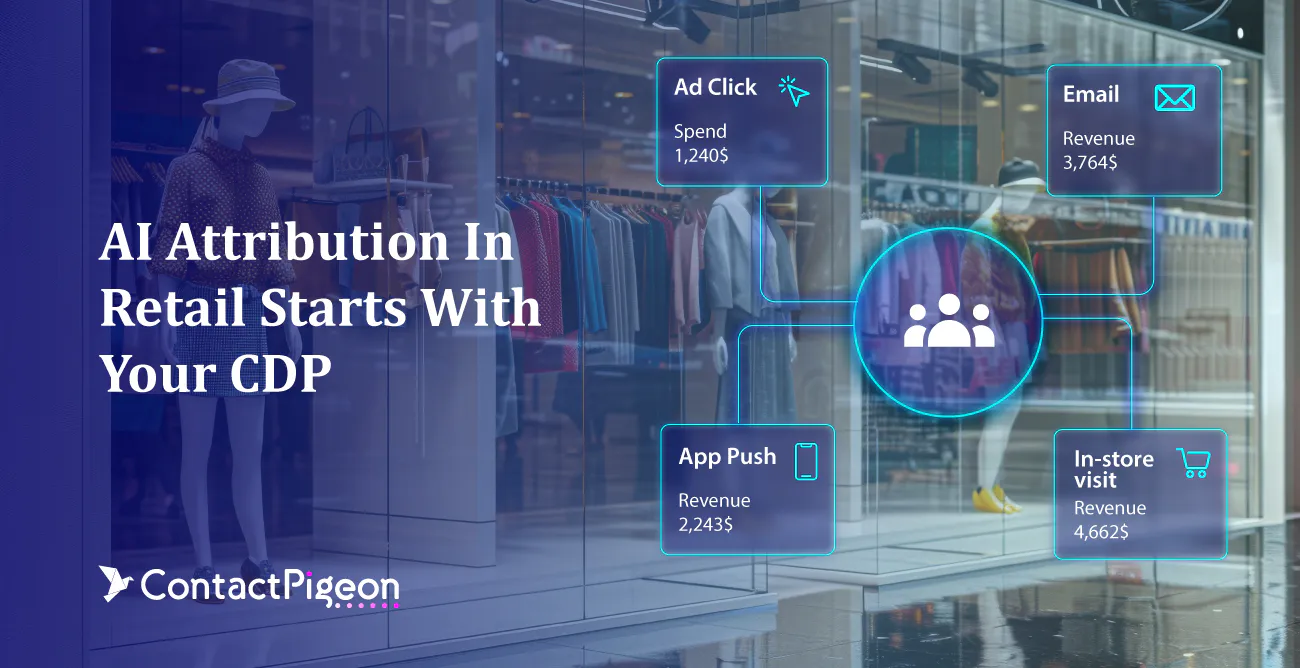
Retailers are adopting agentic commerce across more parts of the customer journey, from predictive segments and paid media audiences to AI shopping assistants, product recommendations, and lifecycle automation. But many teams are still measuring performance with attribution models built for a simpler world. That is why AI attribution in retail needs to start with the CDP.
AI makes every customer journey more dynamic, more personalized, and less linear. A shopper may discover a product through an AI recommendation, compare it later through search, receive an abandoned-cart email, return through a paid ad, and complete the purchase after an on-site prompt. Last-click reporting may credit only one touchpoint, while ignoring the customer signals and AI-driven decisions that influenced the full journey. To measure these journeys properly, retailers need to understand what AI attribution means, where traditional models fall short, and why connected customer data is now the foundation for better measurement.
What is AI attribution in retail?
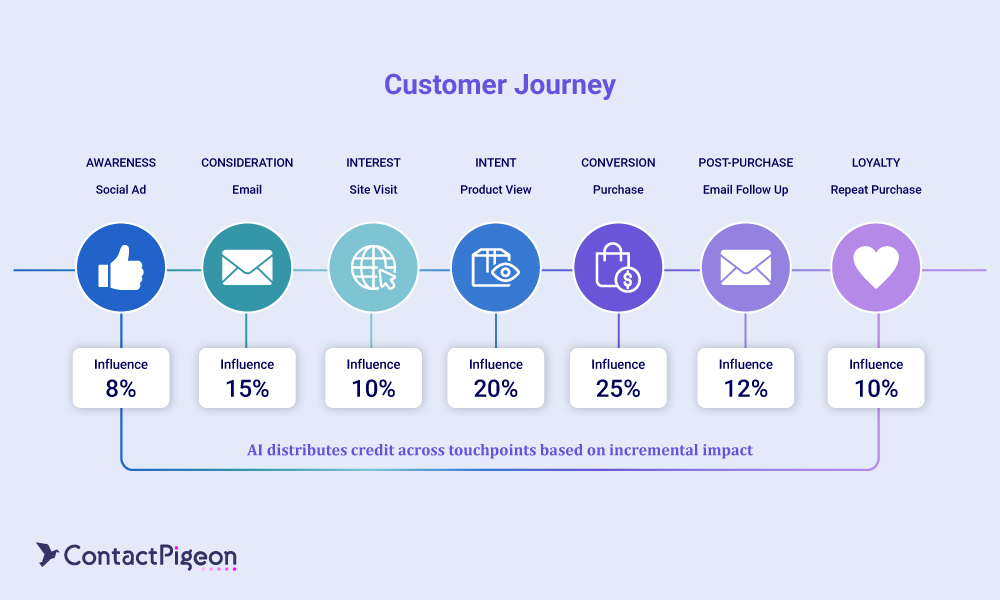
AI attribution in retail is the process of measuring how AI-driven touchpoints, predictions, recommendations, campaigns, and customer interactions contribute to outcomes such as conversions, revenue, retention, and customer lifetime value.
It goes beyond traditional channel attribution because AI does not always behave like a single channel. In many retail journeys, agentic vs conversational commerce illustrates how AI can work behind the scenes as a decisioning layer. It may determine which customer enters a journey, which product is recommended, which message is triggered, which offer is shown, which audience is synced to paid media, or which next-best action is selected.
That makes measurement more complex. A recommendation may influence a product view without creating an immediate sale. A predictive segment may improve campaign timing. An AI assistant may help a shopper narrow their options before they return later through another channel. In each case, the AI-driven action contributes to the journey, even if it is not the final click before purchase.
Why last-click attribution breaks in AI-driven retail journeys
Traditional models were built for simpler journeys
Traditional attribution was designed around clearer paths, where a shopper clicked an ad, visited a website, and converted within a relatively straightforward flow. That model already had limitations, but AI-driven retail journeys make those limitations harder to ignore.
Today, the path to purchase is rarely linear. A shopper may move across email, onsite recommendations, paid media, push notifications, search, and AI-assisted product discovery before making a decision. Each interaction creates a signal, but not every signal leads to an immediate conversion.
AI influences more than the final click
In retail, AI can shape the product a shopper sees, the message they receive, the audience they enter, the offer they qualify for, and the follow-up they get after leaving the website. This means AI may influence the journey long before the final click happens.
For example, a shopper may click a product recommendation in an email, browse similar items onsite, receive a price-drop push notification, see a retargeting ad, use an AI assistant to compare products, and later purchase through direct traffic. In a last-click model, that sale may appear as “direct revenue.” In reality, it was an assisted AI-driven journey.
Retailers need to measure movement, not just conversion source
Last-click attribution can show where the customer came from at the end, but it cannot explain what created intent, reduced hesitation, or helped the shopper make a decision. For retailers investing in AI-powered personalization, recommendations, automations, and customer journey orchestration, this creates a serious measurement gap.
AI attribution vs traditional attribution vs incrementality vs MMM
To measure AI-driven journeys more accurately, retailers need to separate concepts that are often grouped together: attribution, AI attribution, incrementality, and marketing mix modeling. They are connected, but they do not answer the same business question.
The key distinction is simple: attribution shows influence, while incrementality helps prove lift. Attribution may show that an AI-powered recommendation appeared in many converting journeys. Incrementality testing can help determine whether those recommendations created additional revenue or simply received credit for purchases that would have happened anyway.
Why AI attribution starts with connected CDP data
Use up and down arrow keys to resize the meta box pane.
A CDP gives AI attribution the one thing it needs most: connected customer context. Before a retailer can measure how AI influenced a sale, it needs to connect the customer, the interaction, the product, the campaign, and the outcome. That is why a retail CDP should not be seen only as a segmentation tool. It becomes the measurement layer that helps retailers understand how AI-driven journeys actually unfold.
Without that foundation, performance data stays fragmented. Email reports one number, paid media reports another, ecommerce analytics shows a different view, and AI-powered recommendations or assistants may sit outside the attribution model completely.
How a CDP turns attribution into a learning loop
Once the right data is connected, a CDP can help retailers turn attribution into an operational loop. Instead of reporting on performance after the fact, the CDP connects customer signals, campaign actions, AI decisions, and revenue outcomes.
What retailers should measure beyond last-click revenue
Last-click revenue is useful, but it is not enough to understand AI-driven retail performance. AI can support product discovery, improve timing, reduce hesitation, increase order value, reactivate customers, and influence repeat purchases. Retailers need KPIs that reflect that broader impact.
Why attribution should not pretend to be perfect
Not every customer action can be measured perfectly. Several reasons, such as privacy changes, offline behavior, and AI-assisted discovery, can create blind spots. Even with a strong CDP, retailers should avoid treating attribution as a perfect record of reality.
That is why AI attribution needs a blended measurement approach. Deterministic measurement helps retailers track known events, logged-in customer activity, campaign engagement, and purchases. Attribution modeling helps estimate the influence of multiple touchpoints when customers interact with several campaigns, channels, recommendations, or AI-driven actions before converting.
Incrementality testing, holdout groups, and cohort analysis then help validate what attribution suggests. Attribution may show that an AI-driven action appeared in a converting journey. Testing can help determine whether that action changed the outcome. The goal is not perfect certainty, but better decision-making.
Practical examples of AI attribution in retail
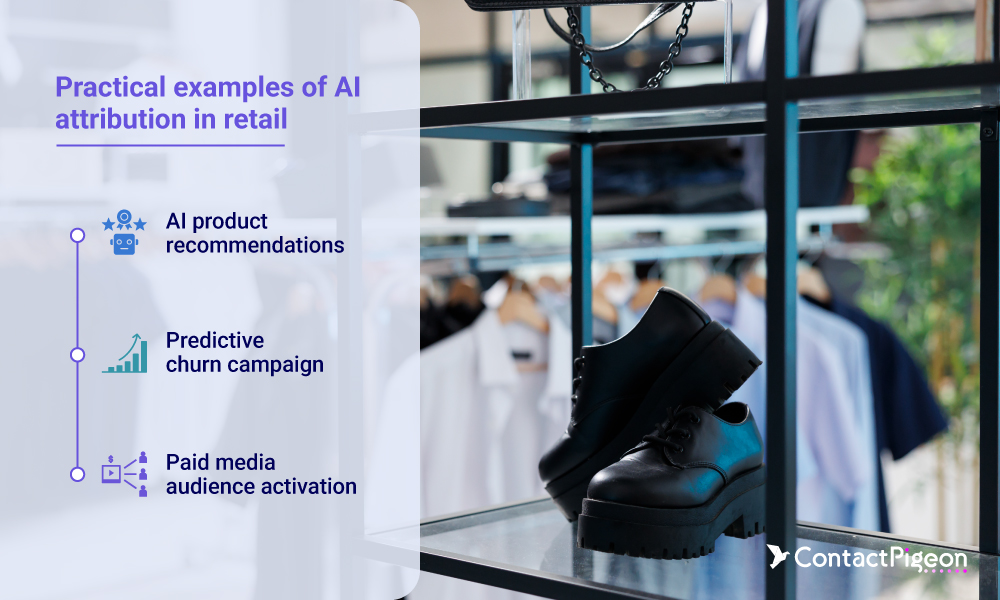
AI attribution becomes easier to understand when it is connected to real retail use cases. The goal is not to prove that one touchpoint did everything. The goal is to understand how different AI-driven actions contributed to the journey and which outcomes they influenced.
AI product recommendations
A customer clicks on an AI-powered product recommendation but does not buy immediately. They return after a cart reminder and purchase two days later.
The retailer should measure the recommendation click, product view, add-to-cart event, cart reminder engagement, purchase, assisted revenue, AOV impact, and repeat purchase behavior. The recommendation may not be the final conversion source, but it helped create the product interest that later turned into revenue.
Predictive churn campaign
The CDP identifies customers with high churn risk. AI recommends a personalized win-back offer, and some customers purchase within seven days.
The retailer should measure churn-risk segment size, campaign engagement, reactivation rate, revenue recovered, discount cost, margin impact, and post-purchase retention. This helps show whether the campaign created meaningful recovery or simply discounted purchases that were likely to happen anyway.
Paid media audience activation
A retailer exports high-value CDP audiences into Google Ads or Meta. Customers return through paid ads and later convert through email.
The retailer should measure audience match rate, paid media engagement, email engagement after ad exposure, assisted revenue, repeat purchase rate, ROAS by segment, and incremental lift versus non-exposed customers. A CDP-powered audience may influence paid engagement, while email or onsite personalization completes the journey.
Common mistakes retailers make with AI attribution
AI attribution in retail can create better measurement, but only when retailers avoid the common traps that make performance look clearer than it really is.
Measuring AI like a channel
AI is often a decisioning layer, not a traffic source. It may influence email, onsite personalization, paid media audiences, recommendations, automations, and customer service.
Overvaluing the final click
The final click rarely explains what created intent. Final-click reporting can undervalue recommendations, triggered campaigns, product discovery experiences, and earlier engagement signals.
Ignoring profitability
Attributed revenue means less if it depends on heavy discounts, low margins, or high return risk. Retailers need to know whether AI influenced profitable growth, not only gross revenue.
Treating attribution as proof of lift
Attribution can show influence, but holdouts and incrementality testing are needed to understand whether the AI action created additional value. AI can help model performance, but humans still need to define the business rules, success metrics, attribution windows, testing approach, and guardrails.
How ContactPigeon helps retailers connect AI attribution with customer data
ContactPigeon helps retailers bring customer data, behavioral signals, campaign engagement, AI interaction data, and revenue outcomes into one connected environment. Instead of measuring AI-driven journeys through disconnected tools, retailers can understand how customers move across email, SMS, push notifications, onsite personalization, automations, recommendations, and paid media audiences.
With a retail CDP at the center, teams can create segments, activate campaigns, personalize journeys, and measure performance based on unified customer profiles. This makes AI attribution in retail more actionable because performance is connected back to the customer, not just the channel.
As AI shopping assistants and recommendation systems become part of the customer journey, retailers also need to measure how AI supports product discovery, decision confidence, and repeat engagement. Menura AI can support smarter AI-powered product discovery, while ContactPigeon helps connect those interactions to broader customer engagement and attribution workflows.
For retailers, the opportunity is not simply to give AI more credit. It is to build a measurement foundation that shows where AI adds value, where it needs optimization, and how it contributes to customer and revenue growth over time.
Conclusion
AI is making retail journeys more personalized, more dynamic, and harder to measure with old attribution models. Last-click reporting can still show where the final visit came from, but it cannot explain the customer signals, AI decisions, and assisted interactions that shaped the journey before purchase. That is why AI attribution in retail starts with the CDP. A connected customer data foundation helps retailers bring identity, behavior, product context, campaign engagement, AI interactions, and revenue outcomes into one measurable view.
For retailers, the goal is not simply to give AI more credit. It is to understand where AI adds value, where it needs optimization, and how it contributes to better journeys, stronger retention, and more profitable growth. If you are exploring how AI can improve product discovery, decision confidence, and customer journey measurement, Menura AI can help shoppers find the right products through more natural, relevant, and data-informed conversations.
Want to see how this could work for your retail business? Request a demo with our experts and discover how ContactPigeon can help you connect customer data, AI-powered discovery, and measurable revenue impact.