Online shopping was supposed to improve the customer experience and make buying easier. For most of the last decade, the industry’s answer to “how do we sell more” was “give shoppers more”: more products, more filters, more reviews, more promotions, more ways to pay, and more ways to get it delivered. What that’s produced instead, for a lot of shoppers, is decision fatigue in eCommerce.
That strategy worked, up to a point. Past it, more choice stopped feeling like freedom and started feeling like work. A single purchase can now involve comparing near-identical listings, reading conflicting reviews, weighing a delivery date against a discount code, and wondering whether a better option is sitting one tab over. None of that is a single hard decision, but dozens of small ones, back-to-back, and by the end of it, a lot of shoppers just leave.
That’s part of why generative AI tools have become a real shopping channel rather than a novelty. Adobe’s holiday 2025 data showed retail sites getting the largest year-over-year jump in AI-referred traffic of any industry it tracks, as shoppers used AI assistants to research products and compare options before ever landing on a retailer’s site.
For retailers, that shift is worth more attention than it’s getting. When an AI agent takes over AI product discovery and comparison work, it becomes the one deciding the products that even make the shortlist, which means staying visible now depends on supporting that decision, not just ranking for it. That’s the shift this piece is really about: what’s driving decision fatigue in eCommerce, why AI agents and delegated commerce are stepping into the gap, and what retailers need to have in place before their competitors figure it out first.
- Decision fatigue builds gradually. In eCommerce, it comes from dozens of small decisions stacking up rather than one difficult choice. It usually appears as an abandoned cart or a quiet exit instead of visible frustration.
- Shoppers are already outsourcing comparison work to AI. Retail sites saw the largest year-over-year increase in AI-referred traffic of any industry during the past holiday season.
- Delegated commerce goes beyond chat-based shopping. It allows shoppers to assign an agent specific tasks, such as creating a shortlist, comparing products, or monitoring restocks, rather than only asking questions.
- The shift is already underway. According to Salesforce, 75% of retailers say AI agents will be essential by 2026, while Capgemini found that 71% of consumers want generative AI integrated into their shopping experience.
- Retailers need to prepare their data and discovery experience. Visibility increasingly depends on whether an AI agent trusts the available product data enough to recommend an item. A practical starting point is to clean and enrich product data, connect it with a CDP, and build guided discovery flows for the categories where decision fatigue is highest.
What is decision fatigue in eCommerce?
Decision fatigue in eCommerce is the mental exhaustion shoppers feel when buying online requires too many decisions, comparing similar products, interpreting reviews, choosing a delivery option, applying the right discount, checking a return policy, and still wondering if they picked correctly.
Crucially, decision fatigue in eCommerce rarely announces itself as frustration. It usually looks like exit, delay, and avoidance: a shorter session, an abandoned cart, an “I’ll come back later” that never happens, or a shopper settling for the safest-looking option instead of the one that actually fits. It shows up differently at each stage of the journey:
| Journey stage | How decision fatigue shows up |
|---|---|
| Search & discovery | Broad results, unclear categories, and too many near-duplicate products. |
| Product page | Confusing variants, limited specifications, and no clear explanation of why this product is the right choice. |
| Cart & checkout | Shipping thresholds, competing discounts, and multiple delivery and payment choices. |
| Post-purchase | Second-guessing, return anxiety, and questions about whether a better option was available. |
Why online shopping creates choice overload
More products don’t automatically create more confidence
A large assortment can pull a shopper in, but once they can’t tell what actually separates one option from another, that depth turns into friction rather than reassurance.
Filters solve navigation, not decision-making
A shopper can use filters to go from 500 products to 40 and still have no idea which of the 40 is right for them; filtering narrows the field without answering the underlying question.
Reviews cut both ways
They build trust when they’re consistent, but the more subjective or high-stakes the purchase, the more likely mixed feedback is to create doubt instead of resolving it.
Promotions add a layer of math on top of the decision
Limited-time offers, bundles, and free-shipping thresholds can lift conversion, but they also hand the shopper a second problem to solve: not just “which product,” but “am I getting this at the right time, in the right combination, for the best deal.”
Personalization can overload just as easily as it can help
Showing a shopper more relevant products isn’t the same as helping them make progress. If personalized recommendations keep expanding the set of options instead of narrowing it toward a decision, they add to fatigue rather than reducing it.
Why consumers are turning to AI agents
AI agents are gaining ground because they do something filters and search bars were never built to do: they help a shopper move from browsing to deciding. A well-built agent can understand intent expressed in plain language, ask a clarifying question or two, narrow the field, explain the real trade-offs between similar products, and use what it knows about the shopper to skip straight to a relevant shortlist.
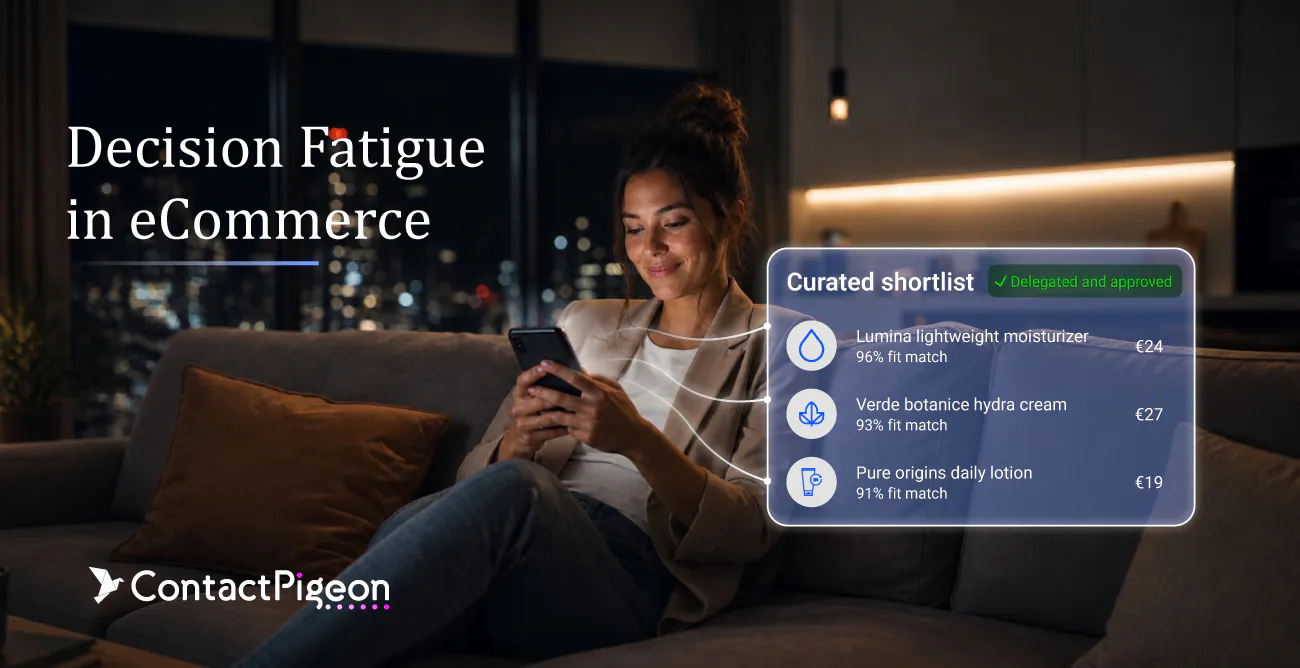
The difference is easiest to see in an example. A shopper isn’t going to enjoy filtering through 180 skincare products by hand. They’d rather say: “I need a lightweight moisturizer for sensitive skin, under €30, that works well under makeup.” An AI agent can turn that one sentence into a short, relevant list, doing in seconds what would otherwise take several rounds of filtering, tab-switching, and review-reading.
From AI assistance to delegated commerce
Agentic commerce takes delegated commerce beyond assistance by allowing shoppers to hand specific shopping tasks to an AI agent rather than working through every discovery and comparison step themselves
This doesn’t mean AI making every decision unsupervised. In practice, most delegation is task-specific and shopper-directed:
- “Find the best option for me.”
- “Compare these two products.”
- “Remind me when this is back in stock.”
- “Build my usual weekly grocery cart.”
- “Find a gift under €50.”
Retailers and consumers are both moving faster toward this than many eCommerce strategies currently account for. Salesforce’s Connected Shoppers Report found that 75% of retailers now consider AI agents essential to staying competitive by 2026, and Capgemini’s consumer trends research found 71% of consumers already want generative AI built into how they shop. That’s not a future scenario; it’s a gap between what shoppers expect now and what most retail experiences currently deliver.
Why delegated commerce matters for retailers
In traditional eCommerce, a shopper compares products through search results, category pages, filters, and reviews, all surfaces the retailer controls directly. Understanding agentic vs conversational commerce helps explain why, in delegated commerce, an AI agent can decide what the shopper sees first and which products even make it into the comparison. That means retailers now have to optimize for AI-mediated discovery, not just human browsing.
Product data becomes a competitive asset, not just backend housekeeping
Agents need structured, accurate detail (size, material, compatibility, use case, delivery constraints, return conditions) to make recommendations that actually hold up. Thin or inconsistent product content doesn’t just look bad to a human; it can make a product invisible to an agent altogether.
Context increasingly matters more than exact keywords
A shopper asking for “a dress for a summer wedding” is describing an occasion, not a SKU. Retailers whose systems only match on literal product terms will lose relevance to ones that understand intent.
Customer profiles determine how useful delegation actually is
An agent can only personalize as well as the data behind it lets it: purchase history, preferences, loyalty status, engagement signals. This is the practical case for a connected customer data platform: the more unified the customer profile, the better an agent can judge what’s relevant, what to rule out, and what the next best action is.
Trust is now part of conversion
Recent research into how AI agents actually evaluate products found that they show real, measurable biases, favoring top-of-page placement, penalizing “Sponsored” tags, and weighing price, ratings, and review volume with sensitivities that vary a lot between models. In other words, agent visibility isn’t guaranteed by good SEO habits alone, and a bad or unexplainable recommendation erodes shopper trust just as fast as a bad human-facing one does.
What AI agents can do differently than traditional product discovery
The honest framing here is that traditional search and navigation are not dead yet, but they’re no longer sufficient on their own. A large study of Ctrip’s AI shopping assistant found that most users don’t abandon chat search; they interleave the two, moving back and forth, and lean on chat specifically for the harder, more exploratory questions that don’t compress well into a keyword.
| Traditional discovery | AI agent-assisted discovery |
|---|---|
| Customer searches with keywords. | Customer explains their intent in natural language. |
| Customer filters products manually. | The agent narrows the options through conversation. |
| Customer compares products alone. | The agent summarizes the differences that matter. |
| Recommendations are largely rule-based. | Recommendations reflect the customer’s context and behavior. |
| Support sits apart from the shopping experience. | Guidance and product discovery happen together. |
The role of conversational commerce in reducing decision fatigue
Conversational commerce matters here because it gives shoppers a natural way to express uncertainty. Instead of forcing them to already know exactly what they want before they can search for it.
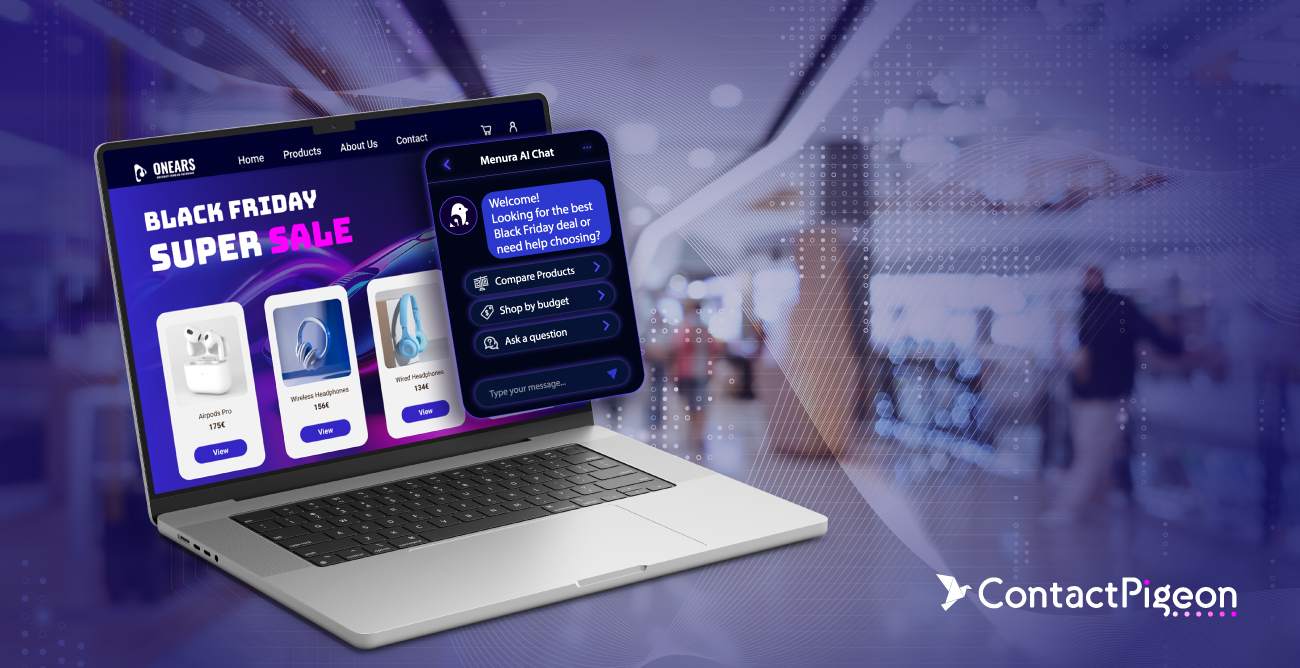
This is where a tool like Menura AI, ContactPigeon’s retail AI agent, fits in. Rather than expecting a shopper to filter, compare, and interpret every option on their own, Menura AI turns product discovery into a guided conversation, surfacing relevant products, explaining what actually separates them, and answering the hesitation-driven questions that usually cause a shopper to stall:
- “I’m not sure what size to choose.”
- “Which one is better for dry skin?”
- “I need a gift, but I don’t know what to buy.”
- “Is this compatible with what I bought last time?”
How retailers can prepare for delegated commerce
- Cleaning and enriching product data: Attributes, use cases, sizing, compatibility, availability, and the relationships between products (alternatives, bundles, refills, upgrades).
- Connecting customer data: A unified CDP lets an agent draw on purchase history, browsing behavior, and preferences instead of guessing at relevance.
- Mapping the highest-fatigue moments: Categories with many variants, high return rates, or repeated support questions are where decision support pays off fastest.
- Building guided discovery flows for the categories where people genuinely need help choosing: beauty, fashion, electronics, gifting, travel.
- Keeping a human escalation path: Delegation still needs a handoff point for anything sensitive, high-value, or emotionally charged.
- Measuring decision support, not just revenue: Assisted conversion, time-to-decision, recommendation acceptance, and handoff quality tell you whether the agent is actually reducing effort.
What is decision fatigue in eCommerce?
Decision fatigue in eCommerce is the mental exhaustion shoppers feel from making too many decisions during a purchase, including comparing products, weighing reviews, and navigating promotions, delivery options, and returns.
Which product categories are most affected by decision fatigue?
Categories with many similar options or a highly subjective fit tend to be most affected. These include beauty, fashion, electronics, gifting, and travel, where the right choice depends on details that a generic product page may not fully capture.
How do AI agents reduce decision fatigue?
AI agents let shoppers describe what they need in plain language, then narrow the available options, compare relevant products, and make recommendations on their behalf instead of leaving them to filter and evaluate everything manually.
Is delegated commerce the same as conversational commerce?
They are related, but they are not identical. Conversational commerce focuses on shopping through chat, while delegated commerce allows shoppers to hand specific tasks, such as product comparison, cart building, or replenishment, to an agent to complete.
What is the difference between delegated commerce and personalization?
Personalization surfaces products that are more relevant to the shopper, but the shopper still has to compare the options and make the final decision. Delegated commerce allows the shopper to hand off a specific task, such as creating a shortlist or restocking a product, rather than simply receiving better recommendations to evaluate.
Why should retailers care now?
Decision fatigue in eCommerce is already pushing shoppers toward AI agents that influence which products they see, compare, and purchase. This makes product data quality, customer context, and recommendation trust competitive priorities rather than purely user-experience considerations.
The future of eCommerce is better decision support
The retailers who win the next few years won’t be the ones with the most products, the most channels, or the loudest promotions. They’ll be the ones an AI agent actually trusts to recommend, because the product data is clean, the customer context is real, and the answer to a shopper’s question is the right one, not just the best-optimized one. That’s a different kind of advantage than most retail teams are currently built for, and it’s easier to get ahead of now than to chase once agents are already routing around you.
Menura AI is ContactPigeon’s retail AI agent, built to turn product discovery into exactly this kind of guided, trustworthy conversation. Book a live demo to see it work against your own catalog and customer data. And since none of this holds up without the customer and product intelligence behind it, explore ContactPigeon’s platform to see how the CDP, automation, and Menura AI work together.