Retailers collect customer signals across every part of the retail customer journey, from product views and purchases to loyalty activity and in-store interactions. Yet these signals often sit in different systems, making it difficult for AI to understand the full customer journey. That is where the retail AI stack becomes important. It gives retailers a blueprint for connecting customer data, AI intelligence, and real-time activation across the business. Instead of treating AI as a feature inside separate tools, the retail AI stack helps retailers build the foundation for smarter decisions across the board.
At the center of this foundation sits the next-gen CDP. A modern retail CDP helps unify customer data, identify intent, and activate smarter decisions across channels. This is what makes agentic commerce more practical: a retail technology stack where AI can respond with greater relevance, speed, and intelligence across the customer journey.
What is the retail AI stack?
The retail AI stack is the connected operating model that helps retailers turn customer signals into smarter action.
In simple terms, it is the structure that allows a retail business to collect data, understand what that data means, decide what should happen next, and activate that decision across the right channel. For AI in retail to work well, these steps need to be connected. Otherwise, customer data remains scattered, decisions remain limited, and automation becomes harder to personalize in a meaningful way.
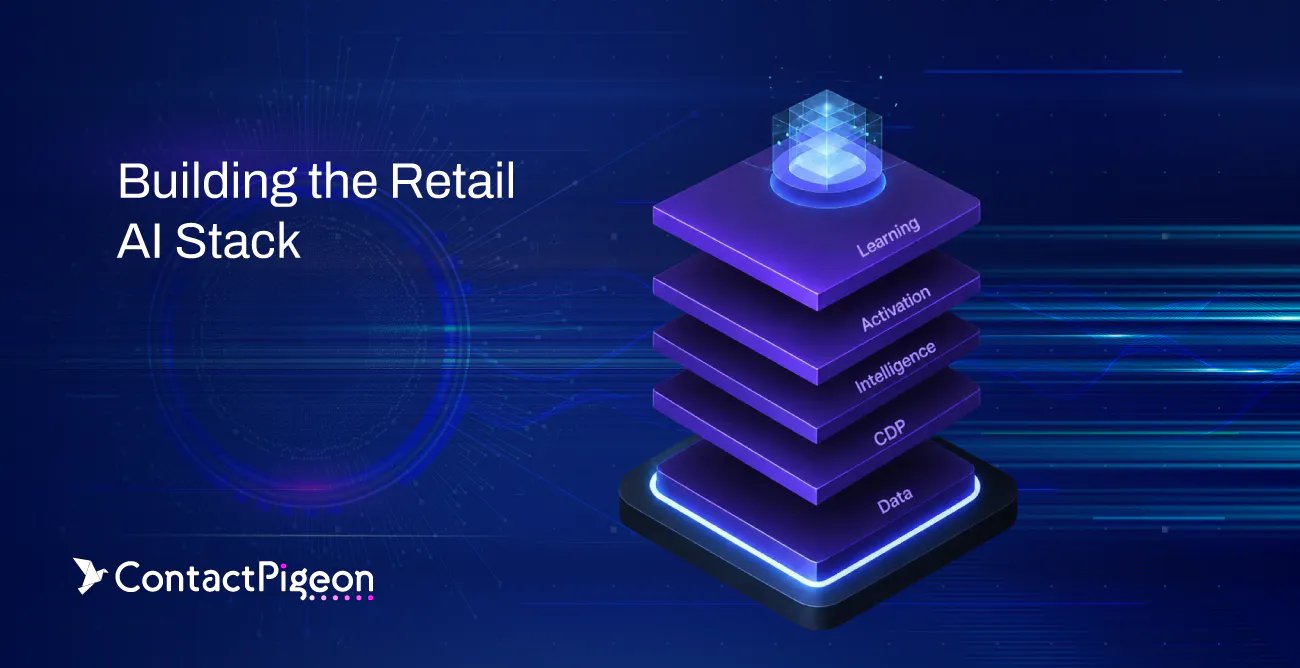
A practical retail AI stack usually includes five core layers. Together, they create the foundation for omnichannel retail AI. The goal is to give the business a practical way to connect data, intelligence, and activation so every customer interaction can become more relevant, timely, and useful.
Data layer
This includes the customer, product, transaction, behavioral, loyalty, consent, and channel engagement data that gives the business visibility into how people browse, buy, return, respond, and interact with the brand.
CDP layer
This is where a retail CDP connects customer signals into usable profiles and segments. Instead of looking at each interaction separately, the customer data platform for retail helps the business understand the customer with more continuity across channels and moments.
Intelligence layer
This is where AI models, predictive analytics, recommendations, product discovery logic, churn prediction, propensity scoring, and next-best-action decisioning help interpret customer behavior and guide decisions.
Activation layer
This is where decisions become customer experiences through email, SMS, push notifications, on-site personalization, ads, loyalty journeys, customer service, and AI shopping assistants.
Learning layer
This is the feedback loop that shows what worked, what changed, and what the system should learn from. It helps the retail technology stack improve over time, based on real customer behavior and performance.
From customer data to customer decisions
The real value of the retail AI stack is not only personalization. It is decision-making at scale.
Retailers already know how to show different messages, products, or offers to different audiences. AI personalization in retail is evolving from audience-level targeting into customer-level decisioning. The retailers that build this capability will understand when to act, how to act, and when not to act.
A connected retail AI stack can help retailers decide who should receive a campaign, who should be excluded, who is ready to buy, who needs product education, who is at risk of churn, and who should receive a discount or a loyalty incentive. It can also help protect margin by identifying customers who are likely to buy without an incentive, or by triggering follow-up communication after an AI agent interaction reveals stronger intent.
These decisions have a direct impact on revenue, retention, customer experience, and operational efficiency. Poor decisioning creates unnecessary discounts, irrelevant campaigns, missed intent signals, and fragmented journeys. Smarter decisioning helps teams act with more precision across timing, channel, content, product, offer, and next-best action.
Why next-gen CDPs are the foundation of the retail AI stack
For many years, CDP conversations focused mainly on data unification and segmentation. That role still matters, but the expectations have evolved. As AI in retail becomes more embedded in customer journeys, retailers need more than organized data. They need customer context that AI can interpret and act on.
This is why next-gen CDPs sit at the foundation of the retail AI stack. They connect signals across online and offline touchpoints, bringing together customer behavior, purchase history, loyalty status, consent data, customer service interactions, and channel engagement. This allows retailers to move beyond static segments and build dynamic journeys that respond to how customer intent changes over time.
A next-gen CDP gives AI the context it needs to support smarter decisions as customers move through different stages of consideration. When a shopper shifts from casual browsing to active intent, the brand’s response should shift with them. Personalization becomes more decision-oriented: not only showing a relevant product, but understanding what the customer may need next, whether that is more information, reassurance, better timing, an incentive, or a clearer path to purchase.
What autonomous commerce actually means
Autonomous commerce describes a retail environment where more customer decisions can be automated, optimized, and personalized based on customer context, business rules, and real-time behavior.
It does not mean retailers remove strategy from the process or allow AI to run the business on its own. The retailer still defines the goals, rules, priorities, margins, brand logic, and customer experience standards. AI supports the execution by helping the business decide what should happen next, faster and with more context.
In practice, autonomous commerce can appear in simple but meaningful ways. A shopper receives a replenishment reminder when they are likely to need the product again. A customer gets product guidance based on their behavior and preferences. A high-intent shopper receives urgency messaging rather than a generic discount. A loyal customer receives early access instead of a price promotion. An inactive customer enters a win-back journey based on predicted churn risk.
It can also shape more complex journeys. An AI assistant can help a shopper compare products, understand differences, and choose with more confidence. A customer journey can adapt automatically after each interaction, so the next message, offer, product recommendation, or channel reflects what the customer just did.
This is what makes autonomous commerce important for retail AI. It brings together customer context, AI decisioning, and activation in a way that helps brands respond with more relevance and less delay. The goal is not to make commerce feel automated. The goal is to make every next step feel more useful to the customer and more intelligent for the business.
Building a smarter retail AI stack
A useful retail AI stack should help the business move from scattered signals to coordinated decisions. That means bringing the right data together, turning it into customer context, applying intelligence, activating decisions across channels, and learning from performance over time.
The purpose is to make the retail technology stack more useful, not more complex. Every layer should help the business understand customers faster, decide with more confidence, and respond more consistently across the journey.
This framework also helps retailers understand maturity. A business may start by connecting data and building more reliable customer profiles. From there, it can add predictive audiences, behavioral triggers, AI personalization, product recommendations, and next-best-action logic. Over time, the retail AI stack becomes a learning system that supports smarter decisions across the full customer journey.
Autonomous commerce grows from connected data, usable customer context, AI decisioning, and coordinated activation. Each layer makes the next one more useful, until the business can respond to customers with more precision across more moments.
Common mistake: Treating AI as a tool, not an operating system
Understanding agentic vs conversational commerce helps retailers move beyond approaching AI as a collection of separate tools for content creation, recommendations, chat, segmentation, analytics, or campaign automation.This can create useful improvements, but it does not automatically create a smarter customer journey.
The bigger shift happens when AI becomes connected to the systems that shape customer understanding and action. That means linking AI to the customer data layer, the decisioning layer, and the activation layer, so it can work with richer context and support decisions across the full journey.
AI turns isolated capabilities into a connected decisioning system, helping the business decode what each customer is showing through their behavior and decide what should happen next.
The conversation needs to move from randomly adding AI capabilities to strategically building the conditions that allow AI to make better decisions. Without connected customer context, AI remains useful in isolated moments. With the right stack beneath it, AI becomes part of how the business recognizes intent, protects margin, improves relevance, and responds faster across the customer journey.
Where ContactPigeon fits
ContactPigeon helps retailers move from disconnected campaigns to connected customer journeys. The platform brings together customer data, segmentation, automation, personalization, and omnichannel activation in one environment, making it easier for teams to respond to customers based on behavior, lifecycle stage, and intent.
For retailers building a stronger retail AI stack, this connected environment becomes important. Teams can use customer data to create smarter segments, automate journeys, personalize interactions, and activate campaigns across email, SMS, push notifications, onsite messages, ads, and loyalty flows.
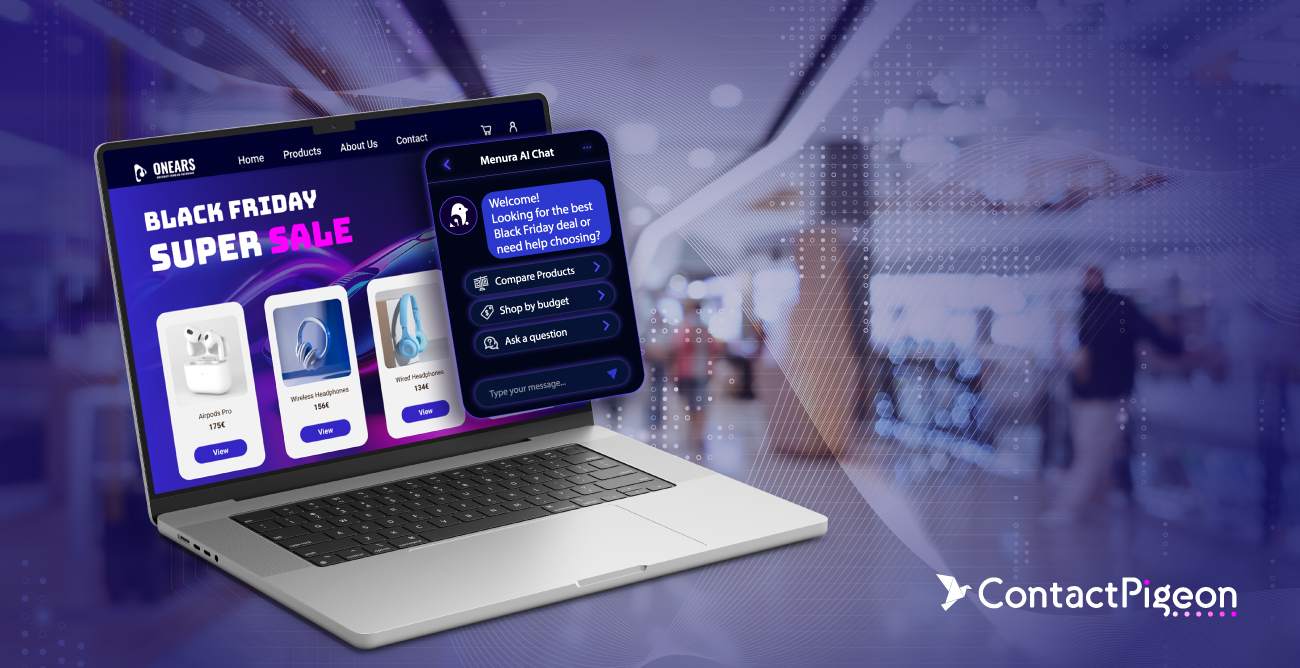
Menura AI extends this journey into AI-assisted product discovery and customer guidance. As part of the intelligence and activation layer, it helps shoppers ask questions, compare products, receive relevant recommendations, and move through the buying journey with more confidence.
Together, ContactPigeon and Menura AI support a more connected approach to retail AI: one where customer context, automation, personalization, and AI-powered conversations work together to create more relevant customer experiences.
Autonomous commerce starts with context
Retail AI will create the most value when it becomes part of how the business understands customers, makes decisions, and acts across the journey. That requires more than adding AI into separate workflows. It requires a connected foundation where customer data becomes usable context, and context becomes better decisions.
This is why the next-gen CDP is so important to the future of autonomous commerce. It gives AI the customer understanding it needs to recognize intent, adapt journeys, personalize interactions, and support decisions around timing, channel, content, product, and offer. The future of retail AI will belong to the brands that can turn customer context into better decisions and better decisions into more relevant customer experiences.
Book a demo with our experts to see how a smarter retail AI stack can support your customer journeys, or explore Menura AI to discover how AI-powered conversations can guide shoppers toward the right products with more confidence.