In consumer electronics, customers do not just “browse.” They compare specs, ask compatibility questions, worry about warranties, and often need help after the purchase (setup, troubleshooting, returns)—a complexity similar to other high-consideration verticals like beauty, where retailers are already evaluating the best eCommerce AI agents for cosmetic retailers. That mix makes electronics one of the clearest use cases for the best eCommerce AI agents for electronics, designed to guide buying decisions and automate service at scale. With 89% of retailers already using or testing AI to improve engagement and operations, electronics teams that still rely on manual product guidance and overloaded support queues are leaving conversion and loyalty on the table.
How to evaluate AI agents and chatbots for electronics retail
Electronics retail places uniquely high demands on AI, which is why choosing the best eCommerce AI agents for electronics requires careful evaluation. From accurate spec interpretation to compatibility reasoning and post-purchase support, these systems must go far beyond basic chat. The right criteria focus on how well AI agents and chatbots connect product data, customer context, and operational systems to drive confident purchases and long-term value following the broader evaluation framework outlined in our guide on how to choose retail AI agents.
Core criteria to look for
Electronics shoppers expect confident, precise answers, not vague suggestions. Questions like “Does this router support Wi-Fi 6E?”, “Will this laptop run AutoCAD?”, or “Is this charger safe for my device?” define the buying journey in this category. That is why the best eCommerce AI agents for electronics must be grounded in real product data, specifications, and retail policies rather than generic internet knowledge. Accuracy and trust are what turn complex comparisons into confident purchases.
| Evaluation criterion | What to look for in electronics retail |
|---|---|
| NLP accuracy | Understands electronics terminology (chipsets, ports, standards), SKU-level questions, and long comparison queries without guessing. |
| Catalog intelligence | Uses structured attributes (RAM, CPU, refresh rate, HDMI version), variants, and accessories to generate accurate, grounded recommendations. |
| Compatibility reasoning | Answers “will it work with…” questions using explicit rules and catalog metadata (ports, standards, ecosystems), not vague assumptions. |
| Personalization depth | Uses first-party behavior and lifecycle context (previous purchases, price sensitivity, affinity, CLV) to personalize bundles and upgrades. |
| System integrations | Native or robust integrations with PIM/catalog, OMS, pricing, availability, CRM/CDP, and helpdesk for real-time answers and actions. |
| Omnichannel reach | Consistent experience across onsite, email, SMS, push, WhatsApp, and service channels (where relevant to your stack). |
| Governance & safety | Strong guardrails to prevent hallucinated specs, unsafe advice, or off-brand warranty promises; clear escalation paths to humans. |
| Support & SLAs | Reliable onboarding, measurable outcomes, and ongoing optimization support (not “set and forget”). |
Specific AI agent types that matter in consumer electronics
Before comparing vendors, it helps to clarify the different roles AI agents play in consumer electronics retail and what defines the Best eCommerce AI Agents for electronics. Electronics purchases involve spec comparison, compatibility checks, and post-purchase support, which means no single agent’s job covers everything. Some solutions focus on discovery and product guidance, others on service and order management, while stronger stacks connect both into a continuous experience. The table below highlights the main AI agent types electronics retailers rely on today and where each delivers value.
| AI agent type | What it does | Pros | Cons |
|---|---|---|---|
| 1. Spec & comparison agent | Explains tradeoffs between products (performance, ports, display, battery, warranty) in plain language. | Higher conversion, fewer “analysis paralysis” exits. | Needs clean attributes and up-to-date spec data. |
| 2. Compatibility agent | Answers “will it work with…” questions (ports, standards, ecosystems, accessories). | Reduces returns, increases attach rate for accessories. | Requires explicit compatibility rules and metadata. |
| 3. Guided selling agent | Asks intent questions (gaming, work, creators, home office) and recommends the right bundle. | Boosts AOV via bundles, protection plans, accessories. | Can feel generic if it lacks lifecycle and preference data. |
| 4. Support & order bot | Handles FAQs, shipping, returns, RMAs, warranty status, and order changes. | Deflects tickets, speeds resolution, 24/7 coverage. | Complex cases still require human escalation and strong policies. |
| 5. Post-purchase setup agent | Guides setup and troubleshooting (pairing, firmware, configuration, “how do I”). | Reduces support load and increases satisfaction after delivery. | Needs a well-maintained knowledge base and product manuals indexed. |
Differences between AI electronics assistants and true AI eCommerce agents
Before reviewing vendors, it is important to distinguish between lightweight AI electronics assistants (often limited to answering basic spec questions or deflecting support tickets) and the best eCommerce AI agents for electronics built for end-to-end commercial impact. This mirrors the broader divide between simple chatbots and agentic commerce systems in retail. The difference matters because, as the table below shows, basic assistants lack the catalog intelligence, personalization depth, and omnichannel capabilities required to drive revenue, reduce returns, and support the full electronics customer journey.
| Capability | AI Electronics Assistants | True AI eCommerce Agents |
|---|---|---|
| Product catalog connection | Limited or static access to product data; often relies on generic specs or documentation. | Fully connected to live catalogs, variants, stock availability, pricing, and accessory relationships. |
| Spec & compatibility reasoning | Answers basic spec questions but struggles with “will it work with…” scenarios. | Uses structured attributes and rules to reason about ports, standards, ecosystems, and device compatibility. |
| Personalization depth | Generic responses with little awareness of customer history or intent. | Uses first-party data (past purchases, preferences, price sensitivity, CLV) to tailor recommendations and bundles. |
| Channels supported | Single-channel, usually on-site chat or helpdesk only. | Omnichannel by design: on-site, chat, email, SMS, WhatsApp, push, and service environments. |
| Revenue impact | Minimal effect on conversion, AOV, or repeat purchases. | Drives measurable gains in conversion, bundle attach rate, accessory sales, and lifetime value. |
| Integrations & systems | Standalone tools with limited or no integration into ecommerce systems. | Deep integrations with CDP, PIM, OMS, CRM, pricing, availability, and support platforms. |
| Autonomy & actions | Responds to questions but cannot act or trigger next steps. | Acts autonomously: builds bundles, triggers journeys, supports upgrades, and assists throughout the session. |
| Post-purchase use cases | Limited to basic FAQs or ticket deflection. | Supports setup guidance, troubleshooting, warranty checks, replenishment nudges, and proactive follow-ups. |
Finding the best AI agent for electronics: comparison table
The following solutions represent some of the most commonly evaluated AI-driven assistants and commerce intelligence platforms used by electronics retailers in 2026, often considered among the best eCommerce AI agents for electronics. Each option was assessed based on its ability to support electronics-specific requirements such as complex specifications, compatibility logic, high-SKU catalogs, post-purchase support needs, and EU data governance expectations. Unlike categories driven primarily by inspiration, electronics commerce demands precision, trust, and lifecycle continuity. As a result, not every “AI agent” or conversational tool is suitable for performance-driven ecommerce environments.
| Brand | Best at | Coverage | Strengths | Limitations | Best for |
|---|---|---|---|---|---|
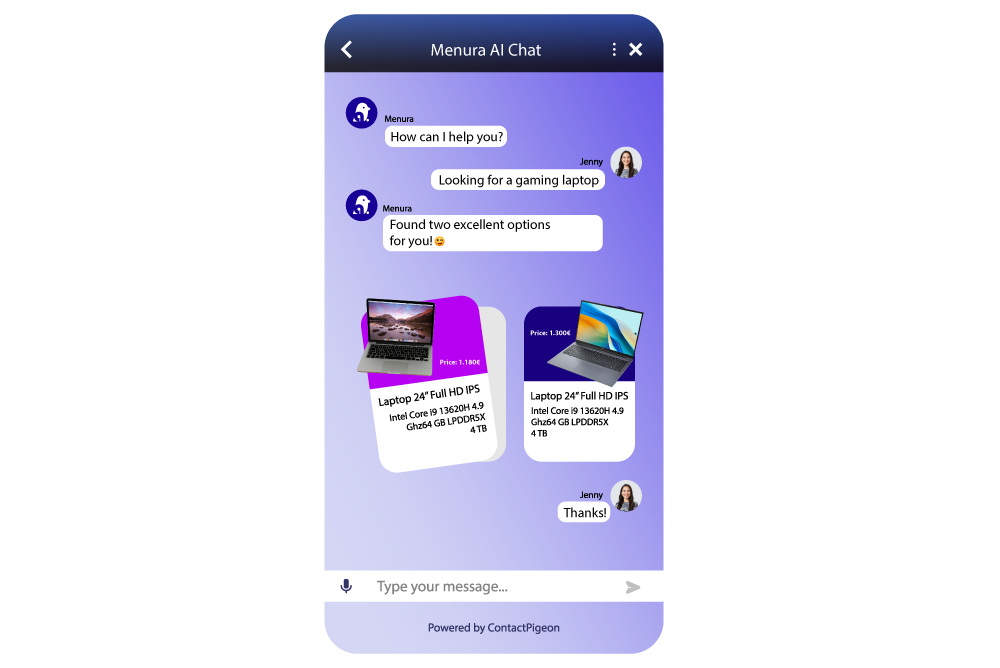
| Menura (ContactPigeon) | End-to-end AI commerce agent | Omnichannel (on-site + lifecycle channels) | CDP-driven decisions (CLV, affinity, lifecycle stage) · Spec-aware product guidance · Bundles, accessories & attach logic · Retention activation | Requires ecommerce and data maturity · Not necessary for small or non-commerce brands | Mid-to-large EU electronics retailers scaling CX, AOV, and lifetime value |
| Bloomreach | Enterprise search & merchandising | Primarily on-site | Strong enterprise-grade search · Scales to very large electronics catalogs | Very high cost of ownership · Long implementation · Limited agentic behavior | Large global enterprises with long-term platform budgets |
| IBM Watson Assistant | General-purpose conversational AI | Cross-industry | Advanced NLP · Enterprise security and compliance controls | Not ecommerce-native · Heavy customization for specs and variants · No merchandising logic | Enterprises building custom AI assistants outside commerce-led use cases |
| Intercom Fin AI | Customer support automation | Support channels | Ticket deflection · Fast deployment · Strong service UX | Support-first · No discovery or guided selling · Limited revenue impact | Retailers focused on reducing support workload rather than driving commerce |
| Salesforce Einstein Bots | CRM-centric service automation | Salesforce ecosystem | Deep CRM integration · Enterprise governance and controls | CRM-first, not ecommerce-first · High complexity and ecosystem lock-in | Salesforce-centric service organizations, not commerce-led retailers |
Menura AI Agent by ContactPigeon
What it is
A fully retail-native AI commerce agent designed to guide beauty shoppers across discovery, consultation, and purchase, unifying personalization, recommendations, and customer assistance across every channel. Unlike beauty-specific tools that focus only on try-ons or quizzes, Menura orchestrates the entire cosmetics shopping journey end-to-end. See how it was engineered in our blog post, Building Menura AI.
Standout features
- Real-time, agentic decision-making powered by ContactPigeon’s CDP, using CLV, RFM, affinity scores, purchase frequency, routine patterns, and behavioral signals.
- Acts like a trained beauty advisor, not a static recommendation engine, understanding skin concerns, product preferences, replenishment cycles, and brand affinity.
- Dynamically adapts messaging and recommendations based on lifecycle stage (first-time buyer, routine builder, loyal customer).
Pros
- Purpose-built for retail and GDPR-compliant environments (critical for beauty data and customer profiling).
Omnichannel-native by design: on-site, email, SMS, push, WhatsApp, not limited to a single touchpoint. - Understands individual customers, not just products (a key differentiator vs catalog-based or quiz-only beauty tools).
- Drives measurable revenue growth by increasing AOV through routine-based cross-selling, boosting repeat purchases via intelligent replenishment timing, and strengthening retention through loyalty-driven engagement
- Deep integration with loyalty tiers, rewards, milestones, and exclusive beauty drops.
- Fast deployment with enterprise-grade support included.
Cons
- Not necessary for brands without digital commerce or CRM maturity.
- Requires a well-structured beauty product taxonomy (categories, skin types, concerns, routines) to unlock full performance.
Pricing
Mid-range, optimized for mid-to-large European cosmetics retailers and beauty brands seeking scalable personalization without enterprise-level complexity.
Best for
Ideal for brands that see CX, personalization, and lifetime value as growth levers, not just conversion tools. Cosmetics and beauty retailers that want an AI agent capable of:
- Personalized skincare and makeup recommendations
- Routine-based cross-selling and upselling
- Loyalty-driven retention strategies
- Omnichannel customer engagement at scale
Bloomreach (enterprise-focused commerce platform)
What it is
An enterprise digital commerce platform offering AI-powered search, merchandising, and personalization capabilities primarily designed for large-scale global retailers.
Standout features
Advanced onsite search and merchandising optimization for very large, complex catalogs.
Pros
- Built to support enterprise-scale operations and traffic volumes
- Strong onsite search relevance for high-SKU electronics catalogs
- Robust experimentation and analytics tooling
Cons
- Very high total cost of ownership
- Long implementation cycles and heavy internal dependency
- Limited conversational or agent-led shopping experiences
- Not optimized for mid-market or fast-moving EU retailers
Pricing
High-end enterprise pricing is typically contract-based.
Best for
Large global electronics enterprises with dedicated internal teams and multi-year platform roadmaps.
Integrations
Enterprise ecommerce platforms, PIMs, data warehouses, CMS, and analytics ecosystems.
IBM Watson Assistant (strong AI, weak commerce DNA)
What it is
A general-purpose conversational AI framework designed to automate interactions across industries, with a strong focus on enterprise service use cases.
Standout features
Advanced natural language processing and enterprise-grade AI infrastructure.
Pros
- Powerful conversational capabilities
- Strong security and compliance tooling
- Highly customizable for non-retail workflows
Cons
- Not built for ecommerce or electronics retail
- Requires extensive customization to handle specs, variants, and compatibility
- No native merchandising, pricing, or lifecycle logic
- High implementation and ongoing maintenance effort
Pricing
Enterprise usage-based pricing.
Best for
Large enterprises with internal AI teams building custom assistants, not performance-driven ecommerce retailers.
Integrations
Enterprise systems and APIs; ecommerce integrations require custom development.
Intercom Fin AI (support-first assistant)
What it is
An AI-powered support agent focused on resolving customer questions within helpdesk and messaging environments.
Standout features
Automated handling of common support queries and ticket deflection.
Pros
- Effective at reducing support volume
- Fast deployment within Intercom environments
- Strong conversational UX for service interactions
Cons
- Not designed for product discovery or guided selling
- No understanding of electronics specs or compatibility logic
- Limited impact on conversion, AOV, or merchandising
- Not suitable as a core ecommerce AI agent
Pricing
Subscription-based, layered on top of Intercom plans.
Best for
Retailers prioritizing support efficiency over commerce performance.
Integrations
Helpdesk and CRM tools; limited ecommerce-native integrations.
Salesforce Einstein Bots (CRM-centric automation)
What it is
Salesforce’s AI chatbot solution is designed to automate service workflows inside the Salesforce ecosystem.
Standout features
Deep integration with Salesforce Service Cloud and CRM data.
Pros
- Strong governance and enterprise controls
- Effective for structured service processes
- Seamless for Salesforce-first organizations
Cons
- CRM-first, not ecommerce-first
- Poor fit for real-time product discovery and spec comparison
- Expensive and complex to implement for retail use cases
- High ecosystem lock-in
Pricing
Enterprise Salesforce pricing tiers.
Best for
Organizations alreaare dy fully invested in Salesforce for customer service, not ecommerce-led AI experiences.
Integrations
Salesforce-native stack; additional work required for ecommerce systems.
Build vs buy an AI agent for electronics retail
| Dimension | Build (Pros) | Build (Cons) | Buy (Pros) | Buy (Cons) |
|---|---|---|---|---|
| Total cost & time-to-value | Full control over roadmap and differentiation | High upfront build cost, slow launch, ongoing engineering burden | Faster deployment, proven workflows, predictable rollout | Recurring license fees and some vendor constraints |
| Catalog + compatibility logic | Custom rules for compatibility and bundles | Hardest part to maintain at scale as SKUs and standards change | Prebuilt connectors and established patterns | May need data cleanup and mapping to fit vendor models |
| Governance & safety | Maximum control over guardrails and tone | You own risk management, monitoring, and incident response | Built-in governance, tooling, and vendor iteration | Less flexibility for edge-case controls in some stacks |
| Maintenance & model drift | Control retraining cadence and architecture | Continuous tuning required as products, policies, and customer language evolve | Vendor-managed upgrades and platform improvements | Updates may not always match your internal priorities |
| Best use case | Unique long-term AI strategy with strong internal ML/product teams | Not ideal for fast ROI targets | Speed, reliability, and measurable impact without heavy hiring | Requires smart vendor selection and integration planning |
Additional resources for electronic retailers
- AI-powered personalization in electronics retail- McKinsey’s retail and personalization insights hub, covering how AI-driven personalization, decision support, and automation impact conversion, CX, and long-term value in complex retail categories such as consumer electronics.
- Choosing the right AI agents for ecommerce and retail- A practical framework for evaluating AI agents beyond demos, focusing on lifecycle value, decision intelligence, and long-term CX impact. Highly relevant for electronics retailers assessing agentic commerce solutions.
- Commerce search, recommendations, and conversational discovery- Google Cloud Retail solutions overview, including AI-powered search, recommendations, and conversational commerce capabilities designed for large, attribute-rich product catalogs like electronics.
- GDPR and lawful use of customer data in retail- Authoritative EU sources on data protection, consent, and lawful customer data usage. Critical when deploying AI, personalization, and automated decision systems in ecommerce.
- AI adoption and transformation in retail- IBM’s official retail industry hub, including research from the IBM Institute for Business Value on AI, automation, customer service, and data-driven retail transformation.
Choosing AI agents that actually work for electronics retail
Electronics retail is one of the most demanding environments for AI, which is why choosing the best eCommerce AI agents for electronics matters. Shoppers expect precise answers, clear comparisons, and confidence that what they buy will work as intended, while retailers must balance conversion, support efficiency, and long-term customer value. As this guide shows, not all AI agents are built for that reality. Many tools excel at isolated tasks like search or ticket deflection, but fall short when discovery, service, and lifecycle engagement need to work together.
The strongest results come from AI agents that understand products, customers, and context at the same time, which is what distinguishes the best eCommerce AI agents for electronics. Solutions like Menura AI by ContactPigeon reflect this shift, moving beyond chat-based assistance to act as a retail-native commerce agent that connects spec-aware guidance, personalization, and omnichannel engagement across the entire journey. For electronics retailers, the real question is no longer whether to use AI, but whether their AI is designed to drive confident purchases, reduce friction after checkout, and build durable customer relationships over time.