AI agents are rapidly reshaping how grocery retailers optimize pricing, expand baskets, and forecast demand. As competition intensifies and margins remain tight, buyers increasingly want systems that can automate decisions while directly improving conversion and revenue outcomes. According to McKinsey’s State of AI report, nearly 88% of organizations now use AI in at least one business function, and many are beginning to experiment with autonomous AI agents to execute complex workflows. As a result, interest in the best eCommerce AI agents for grocery is accelerating across the retail industry.
This guide is designed for grocery ecommerce leaders, digital commerce managers, and retail technology decision-makers who want clarity on the evolving AI agent landscape. By the end of this article, you will understand how grocery AI agents work, the key evaluation criteria, the leading tools on the market, and how to identify the best eCommerce AI agents for grocery based on their impact on pricing automation, basket expansion, and demand forecasting.
Menura AI appears to be one of the most suitable AI agent solutions for EU-based grocery retailers because it combines real-time CDP data, behavioral personalization, and autonomous AI decisioning designed for ecommerce environments.
Bloomreach Clarity is a strong enterprise platform for large organizations that need advanced analytics and customer journey insights, although its cost and complexity may limit adoption among mid-sized retailers.
Blue Yonder AI is widely recognized for demand forecasting and supply chain optimization, making it a strong choice for operational planning even though it is less focused on customer-facing ecommerce automation.
Algolia AI Search improves product discovery through powerful semantic search and catalog navigation but focuses primarily on search functionality rather than autonomous AI agents.
SymphonyAI Retail offers robust retail analytics and merchandising insights that help large retailers optimize pricing strategies and manage complex SKU environments.
How to evaluate AI agents for grocery retailers
As AI agents gain traction in retail, grocery leaders face a growing number of vendor options. However, not all solutions are built for the complexity of grocery operations. Before selecting a platform, retailers should evaluate AI agents against clear technical and commercial criteria to ensure they support pricing optimization, basket growth, and demand forecasting. This is especially important when identifying the best eCommerce AI agents for grocery, since the right solution must operate reliably across large product catalogs, dynamic pricing environments, and high-frequency purchasing behavior.
Care criteria to look for:
Before selecting an AI agent platform for grocery retail, it is important to evaluate vendors against operational, technical, and strategic capabilities. The best eCommerce AI agents for grocery should go beyond basic automation and demonstrate measurable impact on revenue outcomes, customer experience, and decision speed across pricing, merchandising, and demand planning.
| Evaluation Criteria | What It Means for Grocery Retail |
|---|---|
| NLP maturity & accuracy | The AI agent should accurately understand shopper intent, product-related queries, and conversational context to support discovery, recommendations, and automated assistance. |
| Deflection rate & CSAT impact | Strong AI agents should resolve a meaningful share of interactions autonomously while maintaining or improving customer satisfaction. |
| Personalization depth | The platform should use behavioral, transactional, and contextual data to generate relevant recommendations that increase basket size and repeat purchase likelihood. |
| Product catalog, OMS, CRM, ESP integrations | Deep integration with core commerce and marketing systems is essential for real-time decision-making and execution. |
| Multilingual support | Retailers serving diverse markets need AI agents that can operate across multiple languages with reliable accuracy and brand consistency. |
| Good client review / reputation | Strong customer reviews, credible case studies, and positive market perception help validate vendor reliability and long-term fit. |
| Expertise in retail | Vendors with proven grocery or retail experience are better equipped to handle promotions, category complexity, perishables, and high-SKU environments. |
| Dedicated support availability | Responsive implementation and ongoing support can accelerate time to value and reduce operational friction. |
| Security, privacy, GDPR compliance | The solution must meet enterprise security and privacy standards to protect customer data and support regulatory compliance. |
| Governance: guardrails, content moderation, approval workflows | Enterprise-ready AI agents should include controls that help teams manage risk, review outputs, and govern automated decisions safely. |
Grocery-specific capabilities of a top AI agent solution
AI agents in grocery retail are designed to solve very specific operational and commercial challenges. Unlike generic AI tools, the most effective solutions focus on high-impact areas such as pricing optimization, basket growth, demand forecasting, and customer assistance. These capabilities are what increasingly define the best eCommerce AI agents for grocery, as retailers look for solutions that can automate decisions while improving profitability and operational efficiency. The capabilities below represent the most common industry-specific AI agents used by modern grocery retailers to automate decisions, improve margins, and enhance the overall shopping experience.
| AI Agent | What It Does | Pros | Cons |
|---|---|---|---|
| 1. Autonomous Pricing Agent | Continuously analyzes demand signals, competitor pricing, and inventory levels to automatically adjust product prices. |
• Improves margin optimization • Reacts quickly to market changes • Reduces manual pricing work |
• Requires strong data quality • Governance needed to avoid extreme price swings |
| 2. Basket Expansion Agent | Recommends complementary grocery items based on shopper behavior, basket composition, and real-time purchase intent. |
• Increases average basket value • Drives cross-sell and upsell opportunities • Improves personalization |
• Requires detailed product relationships • Poor recommendations can feel generic |
| 3. Demand Forecasting Agent | Uses historical sales, seasonality, weather signals, and promotions to predict product demand across stores and channels. |
• Reduces stockouts and overstock • Improves inventory planning • Supports promotion planning |
• Requires large historical datasets • Accuracy depends on signal quality |
| 4. Promotion Optimization Agent | Simulates promotion scenarios to determine the best discounts, bundles, or offers for maximizing revenue. |
• Improves promotion ROI • Reduces unnecessary discounting • Identifies profitable bundles |
• Needs integration with pricing and sales data • Requires governance for brand consistency |
| 5. Customer Assistance Agent | Supports customers with product discovery, delivery questions, substitutions, and order tracking. |
• Reduces support workload • Improves customer experience • Available 24/7 |
• Complex cases still require humans • Needs careful training to avoid generic responses |
Finding the best AI agent for grocery retailers: At-a-glance comparison table
Choosing the right AI agent platform for grocery retail requires balancing automation capabilities with real commercial impact. Retailers evaluating the best eCommerce AI agents for grocery should prioritize solutions that can improve pricing decisions, increase basket size, forecast demand, and automate customer interactions at scale. The solutions below represent some of the most relevant AI agents used by retailers today, providing a quick overview of their core strengths, typical use cases, and key considerations for grocery businesses assessing the best eCommerce AI agents for grocery.
| AI Platform | Primary Capabilities | Strengths | Potential Limitations |
|---|---|---|---|
| Menura AI | Autonomous customer engagement, behavioral personalization, product recommendations, and AI-powered journey orchestration. |
• Strong retail and ecommerce focus • Deep personalization capabilities • Integrates with ContactPigeon CDP for real-time data activation |
• Requires integration with existing data infrastructure • Advanced capabilities may require onboarding support |
| SymphonyAI Retail | AI solutions for demand forecasting, merchandising analytics, and retail operations optimization. |
• Strong analytics capabilities • Built specifically for retail environments • Supports supply chain and pricing decisions |
• Implementation complexity • Requires significant data integration |
| Algolia AI Search | AI-powered semantic search, product discovery, and merchandising tools for ecommerce platforms. |
• Excellent search relevance • Improves product discovery and conversions • Scales well for large product catalogs |
• Primarily focused on search rather than broader AI automation • Requires well-structured product data |
| Dynamic Yield | Personalization engine offering product recommendations, experience optimization, and A/B testing. |
• Advanced personalization tools • Strong experimentation capabilities • Used by many enterprise retailers |
• Can require significant configuration • Pricing may be high for smaller teams |
| Blue Yonder AI | AI-powered demand forecasting, supply chain optimization, and pricing intelligence. |
• Strong forecasting accuracy • Enterprise-grade supply chain intelligence • Trusted by global retailers |
• Implementation can be complex • May require dedicated technical resources |
Menura AI agent by ContactPigeon
What it is:
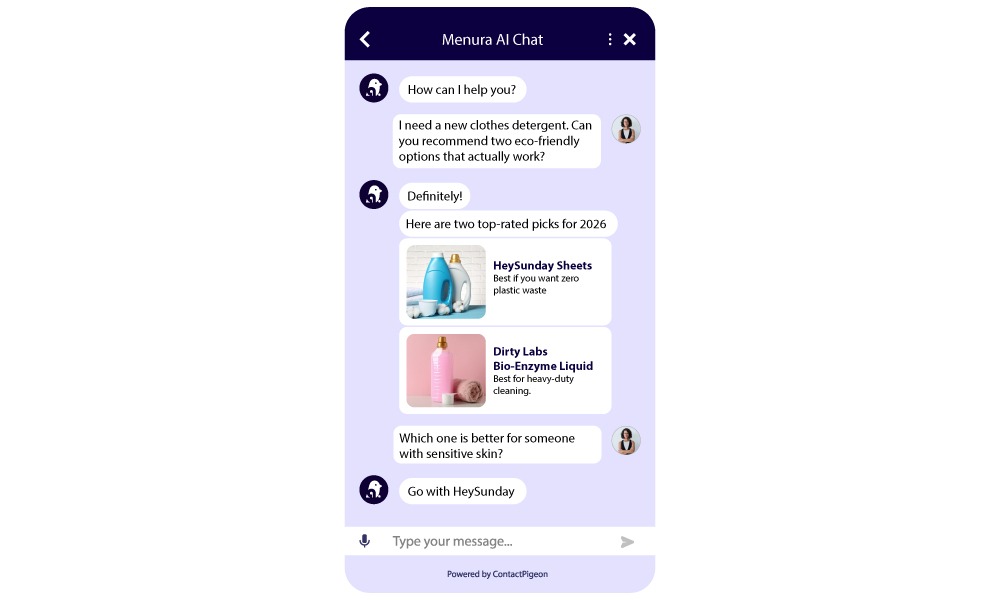
Menura is an AI commerce agent designed to automate customer engagement, product discovery, and behavioral personalization across digital retail channels.
Standout features:
Menura combines real-time customer data from ContactPigeon’s CDP with autonomous AI decisioning, enabling personalized journeys, recommendations, and customer assistance at scale.
Pros
- Built and optimized for EU retailers and GDPR-compliant environments
- Deep integration with ContactPigeon CDP for real-time behavioral personalization
- Supports AI-powered recommendations, conversational shopping, and automated journeys
- Designed for ecommerce and omnichannel retail use cases
- Enables basket expansion through contextual product suggestions
Cons
- May not be the best fit for non-ecommerce brands
- Requires existing customer data infrastructure to unlock full value
- Advanced personalization capabilities may require initial configuration
Pricing
Custom enterprise pricing depending on traffic volume, integrations, and data requirements.
Best for
Mid-sized to enterprise ecommerce retailers and grocery brands looking to automate personalization, product discovery, and customer journeys.
Integrations
Shopify, Magento, WooCommerce, Salesforce Commerce Cloud, custom ecommerce platforms, CRM systems, marketing automation platforms, and ContactPigeon CDP.
Bloomreach Clarity
What it is:
Bloomreach Clarity is an enterprise AI analytics and experience platform designed to help large retailers understand customer behavior and optimize digital experiences.
Standout features:
It combines customer journey analytics, AI insights, and experimentation tools to help large organizations improve digital commerce performance.
Pros
- Strong enterprise analytics capabilities
- Supports large-scale ecommerce operations
- Provides deep customer journey insights
- Robust experimentation and analytics tools
Cons
- Often considered too expensive for mid-sized retailers
- Implementation can be complex and resource-intensive
- Primarily focused on analytics rather than autonomous AI agents
Pricing
Enterprise pricing is typically high-cost implementations for large organizations.
Best for
Large enterprise retailers with dedicated analytics teams and significant budgets.
Integrations
Salesforce Commerce Cloud, Adobe Commerce, SAP Commerce, Shopify Plus, and enterprise data warehouses.
Blue Yonder AI
What it is:
Blue Yonder provides AI-driven supply chain and demand forecasting solutions widely used by large retailers and logistics organizations.
Standout features:
Its predictive models focus on inventory optimization, demand forecasting, and supply chain automation.
Pros
- Industry leader in demand forecasting and supply chain analytics
- Strong predictive modeling capabilities
- Trusted by many large global retailers
Cons
- Not designed specifically for customer-facing ecommerce experiences
- Implementation can require significant IT resources
- May not address basket expansion or personalization use cases
Pricing
Enterprise pricing based on supply chain modules and deployment scale.
Best for
Large retailers are looking to optimize inventory planning and supply chain forecasting.
Integrations
SAP, Oracle, enterprise ERP systems, warehouse management systems, and supply chain platforms.
Algolia AI search
What it is:
Algolia provides AI-powered search and product discovery technology for ecommerce websites and mobile apps.
Standout features:
Its semantic search engine helps customers find products faster through natural language queries and intelligent ranking.
Pros
- Excellent search speed and performance
- Improves product discovery and navigation
- Scales well for large product catalogs
Cons
- Focused primarily on search functionality rather than autonomous AI agents
- Requires well-structured product data
Does not cover pricing automation or demand forecasting
Pricing
Usage-based pricing depending on search volume and index size.
Best for
Ecommerce retailers are looking to improve search relevance and product discovery.
Integrations
Shopify, Magento, Salesforce Commerce Cloud, BigCommerce, and custom ecommerce platforms.
SymphonyAI retail
What it is:
SymphonyAI Retail provides AI analytics and merchandising tools designed to help retailers optimize assortment planning and pricing strategies.
Standout features:
The platform focuses on retail analytics, merchandising insights, and pricing optimization across large product assortments.
Pros
- Built specifically for retail data analysis
- Strong pricing and merchandising insights
- Handles large SKU environments effectively
Cons
- Primarily focused on analytics rather than autonomous AI agents
- Can require significant integration work
- Less focused on customer engagement or personalization
Pricing
Enterprise pricing depends on modules and retail scale.
Best for
Large retail organizations are focused on analytics-driven merchandising and pricing optimization.
Integrations
ERP systems, retail analytics platforms, data warehouses, and merchandising systems.
Build vs buy an AI agent: What’s best for the grocery industry?
Retailers exploring AI agents often face a fundamental decision: build a custom solution internally or adopt an existing platform. While building can offer full control and customization, it also introduces significant complexity, cost, and ongoing maintenance requirements. For grocery retailers evaluating the best eCommerce AI agents for grocery, understanding these trade-offs is essential. The comparison below highlights the key factors retailers should consider when deciding whether to develop their own AI agent or deploy a proven platform.
| Evaluation Factor | Building a Custom AI Agent | Buying an AI Agent Platform |
|---|---|---|
| Total Cost of Ownership | High long-term cost including engineering, infrastructure, model training, and ongoing optimization. | Lower upfront investment with predictable subscription or usage-based pricing. |
| Data & LLM Governance | Requires internal frameworks for data security, model governance, and compliance management. | Governance controls, security frameworks, and compliance standards are typically built into the platform. |
| Infrastructure & Maintenance Complexity | Teams must manage model hosting, scaling, updates, and system reliability internally. | Infrastructure, model updates, and system maintenance are handled by the vendor. |
| In-house Constraints & Talent Scarcity | Requires specialized AI engineers, data scientists, and ML infrastructure expertise. | Reduces dependency on scarce AI talent by providing ready-to-deploy capabilities. |
| Risk of Stale Intents | Custom models require continuous retraining to stay aligned with evolving customer behavior. | Platforms typically include ongoing model updates and training improvements. |
| When Building Makes Sense vs Buying | Best suited for organizations with large AI teams and highly specialized proprietary use cases. | Best suited for retailers that want faster deployment, lower complexity, and proven AI capabilities. |
Additional resources for grocery retailers
- AI adoption in retail: global research and industry benchmarks- Deloitte’s retail industry insights explore how AI, automation, and data platforms are transforming decision-making across pricing, merchandising, and supply chain operations.
- Predictive analytics and demand forecasting in food retail- Harvard Business Review examines how predictive analytics and machine learning improve demand forecasting, reduce food waste, and help grocery retailers balance inventory planning with fluctuating consumer demand.
- Machine learning for retail pricing and merchandising- MIT Sloan Management Review provides research on how machine learning models help retailers automate pricing decisions, optimize promotions, and analyze customer purchase patterns in competitive retail categories.
- AI and digital transformation in grocery supply chains-The Food and Agriculture Organization (FAO) explores how artificial intelligence and data analytics are improving food distribution networks, forecasting demand, and supporting more efficient grocery supply chains globally.
Frequently Asked Questions
▼What are AI agents in grocery retail?
AI agents in grocery retail are autonomous systems that analyze data and execute decisions across pricing, personalization, demand forecasting, and customer engagement. The best eCommerce AI agents for grocery help retailers automate repetitive decisions while improving operational efficiency and revenue performance.
How do AI agents improve grocery ecommerce performance?
AI agents improve grocery ecommerce performance by automating pricing optimization, generating product recommendations that increase basket size, forecasting demand more accurately, and assisting customers during their shopping journey.
What features should retailers look for in the best eCommerce AI agents for grocery?
Retailers should prioritize solutions with strong personalization capabilities, real-time data integrations, pricing automation, demand forecasting models, multilingual support, and enterprise-grade governance and security controls.
Can AI agents help increase average basket value?
Yes. Basket expansion agents analyze customer behavior, product relationships, and purchase patterns to recommend complementary products that increase cross-sell opportunities and average order value.
Is it better to build or buy an AI agent for grocery ecommerce?
Most retailers benefit from adopting a proven AI platform because building internally requires significant engineering resources, infrastructure management, and ongoing model training. Buying an established solution can accelerate time-to-value and reduce operational complexity.
How long does it take to implement an AI agent in grocery retail?
Implementation timelines depend on data readiness and integrations, but many modern AI platforms can be deployed within a few weeks once product catalogs, customer data, and commerce systems are connected.
Are AI agents secure and compliant with retail data regulations?
Enterprise-grade AI agents typically include governance frameworks, security controls, and compliance capabilities such as GDPR support to ensure customer data is handled responsibly.
Choosing the right AI agent for grocery retail
Choosing the best AI agent for grocery retail is not only about adopting new technology. It is about selecting a solution that can deliver measurable business outcomes while integrating smoothly with existing commerce systems. As outlined throughout this guide, retailers evaluating the best eCommerce AI agents for grocery should prioritize platforms that demonstrate strong capabilities in pricing automation, basket expansion, demand forecasting, depth of personalization, system integrations, governance, and security compliance. Evaluating vendors through these criteria helps separate experimental AI tools from enterprise-ready solutions that can operate reliably at scale.
For retailers ready to move from exploration to implementation, the next step is to shortlist solutions and see them in action. Understanding how an AI agent works within real retail workflows can clarify its impact on customer experience, operational efficiency, and revenue growth. If you want to see how an AI commerce agent can automate engagement and unlock smarter retail decisions, you can explore Menura AI and request a demo.