Travel shoppers expect fast answers, personalized guidance, and fewer steps between inspiration and booking. That is why the best eCommerce AI agents for tourism are becoming a practical growth lever for travel retailers that want to automate high-intent conversations, reduce support pressure, and turn more browsing sessions into conversions.
Adoption is already moving beyond theory. A large-scale 2026 study of Ctrip’s embedded shopping AI assistant analyzed 31 million users and found that shoppers often use AI chat for exploratory travel tasks, with attraction-related queries making up 42% of observed chat requests. For travel retail marketing, eCommerce, and digital experience teams, this guide breaks down what to look for in an AI agent or chatbot, which tools stand out, and how to evaluate ROI across conversion, customer experience, and operational efficiency.
How to evaluate AI agents/chatbots for tourism
Before choosing an AI agent or chatbot, travel retailers need to look beyond simple automation and evaluate whether the tool can support real customer journeys. Understanding agentic vs conversational commerce can help travel retailers choose AI agents that move customers from discovery and comparison to booking assistance, support, and repeat purchases
| Evaluation Criteria | What It Means for Travel Retailers |
|---|---|
| NLP maturity and accuracy | The chatbot should understand complex travel questions, including destination preferences, booking intent, budget, dates, policies, and follow-up questions. |
| Deflection rate and CSAT impact | A strong AI agent should reduce repetitive support tickets while improving customer satisfaction during high-pressure moments such as booking changes, cancellations, or urgent travel questions. |
| Personalization depth | The tool should use customer behavior, preferences, loyalty data, and past bookings to recommend relevant destinations, packages, upgrades, or add-ons. |
| Product catalog, OMS, CRM, and ESP integrations | The platform should connect with inventory, booking engines, CRM, email marketing, and customer data systems so conversations can trigger useful actions across the journey. |
| Multilingual support | Since travel audiences are often international, the AI agent should support multiple languages without losing context, accuracy, or brand tone. |
| Good client review and reputation | Client reviews, case studies, and market reputation help show whether the provider can deliver reliable performance beyond the sales demo. |
| Expertise in retail | A provider with retail expertise is more likely to understand conversion journeys, merchandising logic, customer segmentation, lifecycle marketing, and revenue attribution. |
| Dedicated support availability | Strong onboarding and ongoing support are important for training the chatbot, improving flows, reviewing performance, and adapting the tool as customer needs change. |
| Security, privacy, and GDPR compliance | The solution must protect customer data, manage consent properly, and meet privacy requirements, especially when handling booking, payment, loyalty, or personal travel details. |
| Governance and guardrails | Look for content moderation, approval workflows, escalation rules, and brand-safe guardrails that support trustworthy AI agents and prevent inaccurate, risky, or off-brand responses. |
Specific capabilities of a top AI agent solution for travel retailers
Not every AI agent solves the same problem in travel retail. Some are built to guide shoppers through trip discovery, while others focus on booking support, post-purchase service, upsells, or loyalty. The table below breaks down the main types of AI agents travel retailers can use, how they compare with the best eCommerce AI agents for tourism, and where they can create the most value across the customer journey.
| AI Agent | What It Does | Pros | Cons |
|---|---|---|---|
| 1. AI Trip Planning Agent | Helps shoppers build trip ideas based on destination, budget, travel dates, interests, group size, and preferred experiences. | • Reduces planning friction • Supports high-intent discovery • Helps move users from inspiration to booking | • Needs accurate destination and availability data • Can feel generic if not connected to customer preferences |
| 2. Destination Recommendation Agent | Recommends destinations, hotels, packages, or experiences based on customer intent, seasonality, past behavior, and travel preferences. | • Improves product discovery • Makes browsing feel more personal • Helps promote relevant travel packages | • Requires strong segmentation and product tagging • Poor recommendations can reduce trust quickly |
| 3. Booking Assistance Agent | Guides customers through booking-related questions, such as availability, room types, travel dates, baggage rules, transfers, and package details. | • Reduces booking hesitation • Supports conversion during decision-making • Can answer repetitive pre-booking questions instantly | • Must be connected to live inventory and booking rules • Complex cases may still need human support |
| 4. Customer Support and Order Management Bot | Answers customer questions about bookings, confirmations, cancellations, refunds, loyalty points, travel documents, and itinerary updates. | • Reduces support workload • Available 24/7 • Improves response speed during urgent travel moments | • Needs clear escalation rules • Sensitive travel issues require careful handling and human fallback |
| 5. Upsell and Cross-Sell Agent | Suggests relevant add-ons such as insurance, seat upgrades, excursions, transfers, car rentals, airport services, or premium packages. | • Increases AOV • Supports ancillary revenue • Makes add-ons feel more relevant to the trip | • Can feel pushy if poorly timed • Requires strong personalization and journey context |
| 6. Loyalty and Retention Agent | Helps returning customers use loyalty points, access member offers, receive personalized trip suggestions, and rebook based on past behavior. | • Strengthens repeat bookings • Improves loyalty engagement • Supports lifecycle marketing | • Needs CRM and loyalty integration • Limited impact if customer profiles are incomplete |
| 7. Multilingual Travel Assistant | Supports international shoppers with travel questions, booking guidance, and post-booking support in multiple languages. | • Improves accessibility • Supports global audiences • Reduces language-related support barriers | • Translation quality must be monitored • Travel policy details can lose accuracy across languages |
Differences between AI travel planning apps and AI eCommerce agents
Before reviewing the top vendors, it is important to understand the difference between simple AI travel planning apps and true AI eCommerce agents built for tourism. Many travel assistants can suggest destinations, answer basic questions, or help users explore itinerary ideas. However, the best eCommerce AI agents for tourism go further by connecting discovery, booking intent, customer data, support, and revenue-driving actions across the full journey.
This distinction matters because travel decisions are rarely simple. A customer may compare destinations, check prices, ask about availability, review policies, add transfers or insurance, and come back later to complete the booking. The table below explains why lightweight travel assistants are useful for inspiration, but often cannot deliver the same level of personalization, conversion impact, or operational value as the best eCommerce AI agents for tourism.
| Capability | AI Travel Planning Apps | True AI eCommerce Agents |
|---|---|---|
| Inventory and Booking Connection | Often provide general trip ideas without a real-time connection to availability, pricing, room types, packages, or booking rules. | Connect with live inventory, booking engines, pricing, availability, package details, and reservation logic. |
| Personalization Capabilities | Offer broad suggestions based on basic inputs such as destination, budget, or travel dates. | Use first-party data, browsing behavior, past bookings, loyalty status, preferences, group type, and lifecycle stage to guide each interaction. |
| Channels Supported | Usually work in one environment, such as a standalone app, website widget, or chat interface. | Work across on-site chat, email, SMS, WhatsApp, push notifications, support, and loyalty channels. |
| Impact on Revenue | Mainly support inspiration and early-stage discovery, with limited influence on bookings, upsells, or repeat purchases. | Help improve conversion rate, booking completion, ancillary revenue, AOV, cart recovery, retention, and rebooking. |
| Data and System Integrations | Often operate separately from CRM, CDP, booking, loyalty, support, or marketing systems. | Integrate with CRM, CDP, booking engines, PMS, OMS, ESP, loyalty platforms, analytics tools, and support systems. |
| Autonomy and Actions | Can suggest ideas or answer questions, but usually cannot take meaningful commercial action. | Can recommend packages, trigger follow-up journeys, assist with booking steps, escalate support cases, and personalize offers in real time. |
| Post-Booking Use Cases | Usually have limited value after the customer receives basic travel advice or an itinerary suggestion. | Support booking confirmations, itinerary updates, cancellation questions, loyalty reminders, upgrade offers, rebooking campaigns, and post-trip follow-ups. |
Finding the best AI agent for travel retailers: Comparison table
The following solutions represent some of the most relevant AI agents and digital commerce platforms shaping travel eCommerce in 2026. Each platform was selected based on customer experience impact, automation depth, ability to support tourism-specific shopping journeys, and usefulness across use cases such as trip discovery, booking assistance, support automation, ancillary upselling, and post-booking engagement. Together, they show how the best eCommerce AI agents for tourism can support both customer experience and commercial performance.
| Brand | Best at | Coverage | Strengths | Limitations | Best for |
|---|---|---|---|---|---|
| Menura (ContactPigeon) |
End-to-end AI commerce agent | Omnichannel: on-site, email, SMS, push, WhatsApp | CDP-driven decisions · Guided trip discovery · Ancillary upsell · Loyalty activation | Not needed without eCommerce maturity · Needs structured travel offer data | Mid-to-large EU travel retailers scaling CX, conversion, and retention |
| Bloomreach Clarity | Enterprise AI shopping guidance | Mostly on-site discovery | Strong discovery · Enterprise personalization · Advanced catalog logic | Costly and complex · Better for large enterprises · Slower time-to-value | Large OTAs, marketplaces, and enterprise travel brands |
| Zendesk AI Agents | Support automation | Help desk, support channels, messaging | Ticket deflection · Booking changes · Refunds and cancellations · Support workflows | Support-first · Limited upsell logic · Not built for travel eCommerce growth | Travel brands with high customer service volume |
| Intercom Fin | AI service resolution | Chat, help center, support inbox | Fast deployment · FAQ automation · Human handoff | Limited commerce depth · Not travel-retail specific · Weak omnichannel revenue impact | Digital travel brands focused mainly on support efficiency |
| Tidio Lyro | Lightweight AI chatbot | Website chat, selected messaging | Easy setup · Basic FAQs · Lead capture · Accessible for small teams | Limited personalization · Not ideal for complex travel journeys · Limited EU scale | Small travel businesses testing basic AI chat |
Menura AI Agent by ContactPigeon
What it is
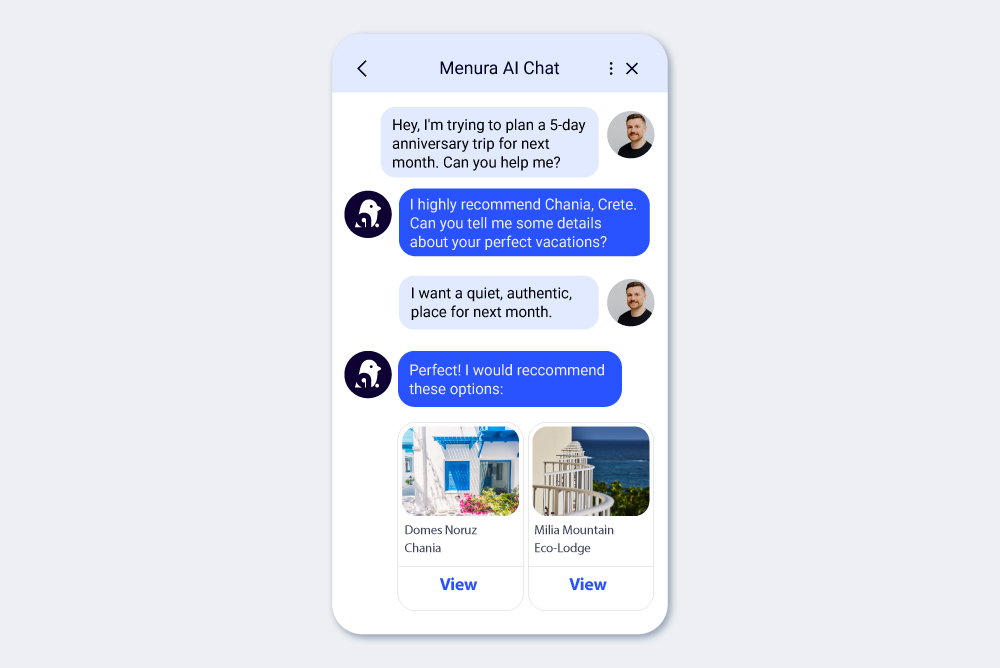
A fully retail-native AI commerce agent designed to guide travel shoppers across discovery, comparison, and purchase, while connecting personalization, recommendations, and customer assistance across every channel.
Standout features
Real-time decision-making powered by ContactPigeon’s customer data and commerce intelligence, including behavioral signals, affinity, lifecycle stage, and purchase history.
Acts more like a digital travel advisor than a static chatbot, helping shoppers explore destinations, compare offers, understand options, and move closer to booking.
Dynamically adapts messaging and recommendations based on where the customer is in the journey, from first-time browsing to repeat booking and loyalty engagement.
Pros
- Purpose-built for retail and eCommerce, not just customer support.
- Strong fit for EU retailers that need GDPR-aware personalization and customer engagement.
- Omnichannel by design: on-site, email, SMS, push, and WhatsApp.
- Can support guided travel discovery, package recommendations, upsells, and ancillary revenue opportunities.
- Connects AI conversations with lifecycle marketing, retention, and loyalty activation.
- Better suited than generic bots for brands that want AI to influence real commercial outcomes.
Cons
- Not necessary for brands without digital commerce or CRM maturity.
- Requires a well-structured travel offer catalog to unlock stronger performance.
- Best suited for retailers that want a commerce agent, not just a simple FAQ bot.
Pricing
Mid-range, optimized for mid-to-large European travel retailers seeking scalable personalization without the cost and complexity of heavier enterprise platforms.
Best for
Ideal for travel retailers that see personalization, customer experience, and lifetime value as growth levers, not just conversion tools. Especially relevant for brands that want an AI agent capable of:
- Personalized travel recommendations
- Guided package and offer discovery
- Ancillary upselling and cross-selling
- Loyalty-driven retention strategies
- Omnichannel customer engagement at scale
Integrations
CRM, CDP, email marketing, automation systems, product catalog, customer data infrastructure, and relevant booking or travel inventory systems.
Bloomreach Clarity: Enterprise AI shopping guidance
What it is
An enterprise AI shopping assistant designed to improve product discovery and digital commerce experiences through conversational guidance and advanced personalization.
Standout features
- Strong product discovery and recommendation capabilities for large, complex catalogs.
- Built for organizations that want AI-assisted browsing layered into a broader enterprise commerce environment.
- Best positioned for teams that already operate with mature merchandising, search, and personalization workflows.
Pros
- Strong enterprise positioning.
- Useful for large travel brands with broad inventories or complex booking options.
- Supports advanced personalized discovery experiences.
- Works well for organizations with the internal resources to manage implementation and optimization.
Cons
- Can be too expensive or complex for smaller travel retailers.
- More suited to large enterprises than lean travel eCommerce teams.
- Often makes more sense as part of a broader Bloomreach investment.
- Time-to-value may be slower for businesses looking for a focused AI commerce layer.
Pricing
Enterprise pricing is typically sales-led and more suitable for companies with larger digital commerce budgets.
Best for
Large travel enterprises, OTAs, and marketplaces with mature digital infrastructure and a strong need for advanced discovery and personalization.
Integrations
Enterprise eCommerce stack, search, merchandising, CRM, CDP, analytics, and broader personalization systems.
Zendesk AI Agents: Customer support automation
What it is
An AI-powered support solution designed to automate customer service conversations, answer common questions, and reduce service workload.
Standout features
- Strong support for automation for repetitive travel queries such as cancellations, booking changes, refunds, itinerary questions, and service policies.
- Effective at deflecting tickets and improving response speed.
- Useful when travel brands need reliable customer service efficiency at scale.
Pros
- Strong for ticket deflection and support automation.
- Helps travel teams manage high service volumes.
- Good for repetitive booking and policy-related questions.
- Reliable for service operations that already use Zendesk.
Cons
- Not a true commerce agent for travel retail.
- Limited in product discovery, booking guidance, and ancillary upsell use cases.
- Does not naturally support lifecycle marketing or customer value growth.
- Better at service efficiency than commercial personalization.
Pricing
Tiered pricing based on support plans and AI capabilities.
Best for
Travel businesses with high customer service volume that want AI primarily for support efficiency, not end-to-end commerce growth.
Integrations
Help desk, ticketing, customer support workflows, knowledge bases, CRM, and messaging channels.
Intercom Fin: AI customer service agent
What it is
An AI service agent built to answer customer questions, automate support interactions, and escalate more complex issues to human teams.
Standout features
- Fast deployment across support environments.
- Strong at answering FAQ-style queries and handling routine customer conversations.
- Works well for digital-first support teams that need quick AI adoption.
Pros
- Good support automation for routine questions.
- Strong human handoff model.
- Useful for reducing pressure on service teams.
- Suitable for travel brands that prioritize fast service response.
Cons
- Not built specifically for travel eCommerce merchandising or package discovery.
- Limited capability in upselling, cross-selling, and deeper travel recommendation logic.
- Does not function as a full omnichannel commerce orchestration layer.
- Less suited for brands focused on conversion and retention growth.
Pricing
Usage-based pricing tied to AI-resolved conversations and selected plan structure.
Best for
Travel brands that want to improve customer support efficiency but do not need a full commerce-focused AI agent.
Integrations
Support inboxes, help centers, messaging tools, CRM platforms, and connected support workflows.
Tidio Lyro: Lightweight AI chatbot
What it is
A lightweight AI chatbot focused on answering customer questions, automating simple conversations, and helping smaller businesses add chat-based support.
Standout features
- Easy to deploy and accessible for smaller teams.
- Useful for FAQ automation, lead capture, and basic customer engagement.
- Practical as a first step into AI chat.
Pros
- Easy setup.
- Lower barrier to entry for smaller travel businesses.
- Useful for simple support and lead capture.
- Can help teams test chatbot use cases without a heavy implementation.
Cons
- Not purpose-built for travel retail.
- Limited personalization and journey depth.
- Weak fit for complex booking journeys or advanced ancillary selling.
- Less suitable for larger EU travel retailers with broader governance and integration needs.
Pricing
Lower-cost and usage-based compared with heavier enterprise platforms.
Best for
Small travel businesses or local agencies looking for a basic AI chatbot rather than a true AI commerce agent.
Integrations
Website chat, selected CRM tools, help desk workflows, email, and limited commerce integrations, depending on the setup.
Build vs buy an AI agent: What’s best for the travel retail industry?
| Dimension | Build a Custom AI Agent | Buy an AI Agent |
|---|---|---|
| Total cost of ownership | High upfront and ongoing cost across LLM access, engineering, data pipelines, integrations, testing, optimization, and support. | Lower and more predictable cost, with platform, maintenance, updates, and support usually included in the commercial agreement. |
| Data and LLM governance | Full control, but the retailer must manage consent, privacy, model behavior, data usage, security, and compliance internally. | Governance is easier to operationalize when the vendor already supports privacy controls, guardrails, permissions, and GDPR-ready workflows. |
| Infrastructure and maintenance complexity | Requires continuous maintenance across hosting, APIs, booking data, product feeds, customer data, model updates, monitoring, and fallback logic. | Reduces technical complexity because infrastructure, updates, reliability, and performance monitoring are handled by the provider. |
| In-house constraints and talent scarcity | Depends on access to AI engineers, data teams, UX specialists, CRM experts, and travel eCommerce specialists, which can slow deployment. | Faster to launch because the retailer can rely on vendor expertise, implementation support, and existing AI commerce capabilities. |
| Risk of stale intents | Higher risk if customer intents, seasonal travel demand, policies, pricing, and booking rules are not continuously updated. | Lower risk when the agent is connected to live catalogs, customer data, automation workflows, and ongoing optimization processes. |
| When building makes sense vs buying | Best for very large travel enterprises with proprietary systems, strong AI teams, custom compliance needs, and the budget to maintain the agent long term. | Best for travel retailers that want faster time-to-value, proven commerce use cases, omnichannel activation, and lower operational burden. |
Additional resources for travel retailers
- AI agents in travel eCommerce– Research on embedded AI assistants in travel eCommerce, including how shoppers use chat for exploratory travel discovery.
- ContactPigeon case studies– Real examples of retail brands using omnichannel automation, personalization, and customer engagement to increase eCommerce performance.
- AI adoption and market outlook in travel– A market overview of AI in travel, including customer service, booking, travel planning, personalization, and operations.
- AI-powered chatbot impact on travel decisions– Research on how tourism chatbots influence satisfaction, continued use, and destination visit intention.
Choosing the right AI agent for travel retail
Travel retail is entering a new era where personalization, real-time guidance, and intelligent automation determine which brands can turn browsing intent into bookings. The best eCommerce AI agents for tourism, such as Menura AI, make this possible by helping shoppers discover relevant destinations, compare packages, understand add-ons, receive timely support, and move through the booking journey with less friction.
As customer expectations rise, travel brands need AI that understands both their offers and their shoppers with precision. The right AI agent should connect customer data, inventory, recommendations, support, and omnichannel engagement in a way that improves CX while supporting measurable gains in conversion, ancillary revenue, retention, and customer lifetime value.
If you are ready to transform your digital travel experience, book a personalized Menura AI demo and see how travel retailers can guide shoppers through smarter, more intuitive AI-powered journeys.