Zara matters now because it represents a retail model where speed, assortment control, store density, digital demand, and inventory visibility operate as one commercial system. As Inditex’s largest concept, Zara shows how modern fashion retailers can turn operating discipline into customer relevance across stores and online channels.
This case matters to retail leaders because Zara is not simply an eCommerce success story. It is a case study in how a vertically coordinated retail business can keep scaling while reducing store count, expanding online sales, and investing in technology-led customer experience.
Reporting note: Inditex reports Zara together with Zara Home in older years and reports Zara, Zara Home, and Lefties together in FY2025. Some performance charts use Inditex group-level reporting, which is the most consistent public metric across years.
Performance timeline of Zara
This timeline covers FY2021–FY2025, using Inditex’s public reporting. The visible dimensions are sales, profit before tax, online sales, store footprint, and geographic sales mix.
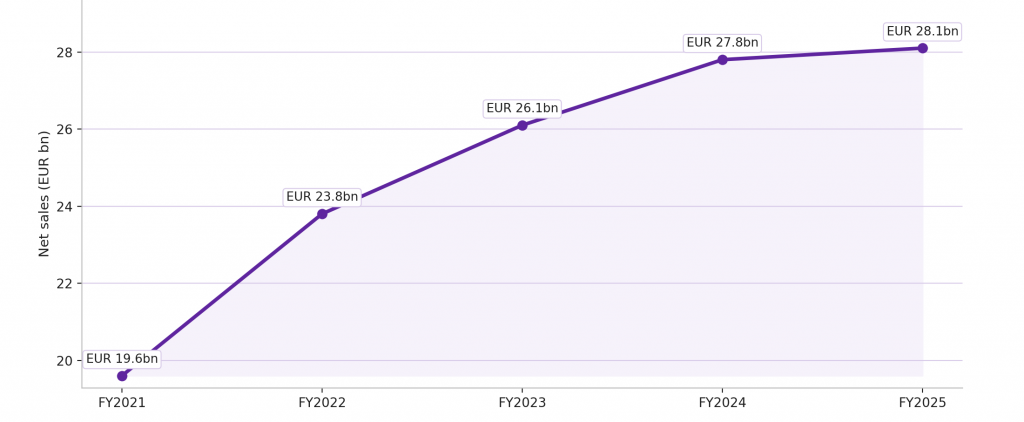
Chart 1: Net sales of Zara, Zara Home, and Lefties — FY2021–FY2025
This chart shows the sales trajectory of Inditex’s Zara reporting segment.
Key inflection points
- FY2021–FY2022: Zara concept sales rose from EUR 19.6bn to EUR 23.8bn, a reported increase of about EUR 4.2bn. (Inditex)
- FY2024–FY2025: Zara concept sales rose from EUR 27.8bn to EUR 28.1bn, an increase of about EUR 0.3bn; FY2025 comparability is affected by the inclusion of Lefties. (Inditex)
Why this matters: Zara has moved from post-pandemic recovery growth into a more mature growth phase where productivity, margin, and channel integration matter more than headline expansion.
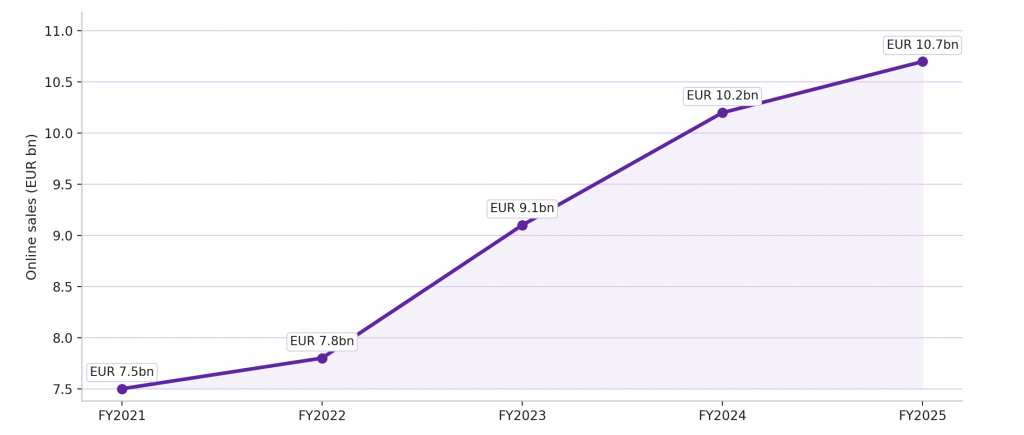
Chart 2: Online sales of Inditex — FY2021–FY2025
This chart uses Inditex group-level online sales, the metric published consistently across FY2021–FY2025.
Key inflection points
- FY2021–FY2025: Online sales increased from EUR 7.5bn to EUR 10.7bn, an absolute increase of EUR 3.2bn. (Inditex)
- FY2024–FY2025: Online sales grew 4.8%, reaching EUR 10.7bn. (Inditex)
Why this matters: Online has become a scaled revenue layer, while Zara’s advantage remains tied to how digital demand connects with stores and inventory.
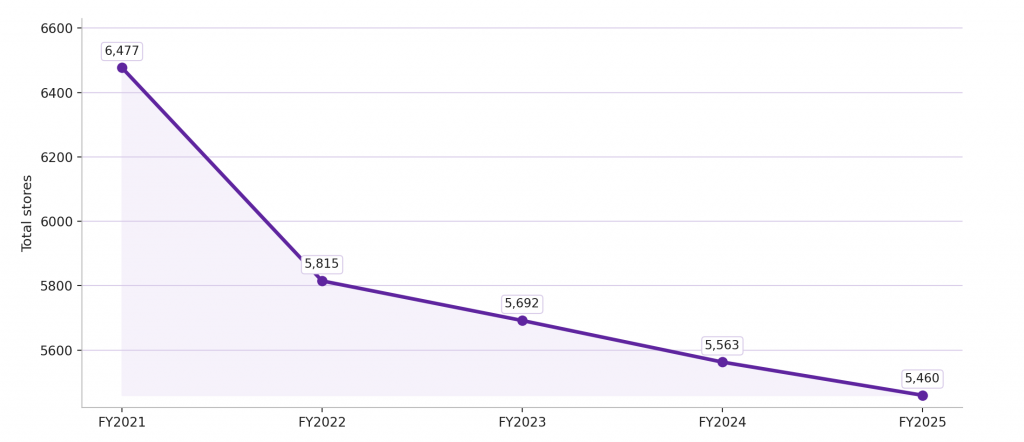
Chart 3: Inditex store count — FY2021–FY2025
This chart uses Inditex group-level store count to show the company’s physical footprint trend.
Key inflection points
- FY2021–FY2025: Inditex store count declined from 6,477 to 5,460, a reduction of 1,017 stores. (Inditex)
- FY2022–FY2025: Inditex reported that sales grew 22% over three years while the number of stores declined 6% and net space increased 6%. (Inditex)
Why this matters: The model has shifted from store-count expansion to larger, more productive stores connected to online demand.
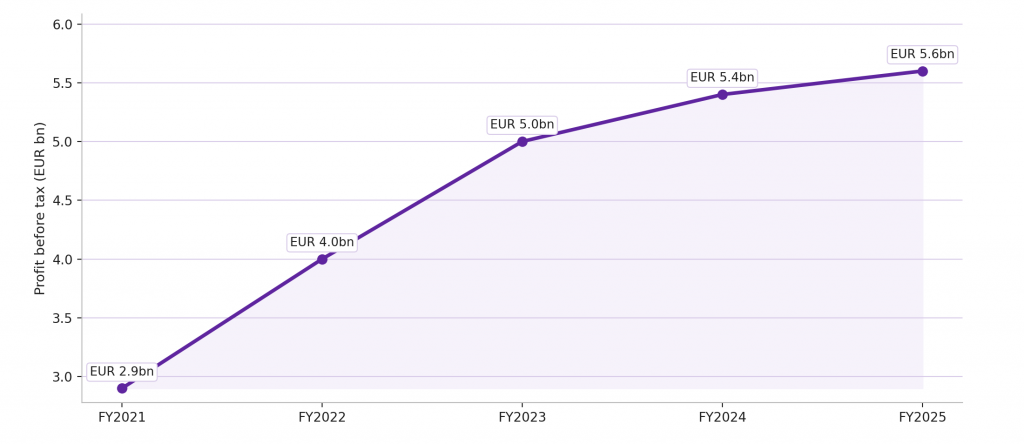
Chart 4: Profit before tax of Zara, Zara Home, and Lefties — FY2021–FY2025
This chart shows the reported profit before tax for the Zara concept.
Key inflection points
- FY2021–FY2023: Zara concept PBT increased from EUR 2.9bn to EUR 5.0bn, an absolute increase of EUR 2.1bn. (Inditex)
- FY2024–FY2025: Zara concept PBT increased from EUR 5.4bn to EUR 5.6bn, an increase of about EUR 0.2bn. (Inditex)
Why this matters: Zara remains the main profit pool inside Inditex, even as sales growth moderates.
Business model decoded: Zara’s retail strategy explained
The Zara retail strategy is built around fast product development, controlled distribution, high store productivity, and online-store integration. Its primary economic lever is speed: matching supply to demand quickly enough to reduce markdown pressure while preserving customer relevance.
Business Model Snapshot
Zara creates and captures value through product speed, controlled distribution, store productivity, and integrated retail operations.
| Dimension | Zara reality | Evidence / source |
|---|---|---|
| Core value proposition | Fashion-led assortment with design, quality, and accessible pricing. |
Inditex describes its model as offering fashion at the right quality and price, supported by customer listening and responsiveness.
Inditex: Our Approach |
| Assortment model | Own-brand, internally coordinated product model. |
Inditex operates eight commercial formats and reports concept-level sales across its brands.
Inditex FY2025 Results |
| Primary revenue streams | Company-managed retail and franchised sales; Zara concept sales are mostly company-managed. |
Zara, Zara Home, and Lefties generated 87% of sales through company-managed stores and 13% through franchised stores in FY2025.
Inditex FY2025 Results Annex |
| Margin profile | High gross margin and high operating profitability. |
Inditex reported 58.3% gross margin and EUR 8.0bn PBT in FY2025.
Inditex FY2025 Results |
| Cost intensity | Personnel, rent, logistics, inventory, and technology are material cost drivers. |
FY2025 operating expenses included personnel expenses of EUR 5.9bn, rental expenses of EUR 1.1bn, and other operating expenses of EUR 4.9bn.
Inditex FY2025 Results |
| Key constraints | Growth requires continued investment in stores, online platforms, and logistics. |
Inditex guided ordinary capex of around EUR 2.3bn in 2026, focused mainly on commercial space, technological integration, and online platforms.
Inditex FY2025 Results Annex |
Value creation logic
- Customer value driver: Zara creates value through fast alignment between customer demand and new product availability; Inditex states that customer listening, real-time sales data, and targeted production runs inform product decisions. (Inditex)
- Assortment and pricing logic: The model prioritizes frequent assortment renewal instead of deep, long-season inventory exposure.
- Differentiation vs peers: Proximity sourcing and short production runs allow Inditex to respond faster to demand than retailers with longer, fully offshore planning cycles. (Inditex)
Value capture & economics
- Profitability signal: Zara, Zara Home, and Lefties generated EUR 5.6bn PBT in FY2025, making the Zara concept Inditex’s largest profit contributor. (Inditex)
- Cost drivers: Personnel, rent, logistics, online platforms, store technology, and inventory management are structurally important because Zara’s model depends on rapid availability and store productivity. (Inditex)
- Pricing and volume leverage: The model captures value by selling large volumes of fashion-led products through company-managed and franchised retail channels.
Scale effects & structural advantages
- Scale advantage: Inditex operated 5,460 stores at FY2025 year-end and reported online sales of EUR 10.7bn, giving Zara access to both physical and digital demand signals. (Inditex)
- Vertical coordination: Inditex links design, production, logistics, stores, and online through an integrated value chain. (Inditex)
- Defensibility: RFID, store-online integration, and centralized logistics make the model difficult to copy without comparable operating discipline. (Inditex)
Structural limits & trade-offs
- Capital intensity: The model requires continued investment in stores, technology, logistics, and commercial space. (Inditex)
- Growth constraints: Store optimization can lift productivity, but it also limits growth from simple unit expansion.
- Profitability vs growth tension: FY2025 showed stronger profit resilience than Zara sales acceleration, meaning future growth depends on productivity, assortment relevance, and channel integration rather than store-count expansion alone.
Omnichannel architecture: Zara’s online-to-offline retail strategy
The Zara retail strategy uses stores, online, mobile, RFID, and inventory systems to connect customer demand with physical supply. The architectural backbone is an integrated inventory visibility supported by RFID, store-based services, and Inditex’s Open Platform.
Omnichannel Architecture Snapshot
Zara’s online-to-offline architecture connects stores, eCommerce, mobile services, inventory visibility, and logistics investment.
| Layer | Zara implementation | Evidence / source |
|---|---|---|
| Sales channels | Stores, DTC website, mobile app, Zara Home, Zara Pre-Owned in selected markets. |
Zara US public site exposes store, online, app, gift card, and Pre-Owned navigation.
Zara US Website |
| Inventory model | Integrated stock across stores and online. |
Inditex states RFID integrates stock across all brands and that SINT enables online orders to be fulfilled from store stockrooms and online stockrooms.
Inditex: Our Approach |
| Fulfillment options | Store pickup, home delivery, delivery points, and Store Mode services in supported markets. |
Zara US help pages describe store pickup, delivery options, and Store Mode.
Zara Store Mode |
| Customer identity | Account-based and guest purchasing; Zara QR links purchases and receipts in app contexts. |
Zara allows registered or guest checkout, with order tracking available through accounts or the guest order link.
Zara Online Purchases Help |
| Store services | Store Mode supports in-store location, fitting-room booking, and collection workflows in selected stores. |
Zara US help pages describe Store Mode features and usage conditions.
Zara Store Mode |
| Logistics backbone | Centralized logistics investment supports store and online operations. |
Inditex outlined a 2024–2025 logistics expansion plan, including EUR 900m per year to increase logistics capacity.
Inditex 9M2025 Results |
Channel & inventory connectivity
- Inventory model: RFID is used across Inditex brands to integrate stock and help locate items. (Inditex)
- Fulfillment paths: SINT supports online order fulfillment from both store stockrooms and online stockrooms. (Inditex)
- Store services: Zara Store Mode supports in-store location, fitting-room booking, and order collection services in selected stores. (Zara)
Customer identity & data continuity
- Identity linkage: Customers can buy online as registered users or guests. (Zara)
- Order tracking: Registered users can track orders through their account; guests can track orders through the “Manage Your Order” link. (Zara)
- Purchase support: Zara provides order, delivery, exchange, return, and payment support through its online help center. (Zara)
Order orchestration & fulfillment logic
- Store-linked fulfillment: SINT enables online orders to be fulfilled from store stockrooms and online stockrooms. (Inditex)
- Delivery options: Zara US offers store pickup, home delivery, and delivery-point options. (Zara)
- Logistics investment: Inditex’s 2024–2025 logistics expansion plan allocated EUR 900m per year to increase logistics capacity. (Inditex)
Architectural trade-offs
- Speed vs complexity: Store-online integration increases fulfillment flexibility while adding execution complexity across stores, logistics, and digital systems.
- Cost vs flexibility: RFID, store technology, and logistics investment create flexibility but require sustained capex.
- Dependency risk: The model depends on accurate inventory, store execution, logistics capacity, and system coordination.
Analysis of Zara’s growth marketing strategy
Method used: Observational Executive Review using public disclosures, official site captures, visible owned-channel structures, and Inditex reporting.
Summary Table: Zara’s Growth Engines
Zara’s growth marketing strategy is product-led and store-amplified, using owned channels, store visibility, editorial launches, circularity services, AI-assisted discovery, and collaborations.
| Growth engine | Objective | Public signal | Timeframe | Strategic role | Owner |
|---|---|---|---|---|---|
| Product-led editorial launches | Build brand relevance |
Zara 50 used 50 top models and 50 creators.
Inditex Annual Report 2025 |
FY2025 | Turns product launches into brand attention. | Brand / creative |
| Owned app and web audience | Retain and monetize demand |
Online sales reached EUR 10.7bn, up 4.8%.
Inditex FY2025 Results |
FY2025 | Converts digital demand across Inditex brands. | eCommerce / digital |
| Store-led visibility | Acquire and convert local demand |
5,460 stores across 97 markets.
Inditex Annual Report 2025 |
FY2025 | Keeps stores central to discovery and fulfillment. | Retail / expansion |
| Circularity services | Extend post-purchase engagement |
Zara Pre-Owned active in 17 markets.
Inditex Annual Report 2025 |
FY2025 | Expands the relationship beyond new-product buying. | Sustainability / digital |
| AI-assisted experience | Support product discovery |
Zara Try-On available in 26 markets.
Inditex Annual Report 2025 |
FY2025 | Adds AI-enabled outfit visualization to digital commerce. | Product / digital |
| Collaborations and capsules | Create demand moments |
Zara x Ludovic de Saint Sernin and Zara x Disney with Harry Lambert highlighted.
Inditex Annual Report 2025 |
FY2025 | Builds cultural relevance through limited product initiatives. | Brand / merchandising |
Product-led editorial launches
- Zara’s 50th anniversary campaign involved 50 top models in a Steven Meisel film and a dedicated exclusive collection in FY2025. (annualreport.inditex.com)
- The Zara 50 Creators project included 50 exclusive pieces designed with major cultural figures. (annualreport.inditex.com)
- In short: Zara turns product and culture into acquisition media.
Owned app and web audience
- Inditex online sales reached EUR 10.7bn in FY2025, growing 4.8% year over year. (Inditex)
- FY2024 disclosures showed 218m active apps and 8.1bn online visits, the latest detailed audience metrics included in the supplied evidence. (Inditex)
- In short: Owned channels give Zara and Inditex direct digital demand at scale.
Store-led visibility
- Inditex had 5,460 stores across 97 markets at FY2025 year-end. (annualreport.inditex.com)
- FY2025 included 190 openings, 217 refurbishments, and 293 absorptions across the group. (Inditex)
- In short: Stores remain media, fulfillment nodes, and conversion assets.
Circularity services
- Zara Pre-Owned circularity services were active in 17 markets in FY2025. (annualreport.inditex.com)
- The service supports resale, repair, and donation journeys. (annualreport.inditex.com)
- In short: Circularity extends customer engagement beyond new-product buying.
AI-assisted product discovery
- Zara introduced an AI-powered Try-On feature in 26 markets in FY2025. (annualreport.inditex.com)
- Inditex described the feature as designed to help users mix and match garments and visualize combinations. (annualreport.inditex.com)
- In short: AI is being used as a discovery layer, not only automation.
Collaborations and capsule drops
- FY2025 highlighted Zara x Ludovic de Saint Sernin and Zara x Disney with Harry Lambert among notable brand initiatives. (annualreport.inditex.com)
- Zara’s public site also surfaced collaboration navigation, including Dylan’s T-Shirt Club, Willy Chavarria x Zara, and Ford. (Zara)
- In short: Collaborations refresh attention through product and cultural association.
Sourcing block
- Inditex, FY2025 Results, 2026-03-11. (Inditex)
- Inditex, Annual Report 2025, Our Drivers. (annualreport.inditex.com)
- Inditex, FY2024 Results, 2025-03-12. (Inditex)
- Zara US public website capture, 2026-04-30. (Zara)
Analysis of the eCommerce strategy of Zara
Zara’s eCommerce strategy supports the brand by combining editorial merchandising, direct product discovery, account-based ordering, and fulfillment messaging.
eCommerce Strategy Summary
| Area | Strength / issue | Why it matters | Metric / evidence | Priority | Owner |
|---|---|---|---|---|---|
| Home | Clear indexable H1 | Supports basic SEO and brand relevance. |
1 H1: “ZARA United States | New Collection Online,” captured on 2026-04-30.
Zara US Homepage |
H | SEO |
| Home | Newsletter and social links present | Supports owned audience capture. |
1 newsletter link + 6 social links visible in footer.
Zara US Homepage |
M | CRM / Brand |
| Home | Repeated footer blocks visible in captured HTML | Can create crawl and rendering noise. |
Multiple repeated footer sections visible in public page capture.
Zara US Homepage |
M | SEO / Front-end |
| PLP | Product titles and prices exposed | Supports crawlability and product scanning. |
Product names and USD prices visible in PLP HTML.
Zara Men New In PLP |
H | SEO / Merchandising |
| PLP | Editorial “LOOK” tiles precede products | Prioritizes inspiration before product listing. |
8 “LOOK” modules appear before first named product in captured PLP.
Zara Men New In PLP |
M | UX / Merchandising |
| PDP | Price, Add, availability, and returns links visible | Supports purchase decision and confidence. |
PDP shows price, Add, check in-store availability, and shipping / returns link.
Zara PDP Example |
H | Product |
| Checkout | Guest and registered checkout supported | Reduces account-creation friction. |
Zara allows purchase as registered user or guest.
Zara Online Purchases Help |
H | Product |
| Checkout | Delivery and returns costs are explicit | Reduces uncertainty near conversion. |
Store pickup, home delivery, and return options are published.
Zara Delivery Methods |
H | CX / Operations |
Home Page Analysis
What we liked
- The homepage exposes 1 H1: “ZARA United States | New Collection Online,” captured on 2026-04-30. (Zara)
- The footer includes 1 newsletter signup and 6 social links: TikTok, Instagram, Facebook, Pinterest, YouTube, and Spotify. (Zara)
- The main merchandising focus is clear, with “THE NEW” visible as the primary homepage destination. (Zara)
What we didn’t
- The captured HTML shows repeated footer blocks, which can create crawl and rendering noise if replicated in production output. (Zara)
Category Pages Analysis — PLP
What we liked
- The PLP exposes product names and USD prices in crawlable text, including items such as “100% Wool Textured Suit Jacket” at USD 219.00. (Zara)
- The category structure includes new arrivals, best sellers, suits, jeans, jackets, shoes, accessories, and collaborations. (Zara)
- The captured PLP uses both editorial “LOOK” modules and standard product listings. (Zara)
What we didn’t
- The captured PLP showed 8 “LOOK” modules before the first named product listing, prioritizing editorial inspiration before product discovery. (Zara)
Product Pages Analysis — PDP
What we liked
- The PDP exposes product description, contents, measurements, color, SKU, H1, price, and Add action in public HTML. (Zara)
- The PDP includes “Check in-store availability,” supporting cross-channel purchase confidence. (Zara)
- Shipping, exchanges, returns, and help links are visible near the purchase area. (Zara)
Cart Checkout Flow Analysis
What we liked
- Zara supports both registered and guest checkout. (Zara)
- Zara US discloses store pickup, home delivery, and delivery-point options, including 3–5 working days for store pickup and 2–4 working days for standard home delivery. (Zara)
- Online returns are allowed within 30 days, with free store returns and paid drop-off returns in the US. (Zara)
What we didn’t
- Drop-off point returns cost USD 4.95 in the US, while store returns are free; this creates a clear cost difference between return channels. (Zara)
Sourcing block
- Zara US homepage, public capture, 2026-04-30. (Zara)
- Zara US PLP, public capture, 2026-04-30. (Zara)
- Zara US PDP, public capture, 2026-04-30. (Zara)
- Zara US help pages: buying, shipping, returns, Store Mode. (Zara)
Zara marketing strategy resources: Best videos to watch
Video 1: Óscar García Maceiras | CEO Signature Series and Stanton Distinguished Leaders Series
Why it matters
- Covers Inditex’s business model, sustainability approach, and retail evolution from a CEO perspective. (YouTube)
- Useful for CMOs evaluating how product, operating model, and brand relevance are connected.
Video 2: Conversación con Óscar García Maceiras, CEO de Inditex
Why it matters
- Discusses growth opportunities and Inditex’s future operating focus. (YouTube)
- Useful for executives comparing Zara’s growth model with other global fashion retailers.
Zara: The most impressive statistics of the fast fashion retailer
These figures summarize Zara’s scale, economics, operating model, and strategic position using the latest available public data.
1: Zara Concept Revenue
- Metric: EUR 28.1bn
- Period: FY2025
- Context: Zara, Zara Home, and Lefties remain Inditex’s largest reported concept by revenue.
- Source: Inditex FY2025 results. (Inditex)
2: Inditex Group Revenue
- Metric: EUR 39.9bn
- Period: FY2025
- Context: Shows the scale of the group in which Zara is the core concept.
- Source: Inditex FY2025 results. (Inditex)
3: Online Sales
- Metric: EUR 10.7bn
- Period: FY2025
- Context: Confirms online as a scaled revenue channel across Inditex brands.
- Source: Inditex FY2025 results. (Inditex)
4: Gross Margin
- Metric: 58.3%
- Period: FY2025
- Context: Indicates that Zara’s parent group combines speed with margin discipline.
- Source: Inditex FY2025 results. (Inditex)
5: Zara Concept Profit Before Tax
- Metric: EUR 5.6bn
- Period: FY2025
- Context: Shows Zara’s role as the main earnings engine inside Inditex.
- Source: Inditex FY2025 results. (Inditex)
6: Store Footprint
- Metric: 5,460 stores across 97 markets
- Period: FY2025
- Context: Shows Inditex’s global physical reach after several years of store optimization.
- Source: Inditex Annual Report 2025. (annualreport.inditex.com)
7: Zara Concept Store Count
- Metric: 1,500 Zara stores, 374 Zara Home stores, 215 Lefties stores
- Period: FY2025
- Context: Shows the physical footprint of the combined Zara reporting concept.
- Source: Inditex FY2025 results annex. (Inditex)
8: Company-Managed Sales Mix
- Metric: 87% company-managed sales for Zara, Zara Home, and Lefties
- Period: FY2025
- Context: Indicates direct control over most Zara concept revenue.
- Source: Inditex FY2025 results annex. (Inditex)
9: Zara Pre-Owned Market Coverage
- Metric: 17 markets
- Period: FY2025
- Context: Shows how circularity services are becoming part of Zara’s broader customer relationship.
- Source: Inditex Annual Report 2025. (annualreport.inditex.com)
10: AI Try-On Rollout
- Metric: 26 markets
- Period: FY2025
- Context: Shows Zara’s use of AI as a product discovery and outfit-building layer.
- Source: Inditex Annual Report 2025. (annualreport.inditex.com)
Latest news on Zara
These updates cover recent strategic and financial developments from 2025–2026.
News 1: Inditex Reports FY2025 Record Sales and Profit
Source: Inditex
Date: 2026-03-11
What happened: Inditex reported FY2025 sales of EUR 39.9bn, net income of EUR 6.2bn, and Zara concept sales of EUR 28.1bn. (Inditex)
Why it matters
- Confirms Zara’s continued role as Inditex’s core revenue and profit engine.
- Shows that sales growth is slower, making productivity and margin management more important.
News 2: Inditex Reaches EUR 28.2bn Sales in 9M2025
Source: Inditex
Date: 2025-12-03
What happened: Inditex reported EUR 28.2bn in 9M2025 sales, up 2.7%, with sales in constant currency up 6.2%. (Inditex)
Why it matters
- Shows positive growth despite currency pressure.
- Reinforces the importance of constant-currency performance for global fashion retailers.
News 3: Inditex Confirms Logistics Expansion Plan
Source: Inditex
Date: 2025-12-03
What happened: Inditex said its 2024–2025 logistics expansion plan remained on track, allocating EUR 900m per year to increase logistics capacity, with Zaragoza II operational. (Inditex)
Why it matters
- Strengthens the operating backbone behind Zara’s fast replenishment and global growth.
- Indicates that logistics capacity remains a strategic investment area, not a back-office function.
News 4: Zara Introduces AI Try-On in 26 Markets
Source: Inditex Annual Report
Date: FY2025
What happened: Zara introduced an AI-powered Try-On feature in 26 markets, designed to help users create outfits, mix garments, and visualize silhouettes. (annualreport.inditex.com)
Why it matters
- Shows Zara using AI for product discovery and styling, not only operational automation.
- Signals where fashion eCommerce experience may move next.
News 5: Zara Celebrates 50 Years with Creator-Led Brand Platform
Source: Inditex Annual Report
Date: FY2025
What happened: Zara celebrated its 50th anniversary with a Steven Meisel film featuring 50 top models and a Zara 50 Creators project with 50 exclusive pieces. (annualreport.inditex.com)
Why it matters
- Shows how Zara uses cultural relevance and product storytelling to renew brand equity at scale.
- Provides a model for retail CMOs balancing mass reach with design credibility.
News 6: Inditex 1H2025 Results Show Slower Reported Growth but Stable Profitability
Source: Inditex
Date: 2025-09-10
What happened: Inditex reported EUR 18.4bn in 1H2025 sales, up 1.6%, with gross margin at 58.3%. (Inditex)
Why it matters
- Signals that margin discipline remained stable even as reported sales growth slowed.
- Gives CMOs and CFOs a shared lens: growth quality matters as much as growth rate.
Build Your Zara-Inspired Retail Orchestration Map
Zara’s advantage comes from aligning product speed, store productivity, online demand, inventory visibility, and customer engagement. Select a strategic capability below to see how retailers can translate Zara’s model into actionable orchestration.

Lessons learned from Zara’s marketing strategy
These lessons translate Zara’s model into transferable principles for retail leaders.
1: Treat speed as a strategic capability, not a campaign tactic
- What Zara did: Built a model where design, sourcing, logistics, stores, and online channels are coordinated around customer demand.
- Why it worked: Faster response reduces the gap between trend detection and product availability.
- When this applies: Works best when merchandising, supply chain, and channel teams can act on shared demand signals.
2: Use stores as productivity assets, not just expansion units
- What Zara did: Reduced total store count while increasing sales and commercial space productivity.
- Why it worked: Larger, better-integrated stores can support selling, fulfillment, brand presence, and returns.
- When this applies: Works when a retailer already has enough market density to optimize rather than only open new stores.
3: Make product cadence part of the growth engine
- What Zara did: Used frequent product renewal, editorial launches, and collaborations to drive recurring customer attention.
- Why it worked: Product change creates a reason to revisit without relying only on discounting or paid media.
- When this applies: Works when assortment teams can refresh supply without overloading inventory risk.
4: Connect online demand with physical inventory
- What Zara did: Integrated RFID, store stock, online stockrooms, and store-based services.
- Why it worked: Inventory visibility makes digital demand easier to fulfill across the store network.
- When this applies: Works when stores can operate as both selling spaces and inventory nodes.
5: Protect margin by managing complexity
- What Zara did: Combined fast product cycles with high gross margin and disciplined operating expense management.
- Why it worked: Speed can damage profitability unless inventory, store space, and fulfillment are tightly controlled.
- When this applies: Works when growth teams share accountability with finance, merchandising, and operations.
6: Use brand platforms to renew relevance at scale
- What Zara did: Marked its 50th anniversary with creator-led cultural projects and limited product initiatives.
- Why it worked: Mature retailers need brand renewal mechanisms that do not depend only on promotions.
- When this applies: Works when a brand has enough equity to attract credible creative partners.
Key takeaways from Zara’s marketing and retail strategy
Zara’s advantage is not a single channel, campaign, or UX feature. The pattern behind the Zara marketing strategy is system alignment: product decisions, retail footprint, digital demand, inventory visibility, and fulfillment options are designed to reinforce one another. That makes marketing less dependent on paid stimulus and more dependent on how quickly the business can sense demand and respond.
For retail leaders, the implication is clear: the next competitive gap will be operational, not only creative. Brands that connect customer data, assortment planning, inventory, lifecycle messaging, and fulfillment will learn faster and waste less effort than teams optimizing each channel in isolation.
Replicating that capability is difficult because it requires data discipline, process ownership, and execution speed across functions. This is where retailers often look to partners such as ContactPigeon when moving from strategic insight to practical customer orchestration.