Every retail leadership team runs into the same budget meeting eventually. Support wants funding for its next AI agent. So does the warehouse. Both are chasing AI agent ROI in retail out of the same finite pool of money, and only one of them is going to show results by the next board meeting. It’s rarely the one that gets approved first.
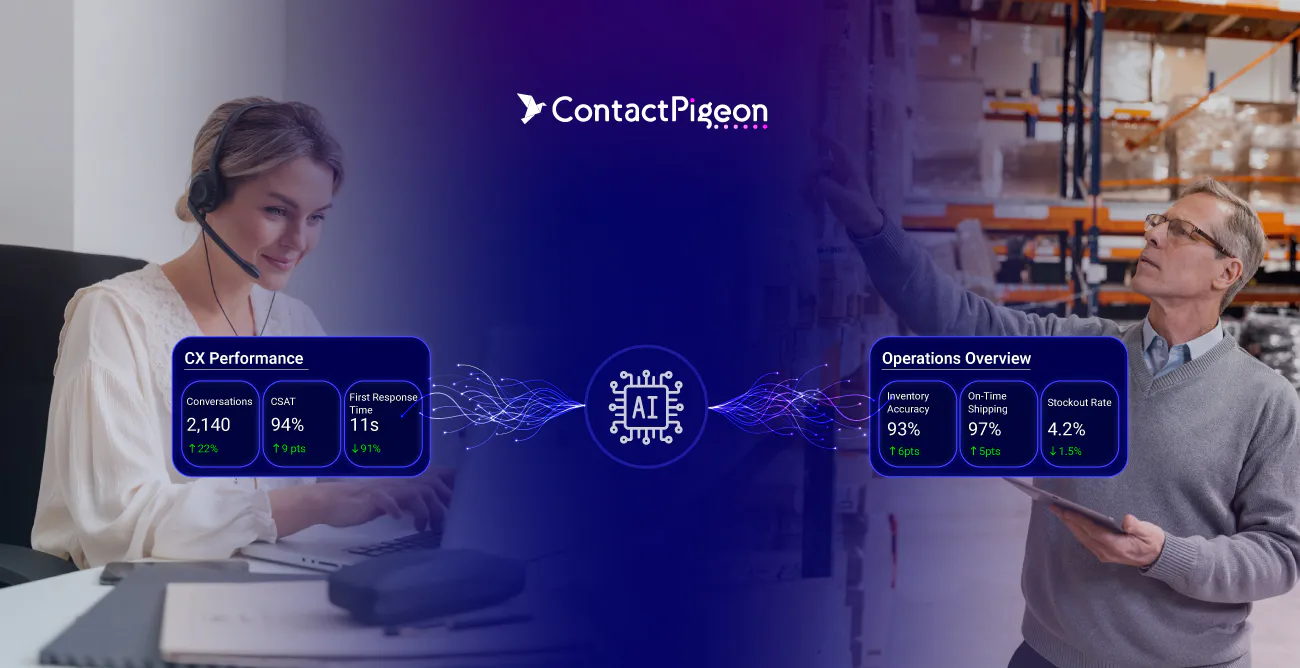
Where AI agents pay off first in retail isn’t a question of which department wants the budget more. Retailers are placing AI agent bets in customer experience and in operations at close to the same rate this year, but the two run on very different payback clocks: one shows measurable value inside weeks, the other doesn’t reach its full return for years. Same bet, different clock: that’s the real shape of AI agent ROI in retail right now. Understanding why tells you where the next dollar should go.
- Retailers are funding AI agents in CX and operations at nearly the same rate. Adoption is close to a coin flip, so it is not what separates a fast investment from a slow one.
- CX AI agents pay back fastest. Their tasks are bounded and reversible, while the measurement infrastructure needed to prove the result, including tickets and CSAT, already exists.
- Operations AI agents take longer to generate returns. Mistakes are costlier and trust in autonomous decisions remains low, although the eventual return can be larger.
- Sequencing CX first can make the operations investment easier to fund. Early CX results build the internal proof and trust needed to support a larger, slower operations rollout.
Is retail actually further along with CX AI or operations AI?
Adoption is close to a coin flip. In an October 2025 survey of 525 leaders at large US enterprises, 49% had deployed AI agents in customer support, compared with 47% in operations, a two-point gap that sits inside the survey’s margin of error (Zapier and Centiment).
If adoption is this close, adoption isn’t the interesting question. It tells you where companies are experimenting or have already gone live. It says nothing about which function pays back faster, which is safer to scale, or which investment builds the internal confidence a bigger bet needs later. That’s the question worth answering, and it has very little to do with which department raised its hand first.
Why customer service AI agents are paying back first
The fastest payback in retail AI isn’t going to the newest technology, but the most forgiving one. Customer service agents handle work that is bounded, repeated, and high in volume: order status, delivery timing, return policy, product availability, size and fit questions, store hours, product discovery, cart hesitation, post-purchase support. A wrong answer here is cheap to catch and cheap to fix, and that combination of bounded scope and low cost of error is exactly what lets these deployments show value fast.
In March 2026, Nucleus Research found that Zendesk AI Solutions reached measurable value in an average of 25 days, alongside a 34% drop in QA review time and a CSAT lift from 81.2 to 85.3. Salesforce’s May 2026 State of Service report put a number on how common that speed is: 70% of companies using AI agents saw measurable value within 60 days.
Retail’s own data backs this up at the operational level. Freshworks found that its AI agents deflected 53% of incoming retail queries, cutting first response time from 12 minutes to 12 seconds and resolution time from over an hour to two minutes. Deflection at that scale changes a P&L line inside the same quarter it launches, not the year after.
A second lever runs alongside deflection. McKinsey has found that AI-driven personalization in customer-facing workflows can lift satisfaction 15 to 20% and cut cost to serve by up to 30%, on top of the direct savings from ticket deflection.
This is where Menura AI sits naturally in ContactPigeon’s own stack: customer-facing AI conversations, product discovery, and service support with outcomes a retailer can measure inside a single reporting cycle. It doesn’t solve every AI agent use case a retailer will eventually need. It sits on the faster-payback side of the curve, the customer-facing side, which is exactly why it’s usually where the first credible AI agent business case gets built.
Why operations AI agents take longer, and why that’s not a red flag
Operations AI agents touch demand forecasting, replenishment, inventory allocation, stockout prevention, warehouse picking, delivery slot optimization, substitutions, returns forecasting, markdown pricing, workforce scheduling, and supplier coordination. These are high-value use cases. They’re also use cases with more systems in the loop, more dependencies between them, and a much higher cost when the agent gets it wrong.
Deloitte found that 85% of organizations increased AI investment over the past year, yet only 6% saw ROI in under a year; most reach satisfactory returns in two to four years. Even getting a first agent live takes longer here: Impact Analytics puts a typical first supply chain agent rollout at 8 to 16 weeks, and that’s before the ROI clock even starts. Strategy hasn’t caught up to enthusiasm either. Only 23% of supply chain organizations have a formal AI strategy in place, according to Gartner, even among those already running AI in production.
The trust gap is the clearest tell. In a January 2026 survey of 514 supply chain leaders, RELEX and Researchscape found that 67% report rising confidence in AI for supply chain decisions. Only 10% would trust it to decide fully on its own. That’s not organizations being slow. That’s organizations being careful with decisions where a mistake compounds across a warehouse instead of a single ticket.
None of this makes operations AI a worse bet, only a bigger and slower one. Organizations investing more heavily in supply chain AI report 61% greater revenue growth than peers, according to IBM, and McKinsey has found that AI-enabled distribution can cut logistics costs 5 to 20% and inventory 20 to 30%. Operations AI isn’t the slower bet because it’s worse. It’s slower because getting it wrong costs more, and everyone building it knows that.
AI agent ROI in retail: Payback period, side by side
Set the numbers from both sections next to each other and the case makes itself.
| Signal | Customer service AI | Operations and supply chain AI |
|---|---|---|
| Time to first measurable value | 25 days on average | 8–16 weeks just to get a first agent live |
| Share seeing value fast | 70% within 60 days | 6% see ROI within a year |
| Path to full return | Deflection and cost gains are visible within the launch quarter. | Two to four years to achieve satisfactory ROI. |
| Willingness to run without a human check | Most CX agents are built to escalate by design. | Only 10% would trust AI with fully autonomous decisions. |
What actually explains the gap, it’s not the department
The variable isn’t which team owns the budget line. It’s how forgivable a mistake is, and how much measurement infrastructure already exists to prove the result. A wrong refund is recoverable inside a single conversation. A wrong reorder propagates through a warehouse, a delivery schedule, and a markdown cycle before anyone can catch it. Support tickets and CSAT scores already exist as measurement infrastructure, so a retailer can prove a CX agent’s value against a baseline that was tracked long before the agent arrived. Trust in autonomous supply chain decisions mostly doesn’t exist yet, which is exactly what that 10% figure above is showing. A fast payback signals that a function was already easier to trust.
Sequencing AI agent investment: The case for CX first
Starting with CX is how you earn the internal trust and proof that gets the harder, bigger operations bet approved next.
CX-first sequencing gives an enterprise retailer an internal ROI story with faster feedback loops, clearer metrics, lower deployment risk, and more visible customer impact: the kind of proof a CFO can act on inside a single budget cycle. That proof doesn’t replace the case for operations AI. It builds the credibility that makes the next, larger, slower-paying investment easier to approve, because the organization now has a working example of an AI agent that did what it was funded to do. That’s what a defensible AI agent ROI story in retail looks like: proof first, scale second.
What leaders get wrong about AI agent ROI in retail
Four assumptions keep coming up in AI agent budget conversations, and each one misreads the comparison above.
- Treating “AI agents” as one undifferentiated budget line. CX and operations agents behave like different asset classes with different risk profiles and different timelines. They shouldn’t be evaluated on the same spreadsheet row.
- Assuming a faster payback means a better investment. Operations AI has a smaller near-term return and a much larger structural ceiling, visible in the revenue and cost figures above.
- Judging operations AI against CX’s timeline. A supply chain agent that hasn’t paid back in six months isn’t failing. It’s on schedule.
- Ignoring that CX’s early win is what builds the trust the operations bet needs later. Sequencing isn’t a consolation prize for the slower function. It’s the strategy.
How does AI agent ROI in retail differ between CX and operations?
Customer service AI agents typically show measurable value within weeks, with some deployments reaching it in as little as 25 days. Operations and supply chain AI agents typically take one to four years to reach a satisfactory return, and even a first rollout usually takes 8 to 16 weeks before that clock starts.
Is CX or operations a better place to start with AI agents?
Neither is inherently better; they solve different problems on different timelines. Customer service AI pays back fastest because the tasks are bounded and reversible, and measurement infrastructure already exists. Operations AI takes longer because of integration complexity and a higher cost of error, but its eventual value ceiling is larger. Many enterprise retailers sequence CX first to build the internal trust the operations investment needs.
Why is AI agent adoption similar in CX and operations, but the ROI timeline is not?
Adoption measures whether a company has deployed an agent at all, not how quickly it pays back. Adoption in customer support and operations sits within two percentage points of each other, but time to measurable value differs by weeks to years. The difference is driven by how forgiving the task is and how much measurement infrastructure already exists to prove the result.
Do operations AI agents ever outperform CX AI agents on ROI?
Over a longer horizon, yes. Operations and supply chain AI agents take longer to reach ROI, but organizations that invest more heavily report meaningfully higher revenue growth than their peers, along with measurable logistics and inventory cost reductions. The potential return is higher, but it takes longer to realize.
When should retailers start with operations AI instead of CX AI?
Retailers may start with operations AI when they already have mature operational data, strong systems integration, high logistics or inventory costs, recurring stockout problems, and executive alignment around a multi-year payback timeline.
The same meeting, a clearer answer
Return to that budget meeting. Support wants funding, the warehouse wants funding, and the board wants proof. The answer isn’t that one function matters more than the other, but that they run on different payback clocks. CX is usually the faster proof engine, whereas operations is usually the bigger structural bet. The retailers who win their next AI budget conversationn will be those who understood the difference and sequenced accordingly, not who picked the right function.
That’s the sequencing case in practice, and it’s the one Menura AI is built to prove first: customer-facing AI agents that show measurable results inside a single reporting quarter. When the operations case is ready to be made, ContactPigeon is built to sit alongside whatever warehouse, inventory, or logistics platform a retailer runs that second bet on, so the CX proof and the operations investment can live on connected data instead of two separate stacks.