BFCM campaign ideas are easy to find. What is harder in 2026 is deciding which tactics are worth using, which customers to target, and what role AI, loyalty, customer value, and live behavior should play in the journey. By November, shoppers will already have seen countdowns, percentage-off banners, early-access emails, free-shipping offers, retargeting ads, and increasingly long promotional windows. The challenge for retailers is no longer generating activity, but deciding what happens next once a shopper shows intent.
The commercial opportunity remains substantial. Deloitte expects 2026 holiday ecommerce sales to reach $316.1 billion to $318.9 billion, up 7.5% to 8.4% year over year. Digital tools, promotions, and comparison shopping are also expected to continue shaping how consumers make purchase decisions. AI is becoming part of that process too. PwC found that 29% of consumers plan to use AI during holiday shopping this year, up from 22% in 2025. Among those shoppers, 75% plan to use AI for product research, 55% for price comparison, and 25% to help them stay within budget.
That does not mean every AI tactic is already proven. Some of the ideas below are established retail plays, others are supported by emerging shopper behavior, and a few are experiments that deserve structured testing before being considered best practice. This article separates those categories and looks at ten BFCM campaign ideas retailers can evaluate based on commercial logic, current evidence, and how realistically they can be implemented this year.
1. Use customer value to control how aggressively you discount
One of the easiest ways to erode margin during BFCM is to give every customer the same incentive. A shopper who bought last week, a customer who purchases every month, and someone who has been inactive for two years represent very different commercial situations. They should not automatically receive the same offer. Among the most practical BFCM campaign ideas is to simplify customer value into a few broad tiers and use those tiers across the journeys you already run.
A simple way to operationalize this is to group customers into broad value tiers:
- High value: Champions, Loyal Customers, strong CLV.
- Mid value/growth potential: Potential Loyalists, Recent Customers, Customers Needing Attention.
- Low value / inactive: Hibernating, Lost, or consistently low-spend inactive customers.
Then adapt the treatment according to the journey:
The point is not to create endless micro-segments. It is to decide how much incentive each relationship actually justifies. This is especially relevant in a year when value-seeking remains widespread. Deloitte reports that 4 in 10 U.S. consumers can be classified as value-seekers, while between 10% and 40% of perceived brand value can come from factors other than price, depending on the category.
What to measure: conversion by tier, margin by incentive, revenue per recipient, recovery rate, and repeat purchase after BFCM.
Key point: customer value should influence how much incentive you are willing to give away.
2. Add Menura AI assistance to your BFCM cart recovery
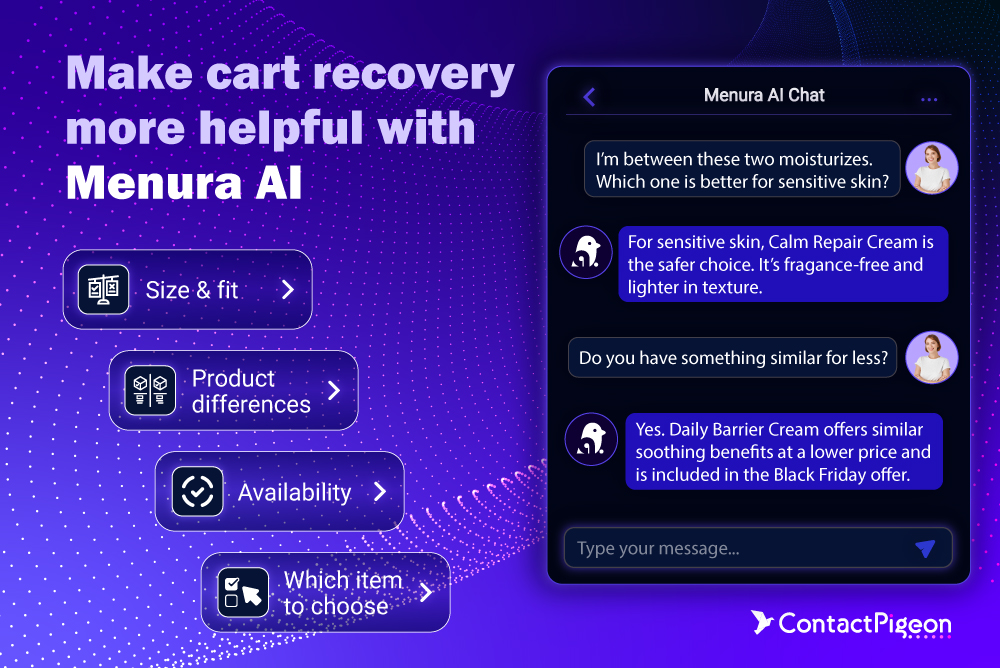
A standard cart-recovery campaign assumes the shopper mainly needs a reminder, and sometimes they do. In other cases, one unresolved question is still holding up the purchase.
The shopper may be unsure about:
- size or fit
- compatibility
- product differences
- whether another option would suit them better
- availability
- whether the product meets their needs
- which item to choose
Instead of only sending the shopper back to checkout, retailers can add Menura AI as an assistance route for people who still need help deciding. A recovery communication could offer two clear paths: return to cart or ask Menura. Once the shopper starts the conversation, Menura AI can help with questions such as:
- “Which of these two products would you recommend?”
- “Is this the right size?”
- “Do you have something similar for less?”
- “What is the difference between these models?”
- “Which one is better for my needs?”
This behavior is becoming more relevant as AI-assisted shopping grows. Adobe found that traffic from generative AI tools to U.S. retail sites increased 693.4% year over year during the 2025 holiday season. Adobe also notes that the overall base remains modest, so this should be read as fast growth from an emerging channel rather than evidence that AI has already become dominant.
Adobe also reported that AI-referred retail traffic converted 31% better than other traffic sources during the 2025 holiday season. That does not prove that AI-assisted cart recovery itself will outperform standard recovery. Still, it does suggest that shoppers using AI for product decisions can arrive with meaningful purchase intent. The application here is straightforward: preserve the standard cart-recovery route and add conversational assistance for shoppers who need more than a reminder.
What to measure: cart recovery conversion, Menura engagement, conversation-to-purchase rate, assisted AOV, and the questions shoppers ask most often.
Key point: use Menura AI to make cart recovery more useful for shoppers who still have a question before they buy.
BFCM puts enormous pressure on retailers to convert intent quickly, but more discounting is not always the answer. The real opportunity is to understand what is stopping the customer at that moment. Sometimes they need a better offer, sometimes better product guidance, and sometimes simply a faster path to the right decision. AI becomes valuable when it helps retailers respond to those differences without losing control of the commercial rules.
3. Give VIP customers early access before giving them a deeper discount
BFCM rewards often follow a simple logic: the better the customer, the larger the discount. That can leave other forms of value underused.
Deloitte found that 72% of consumers say loyalty programs make them more likely to spend with their preferred brand, while 56% say they spend more because of them. The same research found that up to 40% of perceived brand value can come from factors beyond price, including service, convenience, quality, and loyalty. For BFCM, that gives retailers room to use access and recognition before increasing the markdown.
A staggered launch could look like:
- Tuesday: top-value customers
- Thursday: broader loyalty audience
- Friday: public sale
VIP benefits might include:
- first access to limited inventory
- exclusive SKUs
- bonus loyalty points
- gift with purchase
- premium delivery
- referral access for a friend
The communication should also make the reason for that access clear, and connect the benefit to the existing relationship instead of making early access feel like another generic pre-Black-Friday promotion.
What to measure: early-access conversion, revenue before public launch, margin, sell-through, and post-BFCM retention.
Key point: your strongest customers may need recognition more than another 5% off.
4. Build a Cyber Sunday campaign from Friday and Saturday behavior
Cyber Sunday deserves more attention than it usually receives. NRF states that in 2025, 38.7 million U.S. consumers shopped online on the Sunday after Thanksgiving, up from 32.8 million the previous year. In-store Sunday participation also increased 27%, reaching 32.6 million shoppers.
The more interesting marketing advantage is the data available by Sunday morning. This is one of the most time-sensitive BFCM campaign ideas because the segmentation is created by the event itself. Friday and Saturday behavior determines Sunday’s audience.
Retailers already know:
- who repeatedly viewed the same product
- who abandoned a cart
- who clicked without purchasing
- which high-value customers visited without converting
- who concentrated heavily on one category
- who purchased and may now be relevant for a complementary product
What to measure: Sunday conversion, incremental Sunday revenue, recovery rate, and performance by behavior segment.
Key point: Friday generates traffic. Saturday reveals intent. Sunday gives you fresh data to act on.
5. Adapt promotions to inventory and sell-through
Most BFCM campaigns are planned in advance, but inventory changes once the sale begins. One product may outperform expectations by Friday morning, another may barely move. A popular size may disappear while the rest of the range remains well stocked. Continuing to promote every product with the same intensity can waste margin, push shoppers toward unavailable inventory, or leave slower-moving stock untouched. Instead, use actual inventory performance to inform what happens next.
PwC notes that in holiday-driven categories such as apparel, skincare, and food and beverage, a stockout can become more than a missed sale. For a shopper already looking for a reason to hold back, it may be enough to skip the purchase altogether. Menura AI can support this experience when shoppers ask about availability or alternatives, helping them identify another suitable option using current product and stock information.
What to measure: sell-through, stockout rate, margin, campaign revenue by SKU, and conversion on recommended alternatives.
Key point: Your BFCM campaign should react to what is actually selling.
6. Turn creator and video content into shoppable decision guides
BFCM content often repeats the same promotional message in different formats. Google reports that 94% of holiday shoppers who used YouTube took further steps toward purchase after watching a related video. For retailers looking for content-led BFCM campaign ideas, the stronger opportunity is to help shoppers narrow their choices.
Instead of another Black Friday sale, build content around real shopping decisions:
- 3 gifts under €50
- Which running shoe should you buy this Black Friday?
- Three laptops for three different types of students
- Build a skincare routine under €100
Each piece can lead directly into the relevant collection, PDP, cart, or Menura AI product-discovery experience. The content becomes useful before the shopper reaches the product page because it has already reduced the number of choices they need to evaluate.
What to measure: click-through, assisted revenue, conversion from guide content, product discovery, and AOV.
Key point: use BFCM content to solve a choice problem, not just repeat the offer.
7. Start the post-purchase journey before BFCM ends
BFCM marketing often treats purchase as the finish line. For CRM teams, it should usually be the start of the next journey. A customer who just bought during BFCM has already crossed one of the hardest barriers: they chose your brand.
An immediate post-purchase sequence might include:
- loyalty enrollment
- account setup
- referral invitation
- order education
After delivery:
- complementary product recommendations
- usage guidance
- review request
Later in November or December:
- gifting campaigns
- replenishment
- seasonal collections
- VIP qualification based on the BFCM purchase
This is particularly important for retailers that acquire large numbers of first-time buyers during promotional periods. The longer-term commercial value depends on how many of those customers return once the discount window closes.
What to measure: second-order rate, loyalty enrollment, referral rate, cross-sell revenue, and December retention.
Key point: the BFCM order should start the next customer journey.
8. Let shoppers shop by budget with Menura AI
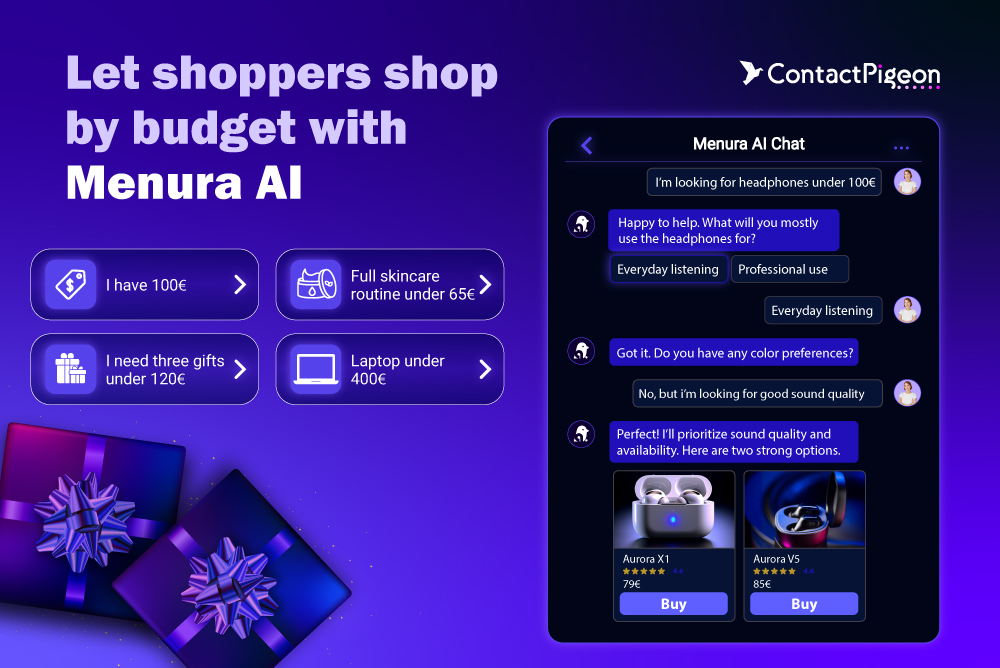
BFCM shoppers do not always arrive with a specific SKU in mind. Many start with a constraint.
- “I have €100.”
- “I need three gifts.”
- “I need a full skincare routine.”
- “I need a laptop for university.”
PwC says 8 in 10 consumers plan to use some form of budgeting strategy during the 2026 holiday season, while 79% say deals and discounts influence when they shop. Among shoppers planning to use AI, 55% expect to use it to compare prices and 25% to help them stay within budget.
Among the AI-led BFCM campaign ideas, budget-based product discovery is particularly practical because the shopper provides the constraint directly. They might ask Menura AI:
- “I need three Christmas gifts for under €100 total.”
- “Find me a skincare routine under €70.”
- “Which TV under €500 is best for gaming?”
- “Build a full outfit for less than €150.”
Menura AI can then narrow the available products according to budget, use case, preferences, BFCM availability, stock, and relevant product attributes.
This has a different role from bargaining.
- Bargaining starts with a product the shopper already wants and asks whether the price can improve.
- Budget-led discovery starts with a spending limit and helps the shopper decide what to buy within it.
What to measure: conversation-to-purchase rate, assisted revenue, AOV, products discovered, and conversion by budget range.
Key point: help shoppers solve the budget problem instead of making them calculate it product by product.
9. Make the final Cyber Monday push about the shopper’s unfinished journey
The final-hours email is usually one of the least personalized communications of Cyber Weekend. The deadline is real, but that doesn’t mean that the message has to be generic. By Cyber Monday evening, you have several days of behavioral data, so use it. The useful idea here is that “last chance” can refer to what the shopper left unfinished, rather than only the promotional deadline.
What to measure: final-hours conversion, revenue per recipient, incremental revenue, unsubscribe rate, and overlap with previous campaigns.
Key point: make the final message reflect the customer’s unfinished journey.
10. Replace the spin wheel with Menura AI bargaining
PwC’s 2026 holiday research shows AI increasingly being used for product research, price comparison, and budget management, all behaviors closely connected to bargain hunting. Instead of another spin wheel or generic coupon pop-up, the retailer could make negotiation part of the promotion itself. The shopper initiates the negotiation, and Menura AI then operates within commercial boundaries defined by the retailer.
The retailer determines:
- eligible products
- margin floors
- maximum discount
- stock thresholds
- customer eligibility
- alternative benefits
The important part is how the experiment is evaluated. A bargaining experience that increases conversion but gives away too much margin is not necessarily successful. Use a control group and compare:
- bargaining participation
- incremental conversion
- average negotiated discount
- AOV
- contribution margin
- revenue per session
Key point: AI bargaining is a controlled BFCM experiment, not a proven shortcut to higher revenue.
Bonus: Your product feed is becoming BFCM marketing infrastructure
This one is not really a campaign idea, but it is becoming part of the infrastructure behind product discovery. Google says people shop across its surfaces more than one billion times per day, powered partly by a Shopping Graph containing more than 60 billion product listings. That matters because AI-assisted shopping increasingly depends on sufficiently rich product information.
A shopper may still search for “women’s boots,” but they may increasingly ask “Find waterproof black ankle boots with a low heel that are comfortable for walking and cost less than €120.” A listing called Boot 4738 does very little to support that request. A richer product feed can.
Before BFCM, audit priority products for:
- title
- brand
- category
- current and promotional price
- availability
- material
- color
- fit
- sizing
- dimensions
- compatibility
- use case
- images
- delivery information
The same principle also applies onsite. Better product information gives Menura AI more context for comparison and recommendation.
Key point: product data is increasingly part of the marketing surface, not just backend catalogue hygiene.
Which BFCM ideas should retailers prioritize in 2026?
The answer depends on what is already working.
- If your segmentation is weak, start with customer value and incentive depth before adding new promotional mechanics.
- If recovery journeys are established but largely reminder-based, adding Menura AI assistance gives shoppers another route when they still need help making the decision.
- If loyalty is strong, VIP access may preserve more margin than simply increasing the discount.
- If those foundations are already mature, the more experimental BFCM campaign ideas become relevant. Budget-led conversational shopping and Menura AI bargaining can then be tested against established experiences. The important distinction is knowing what is already proven, what current shopper behavior makes more relevant, and what still needs to earn its place through testing.
AI-assisted shopping is clearly growing, but it has not replaced the retailer’s own ecommerce journey. PwC found that 64% of consumers who use AI for shopping ideas still open another tab and visit a retailer website to complete the purchase. That may be one of the most useful BFCM insights for 2026. AI increasingly influences discovery and consideration, but retailers still own much of the conversion experience. The opportunity is to make that experience more responsive once the shopper arrives.
Put Menura AI to work this BFCM
If you want to turn these BFCM campaign ideas into conversational shopping experiences, Menura AI can help customers compare products, work within a budget, resolve purchase questions, and explore new mechanics such as controlled AI bargaining.
Book a demo and see how Menura AI can work with your product catalogue, customer experience, and BFCM strategy.