
Furniture purchases are characterized by extended decision cycles, in which research, hesitation, and validation shape the path to conversion. AI agents are becoming embedded in this process, introducing a new layer of interaction across high-intent moments. 52% of executives in organizations using generative AI report that AI agents are already in production, with 49% deployed in customer service and 46% in marketing, positioning them directly within customer-facing operations. (Google Cloud, 2025) For retail and eCommerce leaders, this signals a structural shift. Customer journeys are no longer managed through channels alone, but through systems that guide decisions in real time. This article outlines how to evaluate the best AI agents for home goods & furniture, focusing on the criteria that matter, the operational role they play, and how they translate into measurable ROI.
How to evaluate AI agents for home goods & furniture retail
AI agents in home goods and furniture retail operate within longer decision cycles, higher product complexity, and greater expectations around guidance. Evaluation requires a clear understanding of how these systems perform across both customer experience and commercial impact.
Core criteria to look for
Selecting the best AI agents for home goods and furniture requires a structured evaluation approach. The category introduces a combination of complex product discovery, longer decision cycles, and higher expectations around guidance and accuracy. This shifts the focus from generic AI capabilities to how effectively a solution performs within real customer journeys. The criteria below reflect the dimensions that directly influence both customer experience and commercial outcomes.
| Criterion | What It Means in Practice |
|---|---|
| NLP maturity & accuracy | The agent processes complex, intent-rich queries around dimensions, materials, delivery, and styling with consistency and precision. |
| Deflection rate & CSAT impact | The system handles a meaningful share of customer interactions while maintaining strong satisfaction across high-intent touchpoints. |
| Personalization depth | Interactions reflect browsing behavior, purchase signals, and contextual needs, shaping recommendations that feel relevant and timely. |
| Product catalog, OMS, CRM, ESP integrations | The agent operates with full access to product data, order history, customer profiles, and campaign logic, enabling informed responses. |
| Multilingual support | The experience remains consistent across languages, supporting clarity and trust in multi-market environments. |
| Client review & reputation | Documented outcomes in real retail environments provide a clear indication of reliability and performance. |
| Expertise in retail | The solution reflects an understanding of category-specific dynamics, including product structure, logistics, and merchandising logic. |
| Dedicated support availability | Ongoing optimization is supported through structured guidance, ensuring continuous performance improvement. |
| Security, privacy, GDPR compliance | Data handling aligns with regulatory requirements and safeguards customer information across all interactions. |
| Governance (guardrails, moderation, approvals) | The system includes controls that ensure accuracy, brand alignment, and responsible AI behavior in customer-facing scenarios. |
Home goods and furniture-specific capabilities of a top AI agent solution
Beyond foundational capabilities, retail AI agents in this category must align with how customers actually navigate the buying process. Furniture and home goods purchases involve layered decision-making, where discovery, validation, and reassurance unfold across multiple stages. A high-performing AI agent supports this progression through specialized functions that mirror the structure of the journey, enabling consistent guidance from initial exploration through to post-purchase engagement.
| AI Agent Type | Role in the Journey | What It Enables |
|---|---|---|
| Product Discovery Agent | Early-stage browsing | Interprets vague or constraint-based queries and translates them into relevant product suggestions. |
| Fit & Compatibility Agent | Evaluation stage | Assesses dimensions, space requirements, and product compatibility within real-life contexts. |
| Product Comparison Agent | Decision stage | Structures comparisons across similar products, highlighting meaningful differences for decision-making. |
| Styling & Inspiration Agent | Consideration stage | Recommends complementary products and builds cohesive room concepts based on user preferences. |
| Conversion Support Agent | High-intent moments | Addresses last-mile concerns such as delivery, availability, and product details to support completion. |
| Re-engagement Agent | Post-visit lifecycle | Triggers personalized follow-ups based on browsing behavior, product interest, and timing signals. |
| Customer Support Agent | Post-purchase | Handles order-related queries, delivery updates, and returns with full context of the customer history. |
Finding the best AI agents for home goods and furniture: At-a-glance comparison table
The current landscape of trustworthy retail AI agents spans a wide range of capabilities, from support automation to enterprise workflow optimization. For home goods and furniture retailers, the distinction lies in how closely each solution aligns with the requirements of commerce-driven customer journeys. This comparison provides a structured overview of leading solutions, highlighting their core strengths, primary use cases, and areas of limitation within a retail context.
| Solution | Core Strength | Primary Use Case | Limitations for Home Goods Retail | Best Fit |
|---|---|---|---|---|
| Menura AI (ContactPigeon) | Retail-focused AI agent with deep omnichannel integration | End-to-end customer journey orchestration | Requires eCommerce data maturity to unlock full value | Mid-to-large eCommerce retailers |
| Salesforce Einstein Copilot | Enterprise-grade AI with CRM-native intelligence | Large-scale customer service and sales operations | High implementation complexity and cost structure | Enterprise organizations |
| Intercom Fin AI | Conversational AI for support automation | Customer service and ticket deflection | Limited depth in product-level personalization | SaaS and support-heavy environments |
| Ada AI | No-code AI automation for customer support | High-volume support environments | Limited alignment with complex retail product journeys | Enterprise support teams |
| Zendesk AI | AI-enhanced support and ticketing workflows | Customer service operations | Designed primarily for support, not conversion journeys | Service-led organizations |
1. Menura AI agent by ContactPigeon
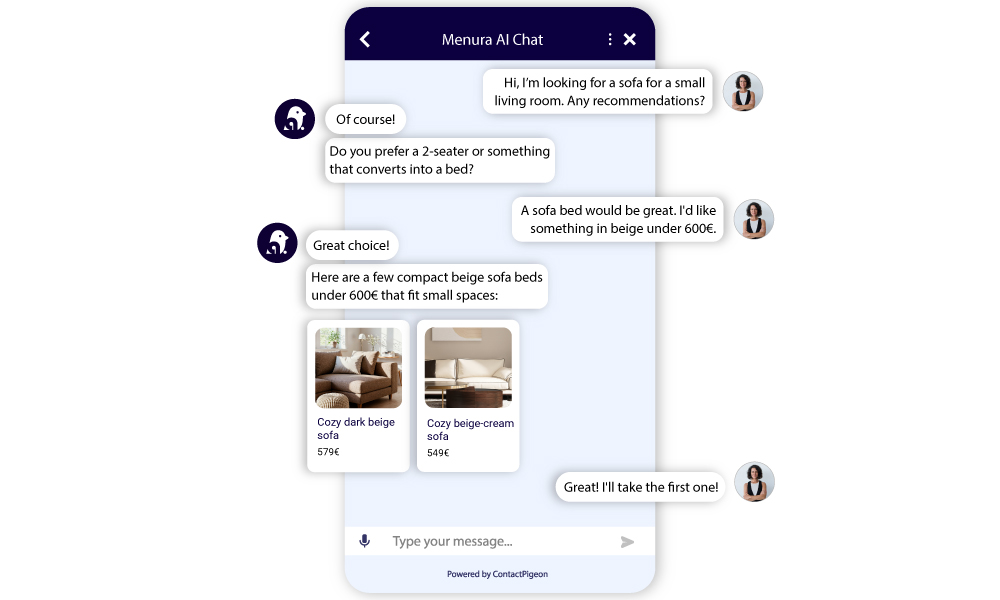
What it is:
A retail-focused AI agent designed to operate across the full customer journey, connecting data, channels, and interactions within a unified environment.
Standout features:
Combines real-time behavioral data with omnichannel execution to deliver context-aware interactions across onsite, email, and push.
Pros:
- Built with EU retailers in mind, including GDPR compliance and regional operational requirements
- Native integration with CDP, enabling deep personalization across the lifecycle
- Designed for eCommerce journeys, from discovery to conversion and retention
- Supports real-time decisioning based on behavioral and transactional data
- Connects onsite interaction with downstream campaign orchestration
Cons:
- Requires structured data and integration maturity to reach full performance
- Less relevant for non-eCommerce or offline-first businesses
- Implementation may require alignment across multiple internal teams
Pricing:
Custom pricing based on scale, data volume, and feature set
Best for:
Mid-to-large eCommerce retailers seeking unified personalization, automation, and AI-driven engagement
Integrations:
Shopify, Magento, WooCommerce, BigCommerce, custom APIs, CRM systems, ESPs, CDPs, and data warehouses
2. Salesforce Einstein Copilot
What it is:
An enterprise AI assistant embedded within the Salesforce ecosystem, designed to support sales, service, and operational workflows.
Standout features:
Deep integration with Salesforce CRM, enabling AI-driven insights and automation across large-scale customer operations.
Pros:
- Extensive enterprise capabilities across multiple business functions
- Strong data infrastructure within the Salesforce ecosystem
- Scalable across global organizations
- Advanced analytics and reporting capabilities
Cons:
- Cost structure aligned with large enterprise budgets
- Implementation complexity across systems and teams
- Limited specialization in retail-specific product journeys
- Requires a full Salesforce ecosystem to unlock value
Pricing:
Enterprise pricing model, typically bundled within Salesforce products
Best for:
Large enterprises with existing Salesforce infrastructure and complex operational needs
Integrations:
Salesforce Cloud ecosystem, third-party enterprise tools, APIs, data platforms
3. Intercom Fin AI
What it is:
An AI-powered support agent designed to automate customer conversations and reduce support workload.
Standout features:
Fast deployment with strong conversational capabilities for handling support queries.
Pros:
- Effective in automating high-volume customer service interactions
- Quick implementation with minimal setup
- Clean user interface and conversation management
- Strong documentation and onboarding
Cons:
- Primarily designed for support, not revenue generation
- Limited depth in product-level personalization
- Less suited for complex catalog navigation and decision support
- Narrower applicability in high-consideration retail categories
Pricing:
Usage-based pricing, typically tied to resolution volume
Best for:
Support-driven organizations and SaaS businesses
Integrations:
CRM tools, helpdesk platforms, APIs, and limited eCommerce integrations
4. Ada AI
What it is:
A no-code AI platform focused on automating customer service interactions at scale.
Standout features:
Automation-first approach with strong workflow configuration for support environments.
Pros:
- Scales efficiently across large support operations
- No-code setup enables faster deployment
- Strong automation for repetitive queries
- Enterprise-grade infrastructure
Cons:
- Limited focus on eCommerce conversion journeys
- Minimal support for product discovery and recommendation logic
- Less alignment with merchandising and retail use cases
- Primarily optimized for support deflection
Pricing:
Custom enterprise pricing
Best for:
Large organizations with high support volume requirements
Integrations:
CRM systems, support tools, APIs, and enterprise platforms
5. Zendesk AI
What it is:
An AI layer within the Zendesk ecosystem designed to enhance customer support workflows and ticket management.
Standout features:
AI-powered automation within a well-established support infrastructure.
Pros:
- Mature support ecosystem with global adoption
- Strong ticketing and workflow automation capabilities
- Reliable performance in structured support environments
- Extensive integration network
Cons:
- Designed primarily for support, not customer journey orchestration
- Limited role in influencing conversion or AOV
- Does not address product discovery or personalization depth
- Requires additional tools for full eCommerce functionality
Pricing:
Tiered pricing based on Zendesk plans and add-ons
Best for:
Organizations focused on customer service operations
Integrations:
Zendesk ecosystem, CRM tools, APIs, third-party applications
Build vs buy an AI agent: What’s best for the home goods and furniture industry?
The decision to build or buy an AI agent introduces both technical and strategic considerations. While in-house development offers control over customization and data, it also requires sustained investment in infrastructure, talent, and ongoing optimization. For most retail organizations, the evaluation centers on balancing long-term flexibility with speed of execution and operational efficiency. The comparison below outlines the key trade-offs across both approaches.
| Dimension | Build (In-house AI Agent) | Buy (AI Agent Platform) |
|---|---|---|
| Total cost of ownership / development | High upfront investment with ongoing costs across development, infrastructure, and iteration | Predictable cost structure with faster time to value |
| Data & LLM governance considerations | Full control over data handling, model behavior, and compliance frameworks | Governance handled within platform constraints, with built-in compliance standards |
| Infrastructure + maintenance complexity | Requires dedicated infrastructure, model management, and continuous optimization | Managed infrastructure with ongoing updates and performance improvements handled externally |
| In-house constraints & talent scarcity | Requires specialized AI, data, and engineering expertise, often difficult to scale internally | Reduces dependency on in-house AI expertise, supported by vendor teams |
| Risk of stale intents | High risk without continuous training, monitoring, and dataset updates | Continuous learning and updates embedded within the platform |
| When building makes sense vs buying | Suitable for organizations with strong AI maturity, proprietary data advantages, and long-term investment capacity | Suitable for retailers seeking faster deployment, proven use cases, and immediate commercial impact |
Additional resources for home goods and furniture retailers
1. Market outlook & growth stats
The furniture industry is showing resilient growth, driven largely by urbanization and the normalization of hybrid work.
- Global Market Projection: The global furniture market is expected to reach approximately $833.94 billion in 2026, growing at a CAGR of 5.4%. (The Business Research Company)
- The “Home Office” Effect: Mordor Intelligence highlights that the shift to hybrid work remains a primary driver, with 2026 home remodeling activity focusing heavily on space-saving and multi-functional office pieces. (Mordor Intelligence)
- US Retail Landscape: Bain & Company forecasts US retail sales to grow 3.5% year-over-year in 2026, reaching $5.3 trillion, while warning of a “flight to value” as consumers remain price-sensitive. (Bain & Company)
2. Consumer behavior & “value seeking”
Shoppers in 2026 are more informed and less brand-loyal, prioritizing value-for-money over convenience.
- The Rise of the “Value Seeker”: Deloitte’s 2026 Outlook notes that 47% of consumers globally are now “value seekers,” regularly sacrificing convenience to keep costs down. (Deloitte Global Outlook)
- Social-First Discovery: Nearly 80 million consumers intend to buy furniture this year, but the journey starts on Instagram and TikTok, not retailer websites. 14% of buyers now find their primary inspiration on Instagram. (Resonate 2026 Trends)
3. Innovation: Agentic AI & 3D tech
Retail is moving from simple “e-commerce” to “agentic commerce,” where AI assistants help manage the buying process.
- 3D Configuration as Standard: Retailers are adopting 3D configurators to combat the 70% cart abandonment rate, which is even higher for high-consideration industries, like home goods and furniture. These tools allow real-time customization of materials and dimensions, drastically increasing buyer confidence. (VividWorks 2026 Trends)
- Agentic Supply vs. Demand: Deloitte highlights a new battleground: Generative Engine Optimization (GEO). Retailers are now racing to ensure their products are “recommended” by the AI agents consumers use to shop. (Deloitte 2026 Provocations)
4. Sustainability & circularity
Eco-consciousness is a corporate mandate and a consumer requirement.
- ESG and Bio-Based Materials: Growth is being fueled by corporate ESG mandates and a rising demand for furniture made from recycled or bio-based materials. (Mordor Intelligence Report)
- The Wood Dominance: Despite new materials, wood remains the top choice for 62% of the market in 2026 due to its perceived durability and cost-effectiveness. (Fortune Business Insights)
Choosing the right AI agent for home goods and furniture retail
Selecting the right AI agent for home goods and furniture retail requires a clear evaluation of how the solution performs across personalization, integration, governance, and commercial impact. The complexity of the category demands systems that support extended journeys, provide structured guidance, and operate consistently across channels.
For retail and eCommerce leaders, the focus is on selecting solutions that translate capability into measurable outcomes. Book a demo and explore how Menura AI enables this shift through real-time personalization and omnichannel orchestration.