Retail promotion optimization starts with understanding what is preventing a purchase. A shopper asks whether a jacket is waterproof. Another needs reassurance about delivery. A third says the price is beyond their budget. A BFCM promotion strategy that gives all three an extra 10% off spends margin before establishing what would help each shopper buy.
- What is retail promotion optimization?
- Retail promotion optimization is the process of deciding which customers receive an offer, what it includes, when it appears, and whether it generates enough additional profit to justify its cost.
- What is AI promotion optimization?
- AI promotion optimization uses AI to support those decisions, for example, by analyzing customer data, helping shoppers resolve product questions, or selecting offers within retailer-approved rules.
For commercial, merchandising, and CRM teams, the practical task is to connect those capabilities to the economics of an offer. This article explains how to review one promotion, calculate what its discount must earn back, and test whether guidance, follow-up, or an incentive produces a better commercial result.
Why peak-season discounts need a profit test
During peak season, a promotion may generate additional orders, increase basket value or help move stock. It can also reduce profit on purchases that would have happened without an extra incentive.
Campaign revenue alone does not tell you which effect dominates. A recovery campaign might record substantial sales while distributing coupons to customers who were already planning to return. Conversely, an offer with a lower conversion rate might generate more profit if it preserves enough gross profit on each order.
This makes the commercial question specific: what does the additional incentive change, and what does that change cost?
Our Black Friday strategies for retailers guide covers broader seasonal preparation. Here, we focus on reviewing and improving the offer itself.
Start with one promotion and diagnose its discount cost
Begin your retail promotion optimization review with a high-volume offer, such as a welcome coupon or cart-recovery incentive. Bring the commercial owner and the CRM team together to answer four questions.
Who receives the offer?
Record eligibility, audience size and the share of orders receiving the discount. Break results down by product category and customer group where the data allows.
Purchase history can help identify useful comparisons. Recent buyers, frequent customers and one-time promotional shoppers may respond differently, but their history does not establish how much incentive they need.
What other benefits can they receive?
Map the full route to checkout. A shopper may encounter a public sale price, a welcome coupon, a recovery offer and subsidized delivery.
Check which benefits can combine and calculate their total cost. Campaigns that look reasonable individually can become expensive when they apply to the same purchase.
What is the offer intended to change?
Be specific. Is the aim to secure a first purchase, recover an incomplete order, reactivate a customer or clear selected stock?
Then ask what supports the chosen response. A compatibility question suggests an information gap. An explicit budget objection provides a reason to consider an eligible offer or a more affordable product. An incomplete purchase, by itself, leaves the reason uncertain.
Can you calculate the economics?
Confirm that product costs, discount values, returns, and relevant variable expenses are available. If costs are missing, resolve that gap before drawing conclusions about profitability.
ContactPigeon’s customer segmentation tools help organize the audiences and exclusions for this review. The commercial team defines the policy; CRM translates it into campaign eligibility and follow-up rules.
Calculate what the discount must earn back
Consider a hypothetical product selling for €100 excluding tax, with a cost of goods sold of €60. Assume one product per order and unchanged unit costs. The calculation excludes fulfilment, payment fees, returns and marketing costs.
| Measure | No discount | 10% discount | 20% discount |
|---|---|---|---|
| Selling price | €100 | €90 | €80 |
| Gross profit/order | €40 | €30 | €20 |
| Gross margin | 40% | 33.3% | 25% |
| Orders for €4,000 gross profit | 100 | 134 (rounded up) | 200 |
A 10% discount removes €10 from the selling price and €10 from gross profit. Gross profit per order falls by 25%, from €40 to €30. Maintaining the original total requires approximately 33.3% more orders before rounding. At a 20% discount, the retailer needs twice the order volume.
For your own products:
Gross profit per order = P × (1 − d) − C
Required volume multiplier = (P − C) ÷ [P × (1 − d) − C]
Here, P is the pre-discount selling price excluding tax, d is the discount rate expressed as a decimal, and C is cost of goods sold. The multiplier compares the discounted volume with the volume required at the original price. If discounted gross profit is zero or negative, additional volume cannot recover the original positive gross profit under these assumptions.
This calculation gives the offer a commercial hurdle. Your final decision should also account for changes in basket composition, shipping subsidies, returns and other variable costs.How AI promotion optimization supports incentive decisions
How AI promotion optimization supports incentive decisions
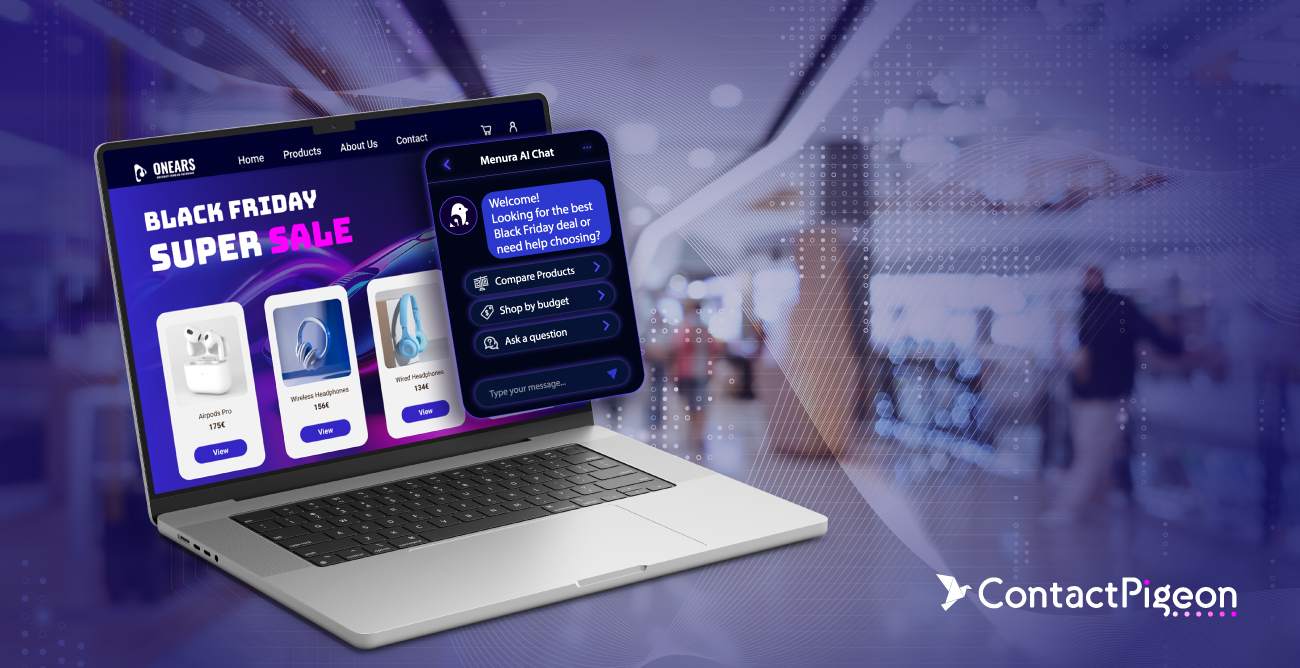
AI can contribute to margin protection by helping shoppers resolve questions before an additional discount is introduced. When price is the stated concern, it can support an approved offer path or identify a suitable alternative within budget. Menura, ContactPigeon’s AI retail agent, supports product discovery, comparisons, and questions within a conversation. Retailers set the information sources, offer eligibility, and commercial limits.
The following examples show how that contribution connects to profit.
Product uncertainty: answer the question first
“Will this work with the equipment I already own?”
The next step is to clarify compatibility and provide a recommendation supported by the available product information. A coupon would leave the shopper’s original question unanswered. If that guidance leads to a purchase without an extra discount, the retailer preserves more gross profit on the order. In the earlier example, the difference is €40 gross profit at the original price versus €30 after a 10% coupon.
That is the commercial opportunity for AI-assisted guidance. The policy still needs to be assessed across all eligible shoppers, including those who leave without buying, and with assistance costs included.
Delivery concerns: provide reliable information
“Can it arrive before my event?”
Give the shopper verified delivery information. If the answer depends on a location, stock position or fulfilment detail that is unavailable, clarify or escalate the question. Reliable information may allow the customer to proceed without a further incentive. It can also prevent a purchase based on an unsupported promise, reducing the risk of cancellations and service problems.
Budget concerns: check the permitted options
“I like it, but can you offer a better price?”
Where configured and verified for the retailer’s setup, Menura can follow an approved bargaining sequence. The response may be an eligible incentive, a suitable lower-priced alternative, or an explanation of the available offers.
Before presenting an incentive, check product eligibility, existing discounts, stock conditions, and the total promotional cost. Any offer must stay within the approved limits and honor existing advertised terms. The commercial aim is to secure a worthwhile purchase at an acceptable contribution. A lower-priced alternative may meet that objective without discounting the original product.
Overlapping campaigns: coordinate the follow-up
A shopper who receives useful product guidance may also qualify for a welcome offer, a recovery coupon and a Black Friday campaign.
ContactPigeon’s segmentation, exclusions and campaign priorities help teams decide which communication takes precedence and when another incentive is appropriate. Suppression after a qualifying purchase can prevent a recovery offer from arriving after the customer has already bought.
Menura addresses the expressed shopping need. The surrounding automation manages follow-up eligibility and timing. Together, those decisions determine the total incentive cost attached to a purchase.
Build these rules into your customer retention strategy so the experience remains relevant after the sale.
Configured lifecycle journeys and site triggers are separate from Menura’s understanding of a conversation. Menura should not be assumed to independently detect an abandoned cart or infer hesitation. Our BFCM AI retail guide explores broader campaign applications.
A customer can qualify for a welcome offer, a cart reminder and a Black Friday campaign at the same time. Marketing teams need to decide which message takes priority and whether another incentive adds value. AI can help shoppers resolve product questions, while segmentation and automation coordinate the follow-up. Measuring these interactions together helps retailers see whether their campaigns are generating additional profit or adding discount cost to the same purchase.
CMO, ContactPigeon
Set commercial guardrails before launch
Retail promotion optimization needs commercial rules that can be checked before an offer reaches the shopper.
- Economics: Minimum gross margin or contribution, maximum discount, promotional budget and treatment of delivery subsidies. Define which benefits can combine.
- Eligibility: Included products and audiences, stock thresholds, validity windows and coupon usage limits.
- Conversation: Approved information sources, permitted offer responses and an escalation route for exceptions.
- Ownership: Commercial leadership approves the policy, merchandising validates product economics, CRM configures journeys, and the implementation team verifies enforcement.
Test boundary cases before launch: an excluded item, an expired coupon, overlapping offers, and a request beyond the approved limit. Writing a rule in a prompt doesn’t guarantee every system enforces it at checkout. Confirm the actual behavior across the conversation, coupon, and commerce setup.
Measure whether retail promotion optimization improves profit
Choose one offer and one policy change to test. For example, compare the current extra-incentive approach with product guidance before any additional offer.
Where feasible, randomly assign eligible customers before exposure. Keep public offers, product access and timing consistent, and prevent customers from receiving conflicting treatments through other channels. Measure the result across the entire assigned audience, including people who do not buy. The core measures are:
- Gross profit or contribution per assigned customer: Contribution should use an agreed definition of variable costs, including relevant communication and AI assistance costs.
- Purchase rate and net sales per assigned customer: These show the revenue effect of changing the policy.
- Discount and benefit costs: Include overlapping coupons and delivery subsidies.
- Returns and repeat purchasing: Use equivalent follow-up periods for each group.
If reliable cost data is unavailable, begin with clearly defined gross profit and state what it excludes. ContactPigeon’s retail analytics dashboard can support campaign reporting, while a complete profit calculation requires the relevant commerce and finance data. Our retail KPIs guide provides further measurement context.
A policy comparison in practice
Suppose 1,000 customers assigned to the current policy generate 100 orders at €30 gross profit each:
100 × €30 = €3,000 gross profit, or €3 per assigned customer.
A proposed policy produces 90 orders averaging €36 gross profit:
90 × €36 = €3,240 gross profit, or €3.24 per assigned customer.
Purchase rate has fallen from 10% to 9%, while gross profit per assigned customer has risen by 8%.
AI-assisted guidance could contribute to such an outcome if more purchases occur without an extra incentive. Changes to offer eligibility or campaign overlap could also increase average gross profit. This hypothetical example illustrates the combined policy result; it does not establish an AI-driven uplift.
To isolate AI’s contribution, compare equivalent audiences with the same offer rules and timing, varying access to AI assistance. Include its operating costs when calculating contribution.
Before launching, agree on test duration, sample requirements, acceptable commercial losses and the decision rule. Review uncertainty and returns before expanding the policy. Chat users and coupon redeemers select themselves into those behaviors, so comparing their conversion rates alone cannot establish incremental impact.
Bring one promotion to your next commercial review
A useful retail promotion optimization review should end with a decision about an actual offer.
Complete this checklist together:
- Current offer: What is available, and what business outcome should it produce?
- Eligible audience: Who receives it, and which customers should be excluded?
- Purchase barrier: What do you know about the issue the offer is intended to resolve?
- Combined cost: Which discounts, perks, and delivery benefits can apply together?
- Profit per order: What remains after the discount and relevant costs?
- Proposed change: Will you test guidance, timing, eligibility, or incentive depth?
- Success measure: What result would justify expanding the policy, and who will review it?
Start with an offer that has enough volume to evaluate and rules the team can control. Use the results to decide whether to retain it, revise it, or expand the approach.
Request a promotion-optimization assessment and bring your current offer rules, audience overlap, and margin assumptions to a conversation with ContactPigeon about which policies to test before peak season.